Part 2 of 4 · JLPT N3
久助君の話 Kyūsukekun no Hanashi, part 2: An Idle Afternoon in the Hay
In this part
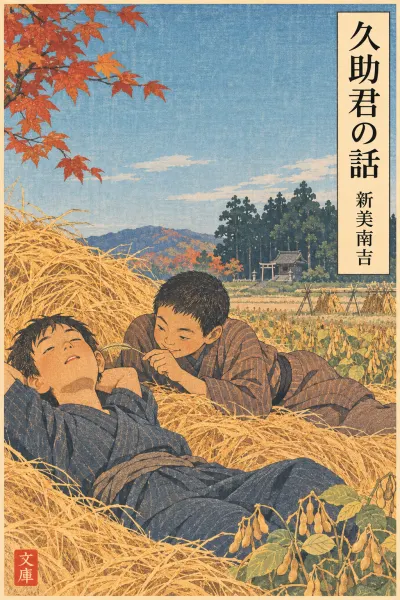
Kyūsuke finds only Hyōtarō, who says the other boys aren't at Tokuichi's because Tokuichi has gone to Handa with his mother. The two boys flop into a sun-warmed haystack, but Hyōtarō turns down every game Kyūsuke suggests. Restless, Kyūsuke teases him by tickling his ear with a blade of grass until Hyōtarō bursts out laughing and charges at him.
AI translation · independently checked
兵太郎君は、手ぶらで、へんにうかぬ顔をしていた。Hyōtarō was empty-handed and wore an oddly gloomy look.
「みんな、どこにいったか知らんかァ」"Know where everybody went?"
と、久助君がきいた。Kyūsuke asked.
「知らんげや」"Dunno."
と、兵太郎君がこたえた。Hyōtarō answered.
そんなことなんか、どうでもいいという顔をしている。He looked as if that sort of thing didn't matter to him one bit.
まるたんぼうのはしを、大工さんがのみで、ちょっちょっとほってできたようなその顔を、久助君はまぢかにつくづくと見た。Kyūsuke took a long, careful look, up close, at that face, which looked as if a carpenter had made it by chipping a few quick strokes with his chisel into the end of a log.
「徳一がれにいやひんかァ」"Ain't they over at Tokuichi's place?"
と、久助君がまたきいた。Kyūsuke asked again.
「いやひんだらァ」"Reckon not."
と、兵太郎君がこたえた。Hyōtarō answered.
赤とんぼが、兵太郎君のうしろを通っていって、ほし草にとまった。A red dragonfly flew past behind Hyōtarō and settled on the hay.
そのはねが、日の光をうけてきらりと光った。Its wings caught the sunlight and glittered.
「いってみよかよォ」"Let's go see, huh?"
と、久助君がじれったそうにいった。Kyūsuke said impatiently.
「ううん」"Mm."
と、兵太郎君はなま返事をした。Hyōtarō gave a half-hearted answer.
「なァ、いこうかよォ」"C'mon, let's go, huh?"
と、久助君はうながした。Kyūsuke urged him.
「んでも、徳やん、さっきおっかンといっしょに、半田の方へいきよったぞ」"But Tokuyan went off toward Handa a while ago with his ma."
と、兵太郎君はいって、つよいかおりをはなっているほし草のところへ近づき、なかばころがるようにもたれかかった。Hyōtarō said, and he went over to the hay, which gave off a strong smell, and leaned back against it, half tumbling into it.
久助君は、徳一君のところにもなかまたちはいないことがわかって、がっかりした。Kyūsuke was disappointed to learn that his friends weren't at Tokuichi's either.
が、兵太郎君の動作をみたら、きゅうに、ここで兵太郎君とふたりきりで遊ぼう、それでも十分おもしろいという気がわいてきた。But when he saw what Hyōtarō did, he suddenly felt like playing right here, just the two of them, and thought that would be plenty of fun.
ほし草の積んであるところとか、つぼけ(藁積)のならんでいるところは、子どもには、ひじょうにたくさんの楽しみをあたえてくれるものだ。Places where hay is stacked, or where straw ricks stand in rows, give children a great many pleasures.
そこで、久助君も兵太郎君のそばへいって、じぶんのからだをゴムまりのようにほし草にむかって投げつけた。So Kyūsuke went over beside Hyōtarō too and flung himself at the hay like a rubber ball.
ほし草はふわりと、やわらかにあたたかく、久助君をうけとった。The hay caught Kyūsuke lightly, softly and warmly.
とたんに、ヒチヒチと音をたてて、ばったが頭の上から豆畑の方へ飛んでいった。At that very moment a grasshopper went off with a chit-chit sound, flying over his head toward the bean field.
久助君は、頭や耳に草のすじがかかったが、とろうとしなかった。Wisps of grass caught on Kyūsuke's head and ears, but he made no move to pick them off.
ほし草の山は、昼間じゅう太陽にあたためられていたので、そこにもたれかかっていると、おかあさんのふところにだかれていたじぶんを思い出させるような、ぬくとさだった。The haystack had been warmed by the sun all day long, so leaning against it gave a cozy warmth that reminded him of being held close in his mother's arms.
久助君は、ねこのようにくるいたい衝動が、からだの中にうずうずするのを感じた。Kyūsuke felt an urge to romp about like a cat tingling restlessly through his body.
「兵タン、すもうとろうかやァ」"Hyōtan, wanna wrestle?"
と、久助君はいった。Kyūsuke said.
「やだ。きのう、すもうしとって、そでちぎって、家でしかられたもん」"Nope. Yesterday I was wrestling and tore my sleeve, and I got scolded at home."
と、兵太郎君がこたえる。Hyōtarō answers.
そして、ひざをびんぼうゆるぎさせながら、あおむけに空を見ている。And he lies on his back looking up at the sky, jiggling his knee restlessly.
「んじゃ、かえるとびやろかァ」"Then how 'bout leapfrog?"
と、久助君がいう。Kyūsuke says.
「あげなもな、おもしろかねえ」"That stuff ain't no fun."
と、兵太郎君は一言のもとにはねつけて、鼻をキュッと鳴らす。Hyōtarō turns it down flat with a single word and gives a sharp little sniff.
久助君はしばらくだまっていたが、ものたりなくてしょうがない。Kyūsuke kept quiet for a while, but he just couldn't stand how dull it was.
ころころと兵太郎君の方へころがり近づいていって、草の先を、あおむいている兵太郎君の耳の中へ入れようとした。He rolled over and over toward Hyōtarō and tried to poke the tip of a blade of grass into the ear of Hyōtarō, who was lying face up.
兵太郎君はほらふきで、ひょうきんで、人をよくわらわせるが、こういう種類のからかいはあまりこのまない。Hyōtarō was a teller of tall tales and a clown who often made people laugh, but he didn't much care for this kind of teasing.
自尊心がきずつけられるからだ。It hurt his pride.
「やめよォッ」"Quit it!"
と、兵太郎君がどなった。Hyōtarō shouted.
兵太郎君がおこって、久助君にむかってくれば、それは久助君の望むところだった。If Hyōtarō got angry and came at him, that was just what Kyūsuke wanted.
「あんまり耳くそがたまっとるで、ちょっとそうじしてやらァ」"You got so much earwax in there, I'll clean it out for you a bit."
といって、久助君はまた草の先で、兵太郎君の頭にぺしゃんとはりついた耳をくすぐる。With that, Kyūsuke again used the tip of the grass to tickle Hyōtarō's ear, which lay pressed flat against his head.
兵太郎君はおこっているつもりであったが、くすぐったいので、とつぜん、ひぁっというような声をあげてわらいだした。Hyōtarō meant to be angry, but it tickled so much that he suddenly let out a sort of "hyah!" and burst out laughing.
そして久助君の方にぶつかってきた。And he came crashing into Kyūsuke.
Vocabulary
| Word | Meaning | JLPT |
|---|---|---|
| うかぬ顔うかぬかお | gloomy, glum facedictionary form: 浮かぬ顔Set phrase; ぬ is the old negative, so literally 'a face that doesn't float up'. | — |
| つくづくつくづく | intently, long and carefully (looking)Also means 'deeply, thoroughly' with feelings: つくづく思う. | — |
| じれったそうじれったい | impatient, irritated by delaydictionary form: じれったい〜そう here means 'looking ~'. | — |
| なま返事なまへんじ | half-hearted, noncommittal answerdictionary form: 生返事生 (なま) adds the sense 'half-done, not genuine'. | — |
| うながしたうながす | to urge, to promptdictionary form: 促す | N1 |
| もたれかかったもたれかかる | to lean against, to recline ondictionary form: もたれかかる | — |
| がっかりしたがっかりする | to be disappointeddictionary form: がっかりする | — |
| つぼけつぼけ | straw rick, stack of rice strawRegional word; the author glosses it with 藁積 (わらぐま). | — |
| ぬくとさぬくとい | warm, snug (dialect form of ぬくい); ぬくとさ = snug, cozy warmthdictionary form: ぬくといDialect form of ぬくい/暖かい; 〜さ turns the adjective into a noun. | — |
| 衝動しょうどう | impulse, urge | — |
| びんぼうゆるぎびんぼうゆるぎ | restless jiggling of the kneedictionary form: 貧乏揺るぎOlder/regional form of 貧乏揺すり (びんぼうゆすり). | — |
| はねつけてはねつける | to reject flatly, to rebuffdictionary form: はねつける一言のもとに = 'with a single word, flatly'. | — |
| ほらふきほらふき | teller of tall tales, braggartdictionary form: ほら吹きFrom ほらを吹く 'to blow a conch shell' = to brag; source of the nickname ほら兵. | — |
| 自尊心じそんしん | pride, self-respect | N1 |
Grammar
〜たような + noun N4 a ~ that looks as if ...
A whole clause plus ような describes a noun by comparison. Here the clause about a carpenter chiselling a log describes その顔.
大工さんがのみで、ちょっちょっとほってできたようなその顔
that face, which looked as if a carpenter had made it with a few quick strokes of his chisel
〜ようとしなかった N3 made no attempt to ~
The volitional form plus とする means 'try to'; in the negative it shows the person didn't even try, often by choice.
頭や耳に草のすじがかかったが、とろうとしなかった
wisps of grass caught on his head and ears, but he made no move to pick them off
〜てしょうがない N3 unbearably ~, can't help feeling ~
After the て-form of an adjective or verb, it expresses a feeling so strong it can't be helped. ものたりなくて is the て-form of ものたりない 'unsatisfying'.
ものたりなくてしょうがない
he just couldn't stand how dull it was
〜てやる N4 do ~ for someone (from above)
〜てやる: do ~ for someone (from above). Doing something for someone of equal or lower status, here in a teasing, bossy tone. やらァ is a casual, Tokyo-style contraction of やるわ (the plain form やる plus a sentence-final particle), meaning roughly 'I'll do it (for you)!'
ちょっとそうじしてやらァ
I'll clean it out for you a bit
〜ているつもり N3 to believe/intend oneself to be ~
つもり after a ている form means the subject thinks or means to be in that state, often contrasting with reality. Hyōtarō means to be angry, but laughs instead.
兵太郎君はおこっているつもりであったが
Hyōtarō meant to be angry, but