Intermediate · JLPT N3
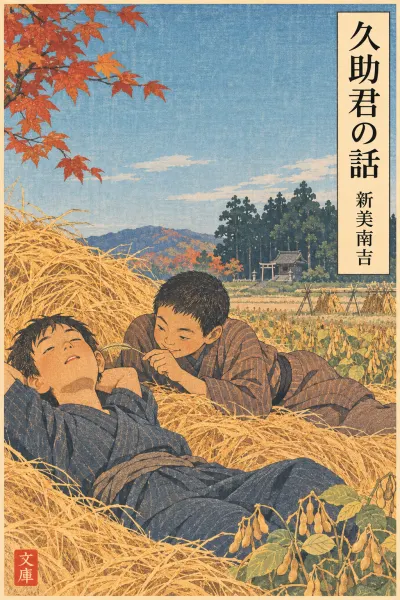
久助君の話Kyūsukekun no Hanashi — Kyūsuke and the Haystack Afternoon
- JLPT N3
- 4,674 characters
- 4 parts
- about 39 minutes
- 2 easier versions
This is a short, quiet story about two village boys spending an autumn afternoon together, told almost entirely from the inside of one child's head. Kyūsuke, kept indoors by his father's new study rule, goes looking for his friends and finds only Hyōtarō, a joker known for tall tales and tuneless singing. The two end up in a sun-warmed haystack, and what starts as idle teasing turns into a long, rolling bout of play-wrestling. Very little happens on the surface. The real action is in Kyūsuke's shifting thoughts as the light fades. The narration is gentle and observant, full of sounds, warmth and the feel of hay, and it treats a child's uncertainty with real seriousness. For learners, the narrative passages are in clear written Japanese and reward careful reading, especially the many sentences that weigh possibilities: is he joking, is he angry, what is he thinking? The challenge is the boys' dialogue, which is in a rustic regional dialect. The lines are short, but their forms will not match textbook Japanese.
Contents
Easier versions
This story is also retold in simpler Japanese. Reading an easier version first makes the original much more approachable.
Before you read
- Separate narration from dialogue. The narrator writes standard plain-form Japanese (〜である, 〜た), but the boys speak a regional dialect: ん often replaces ない (知らん), and forms like 知らんげや, いやひんだらァ and おもしろかねえ are casual country speech. Read these lines for gist, using the context and the notes, rather than trying to parse every syllable.
- Much of the story happens in Kyūsuke's guesses about Hyōtarō, so learn the uncertainty patterns first: 〜かどうか (whether or not), 〜かしれない (might be), まさか〜まい (surely not), and 〜だろうが〜だろうが (whether it's this or that). Following these is the key to following his changing feelings.
- Watch for 〜ているつもり (thinking or intending that one is doing something) and 〜ようとしなかった (would not try to, refused to). They mark the gap between what Kyūsuke believes is happening and what Hyōtarō actually does, and that gap is the heart of Parts 3 and 4.
- Keep the names straight. Hyōtarō also appears as ほら兵 (his 'fibber' nickname) and 兵タン (Kyūsuke's affectionate name for him), and Tokuichi becomes 徳やん in Hyōtarō's speech. The narrator adds 君 to the boys' names throughout.
- Notice the sensory words for sound, light and warmth: listening for friends, the sun-warmed hay, the distant cart at dusk. These details mark the passing of the afternoon and signal the shift into loneliness, so slowing down on them pays off.
Words to know
The most useful words from the notes across the story.
| Word | Meaning | JLPT |
|---|---|---|
| くるいはじめたくるう | to romp wildly, play roughlydictionary form: 狂うUsually means 'to go mad', but of children it means to frolic and roughhouse without restraint. | N3 |
| 町ちょう | chō, an old unit of distance (about 109 m)Read ちょう as a counter, not まち. | N5 |
| あいずあいず | signal, signdictionary form: 合図Used with 送る 'to send' or する. | N3 |
| くせくせ | habit, quirkdictionary form: 癖Usually for personal mannerisms, often slightly odd ones. | N3 |
| 疑問ぎもん | doubt, question疑 = doubt, 問 = ask. | N3 |
| 地平線ちへいせん | the horizon (over land)The horizon over the sea is 水平線. | N3 |
| 心得てこころえる | to regard as, understand (something) to bedictionary form: 心得るSomewhat literary; AとBと心得る = 'take A to be B'. | N2 |
| 思いこんでおもいこむ | to be convinced of, to assume (often wrongly)dictionary form: 思い込む | N2 |
| ほうびほうび | reward, prizedictionary form: 褒美Often used with もらう for a prize given by a school or a superior. | N1 |
| いきごんでいきごむ | to be eager, to be fired updictionary form: 意気込むLiterally 'to push one's spirit in'. Shows strong enthusiasm for doing something. | N1 |
| へだたっているへだたる | to be distant, to be apartdictionary form: 隔たるA written-style word for distance in space or time. | N1 |
| ましまし | better (of two poor choices), the lesser evilImplies that neither option is really good. | N1 |
| うながしたうながす | to urge, to promptdictionary form: 促す | N1 |
| 自尊心じそんしん | pride, self-respect | N1 |
| 本気ほんき | seriousness, in earnestContrasts with じょうだん (joke) throughout the passage; しんけん (真剣) is a near-synonym. | N1 |
Plot summary
Show the full summary (contains spoilers)
After winning a school prize, Kyūsuke has to study for an hour every afternoon, so his friends are usually gone by the time he goes out. One clear autumn day he searches the village and finds only Hyōtarō, who tells him the others are away because Tokuichi has gone to Handa with his mother. The two flop into a haystack. Hyōtarō refuses every game, so Kyūsuke tickles his ear with a blade of grass until Hyōtarō charges him. They wrestle until dusk, and Kyūsuke keeps wondering whether it is play or a real fight. When the struggle ends and they stand up, Hyōtarō stares lonely at the horizon. For a moment Kyūsuke feels he has spent the day with a stranger, then recognises his familiar friend. They part awkwardly, and Kyūsuke is left sensing that even people we know well can become strangers.
About the author
Niimi Nankichi was a Japanese writer of children's stories, poems and songs from Handa in Aichi Prefecture. The countryside of that area is widely thought to lie behind the village and hills of Gongitsune. He began writing as a young man. Gongitsune appeared in the children's magazine Akai Tori (The Red Bird), edited by Suzuki Miekichi. Niimi later worked as a teacher at a girls' school while continuing to write. His health was poor, and he died of tuberculosis while still in his twenties. Many of his works were published and became widely known only after his death. Besides Gongitsune, he is especially remembered for Tebukuro wo Kai ni (Buying Mittens).