Advanced · JLPT N1
名人伝Meijinden — The Making of a Master
- JLPT N1
- 5,718 characters
- 4 parts
- about 48 minutes
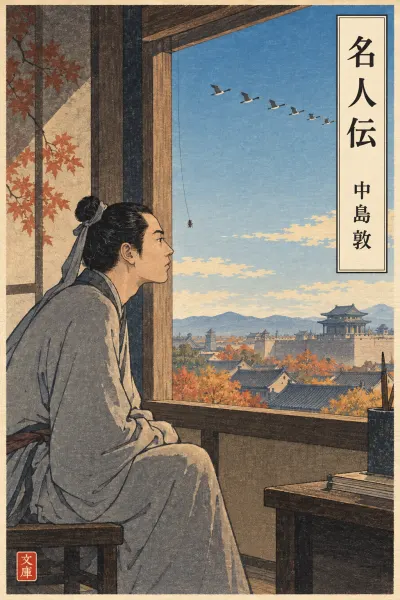
名人伝 is a short fable set in ancient China, told in Japanese prose that carries the rhythm of classical Chinese. Kishō, a man of Kantan, resolves to become the greatest archer in the world, and the story follows him through years of strange training under two teachers: the famed marksman Hiei and, later, an ancient hermit on a remote mountain. The exercises are absurd but described with complete seriousness. One of them is staring at a louse until it looks as big as a horse. Now and then the narrator steps in as a self-styled 'fable-writer' with dry asides. The tone is deadpan and faintly ironic, and the story slowly asks what mastery actually means. For learners this is demanding reading, measured at N1. The prose is dense with kanbun-style vocabulary, classical negatives such as 〜ぬ and 〜ざる, and set phrases like 〜に足りぬ and 〜をおいてない. However, it is short, about 5,700 characters in four parts, and each part centres on one vivid, memorable scene that helps you keep your bearings.
Contents
Before you read
- Learn the core archery vocabulary first: 弓 (bow), 矢 (arrow), 射る (to shoot), 的 (target), 名人 and 達人 (master, expert). The whole story is built around these words, and many compounds such as 射術 or 弓矢 grow from them.
- Expect classical negatives and kanbun-style constructions throughout: 〜ぬ for 〜ない, 〜ざる before nouns, 〜だにしない ('does not even…'), and 〜が故に ('because'). Reading 〜ぬ as 〜ない in your head will clear up most sentences.
- Recurring evaluative phrases carry the story's judgments, so watch for them: 〜に足りぬ/〜に足る (not worth / worth), 〜に過ぎない (no more than), 〜をおいてほかにない (none other than), and 〜に違いない (must surely be).
- The old masters Hiei and Kan'yō speak in elderly, archaic Japanese, using じゃ for だ, 儞 for 'you', and 夫子 as a respectful term of address. Treat these as markers of age and dignity rather than as new grammar.
- Proper names use Japanese on'yomi readings of Chinese names (趙 = Chō, 邯鄲 = Kantan, 斉 = Sei). Brief digressions about figures like Duke Kan or the First Emperor are the narrator's ironic asides, and you can read them lightly without losing the main plot.
Words to know
The most useful words from the notes across the story.
| Word | Meaning | JLPT |
|---|---|---|
| 児戯じぎ | child's play児戯に類する means 'is no better than child's play'. | — |
| 名人めいじん | master, virtuosoKey word of the story; the title 名人伝 means 'Biography of a Master'. | N3 |
| 工夫くふう | ingenious plan, device, contrivanceA very common word for a clever idea or improvement. Not to be confused with こうふ 'labourer'. | N2 |
| 眩暈めまい | dizziness, vertigoめまい is often written in kana or as 目まい. | N2 |
| 罵りののしる | to abuse verbally, to rail atdictionary form: 罵る | N1 |
| 自尊心じそんしん | pride; self-respect〜にこたえる here means 'to hit hard, to sting'. | N1 |
| 前途ぜんと | the road ahead; one's future prospects前途程遠い = there is still a long way to go. | N1 |
| 辿りつくたどりつく | to finally reach (after a hard journey)dictionary form: 辿り着く | N1 |
| 今更いまさら | now, at this late stageImplies it is too late to change course. | N1 |
| 白状はくじょう | confession白状する: to confess, especially to wrongdoing. | N1 |
| 志を立てたこころざしをたてる | to set one's heart on a goal; to resolvedictionary form: 志を立てるA fixed, formal expression for making a serious life resolution. | — |
| 物色ぶっしょく | looking around for a suitable person or thingUsed with する; here it means searching for a suitable teacher. | — |
| 門人もんじん | disciple, pupilCompare 門に入る (sentence 4), 'to enter someone's school; to become their pupil'. | — |
| 機織台はたおりだい | loom機 is read はた when it means a loom, as in 機を織る 'to weave'. | — |
| 修練しゅうれん | training, disciplineOften used with 重ねる, 'to keep up repeated training'. | — |
Plot summary
Show the full summary (contains spoilers)
Kishō of Kantan becomes the pupil of the master archer Hiei. He trains for two years until he never blinks, then three more staring at a louse until it seems as large as a horse. When he can shoot it through the heart, Hiei teaches him everything. His skill becomes miraculous, and to be the best he ambushes Hiei, who parries his last arrow with a thorn. Ashamed, they embrace, and Hiei sends him west to the hermit Kan'yō. On Mount Kaku, Kishō shows off by downing five birds with one arrow, but the old man, holding no bow at all, brings down a kite circling high overhead. After nine years Kishō returns with a blank face, and Hiei hails him as the true master. He never touches a bow again, and his fame grows through rumour. Shortly before his death, after forty quiet years, he fails even to recognise a bow.
About the author
Nakajima Atsushi was born in Tokyo into a family of scholars of the Chinese classics, a background that shows clearly in his style. After studying Japanese literature at Tokyo Imperial University, he taught at a girls' school in Yokohama. He later went to Palau, then under Japanese administration, to prepare Japanese-language textbooks for the South Seas Bureau. His small body of work includes several stories drawn from Chinese history and legend, among them Meijinden and Riryō.