Part 4 of 4 · JLPT N1
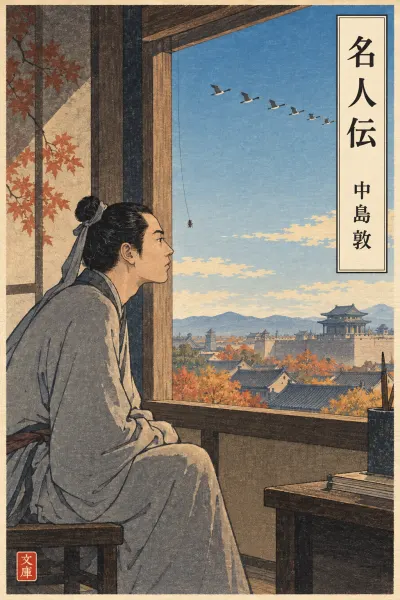
名人伝 Meijinden, part 4: The Master Who Forgot the Bow
In this part
Kishō returns to Kantan as the world's greatest archer but never touches a bow again, and his fame only grows as wild rumours spread. Over forty quiet years he sinks into perfect stillness and dies like vanishing smoke. Shortly before his death he fails to recognise a bow, and his astonished host realises that the master has forgotten archery altogether.
AI translation · independently checked
邯鄲の都は、天下一の名人となって戻って来た紀昌を迎えて、やがて眼前に示されるに違いないその妙技への期待に湧返った。The capital of Kantan welcomed Kishō home as the greatest master in the land, and the whole city seethed with anticipation of the marvellous skill he would surely soon display before their eyes.
ところが紀昌は一向にその要望に応えようとしない。Kishō, however, showed no sign whatever of answering their wishes.
いや、弓さえ絶えて手に取ろうとしない。Indeed, he would not so much as take a bow in his hand.
山に入る時に携えて行った楊幹麻筋の弓もどこかへ棄てて来た様子である。It seemed that even the bow of willow wood and hemp sinew he had carried with him into the mountains had been thrown away somewhere.
そのわけを訊ねた一人に答えて、紀昌は懶げに言った。When someone asked him why, Kishō answered languidly:
至為は為す無く、至言は言を去り、至射は射ることなしと。"The highest action is no action; the highest speech casts off words; the highest shooting is not to shoot."
なるほどと、至極物分りのいい邯鄲の都人士はすぐに合点した。"Of course," said the people of Kantan, who were exceedingly quick to understand, and they were satisfied at once.
弓を執らざる弓の名人は彼等の誇となった。The master archer who would not take up a bow became their pride.
紀昌が弓に触れなければ触れないほど、彼の無敵の評判はいよいよ喧伝された。The less Kishō touched a bow, the more loudly his reputation as an archer without equal was trumpeted abroad.
様々な噂が人々の口から口へと伝わる。All manner of rumours passed from mouth to mouth.
毎夜三更を過ぎる頃、紀昌の家の屋上で何者の立てるとも知れぬ弓弦の音がする。Every night, after the third watch, it was said, the twang of a bowstring could be heard on the roof of Kishō's house, though no one knew whose hand plucked it.
名人の内に宿る射道の神が主人公の睡っている間に体内を脱け出し、妖魔を払うべく徹宵守護に当っているのだという。The god of the Way of Archery that dwelt within the master, people said, slipped out of his body while he slept and stood guard all night long to drive away evil spirits.
彼の家の近くに住む一商人はある夜紀昌の家の上空で、雲に乗った紀昌が珍しくも弓を手にして、古の名人・羿と養由基の二人を相手に腕比べをしているのを確かに見たと言い出した。A merchant who lived near his house declared that one night, in the sky above Kishō's home, he had seen with his own eyes Kishō riding on a cloud, for once holding a bow, and matching his skill against the two great masters of old, Gei and Yō Yūki.
その時三名人の放った矢はそれぞれ夜空に青白い光芒を曳きつつ参宿と天狼星との間に消去ったと。The arrows loosed by the three masters, he said, each trailed a pale blue streak of light across the night sky before vanishing between the Three Stars and the Wolf Star.
紀昌の家に忍び入ろうとしたところ、塀に足を掛けた途端に一道の殺気が森閑とした家の中から奔り出てまともに額を打ったので、覚えず外に顛落したと白状した盗賊もある。There was even a thief who confessed that when he tried to steal into Kishō's house, the moment he set his foot on the wall a single bolt of murderous force had rushed out of the hushed house and struck him full on the forehead, so that before he knew it he had tumbled back outside.
爾来、邪心を抱く者共は彼の住居の十町四方は避けて廻り道をし、賢い渡り鳥共は彼の家の上空を通らなくなった。From then on, those who harboured wicked intent went the long way round, avoiding a full ten chō on every side of his dwelling, and the wise migrating birds no longer flew over his house.
雲と立罩める名声のただ中に、名人紀昌は次第に老いて行く。In the midst of this fame that hung about him like clouds, the master Kishō gradually grew old.
既に早く射を離れた彼の心は、ますます枯淡虚静の域にはいって行ったようである。His heart, which had long since left archery behind, seemed to pass ever further into a realm of plain, empty serenity.
木偶のごとき顔は更に表情を失い、語ることも稀となり、ついには呼吸の有無さえ疑われるに至った。His face, already like that of a wooden doll, lost all expression; he rarely spoke, and in the end people came to wonder whether he was breathing at all.
「既に、我と彼との別、是と非との分を知らぬ。眼は耳のごとく、耳は鼻のごとく、鼻は口のごとく思われる。」というのが、老名人晩年の述懐である。"I no longer know the difference between self and other, nor the line between right and wrong. The eye seems to me like the ear, the ear like the nose, the nose like the mouth." Such were the reflections of the old master in his last years.
甘蠅師の許を辞してから四十年の後、紀昌は静かに、誠に煙のごとく静かに世を去った。Forty years after taking his leave of Master Kan'yō, Kishō departed this world quietly, truly as quietly as smoke.
その四十年の間、彼は絶えて射を口にすることが無かった。In all those forty years he never once spoke of archery.
口にさえしなかった位だから、弓矢を執っての活動などあろうはずが無い。Since he would not even speak of it, there could be no question of his ever taking up bow and arrow to do anything.
もちろん、寓話作者としてはここで老名人に掉尾の大活躍をさせて、名人の真に名人たるゆえんを明らかにしたいのは山々ながら、一方、また、何としても古書に記された事実を曲げる訳には行かぬ。Naturally, as a writer of fables, I should dearly like to have the old master perform one last great feat here at the end and make plain what truly made him a master, yet on the other hand I cannot on any account bend the facts recorded in the old books.
実際、老後の彼についてはただ無為にして化したとばかりで、次のような妙な話の外には何一つ伝わっていないのだから。For in truth, of his old age it is recorded only that he passed away in a state of non-action, and nothing else at all has come down to us apart from the following curious tale.
その話というのは、彼の死ぬ一二年前のことらしい。The tale seems to concern a time a year or two before his death.
ある日老いたる紀昌が知人の許に招かれて行ったところ、その家で一つの器具を見た。One day the aged Kishō was invited to the house of an acquaintance, and there he saw a certain implement.
確かに見憶えのある道具だが、どうしてもその名前が思出せぬし、その用途も思い当らない。It was certainly a tool he had seen before, but try as he might he could not recall its name, nor could he think what it was used for.
老人はその家の主人に尋ねた。The old man asked the master of the house.
それは何と呼ぶ品物で、また何に用いるのかと。What was the thing called, and what was it used for?
主人は、客が冗談を言っているとのみ思って、ニヤリととぼけた笑い方をした。Thinking only that his guest was joking, the host gave a sly, knowing grin.
老紀昌は真剣になって再び尋ねる。Old Kishō, quite in earnest, asked again.
それでも相手は曖昧な笑を浮べて、客の心をはかりかねた様子である。Still the host wore an uncertain smile, apparently unable to read his guest's mind.
三度紀昌が真面目な顔をして同じ問を繰返した時、始めて主人の顔に驚愕の色が現れた。When Kishō, with a serious face, repeated the same question a third time, astonishment at last appeared on the host's face.
彼は客の眼を凝乎と見詰める。He stared fixedly into his guest's eyes.
相手が冗談を言っているのでもなく、気が狂っているのでもなく、また自分が聞き違えをしているのでもないことを確かめると、彼はほとんど恐怖に近い狼狽を示して、吃りながら叫んだ。Having made sure that his guest was neither joking nor out of his mind, and that he himself had not misheard, he showed a dismay close to terror and cried out, stammering:
「ああ、夫子が、――古今無双の射の名人たる夫子が、弓を忘れ果てられたとや? ああ、弓という名も、その使い途も!」"Ah, that you, Master — you, the greatest archer of all ages past and present — should have quite forgotten the bow! Ah, both the very name of the bow and its use!"
その後当分の間、邯鄲の都では、画家は絵筆を隠し、楽人は瑟の絃を断ち、工匠は規矩を手にするのを恥じたということである。It is said that for a long while afterwards, in the capital of Kantan, painters hid their brushes, musicians cut the strings of their zithers, and craftsmen were ashamed to take up their compasses and squares.
(昭和十七年十二月)(December 1942)
Vocabulary
| Word | Meaning | JLPT |
|---|---|---|
| 妙技みょうぎ | marvellous skill, superb technique妙 means 'exquisite, wondrous'; it also means 'strange', as in 妙な話. | — |
| 懶げものうげ | languid, listless, weary-lookingUsually written 物憂げ today; 〜げ means 'seeming, -looking'. | — |
| 合点がてん | understanding, being convinced合点がいく means 'to make sense'. Also read がってん. | — |
| 喧伝けんでん | spreading widely, trumpeting abroadLiterary. 喧 means 'noisy'. | — |
| 殺気さっき | murderous aura, killing intentNot to be confused with さっき meaning 'a moment ago'. | — |
| 白状はくじょう | confession白状する: to confess, especially to wrongdoing. | N1 |
| 爾来じらい | since then, from then onKanbun-style literary word; modern equivalent: それ以来. | — |
| 四方しほう | on every side (an area so many units square)A 町 (chō) is about 109 m, so ten chō is roughly a kilometre. | — |
| 述懐じゅっかい | reflection, reminiscence (spoken aloud)Sharing one's thoughts or memories. | — |
| 掉尾ちょうび | the grand finale, the very endLiterally 'a fish flicking its tail'; often in 掉尾を飾る, 'to close in style'. Also read とうび. | — |
| 山々やまやま | very much (wanting to do something one cannot)〜たいのは山々だが: 'I would love to, but…'. | — |
| 無為むい | non-action, doing nothingA Taoist ideal of effortless inaction; also used for 'idleness'. | — |
| 狼狽ろうばい | dismay, panic, consternationVerb: 狼狽える (うろたえる), 'to be flustered'. | — |
| 規矩きく | compass and carpenter's square; standardsThe craftsman's basic measuring tools, here as a symbol of his craft. | — |
Grammar
〜に違いない N3 must be, surely will
Expresses the speaker's strong conviction. Here it modifies 妙技: the skill that would certainly be shown before their eyes.
やがて眼前に示されるに違いないその妙技への期待に湧返った
seethed with anticipation of the marvellous skill that would surely soon be shown before their eyes
〜ば〜ほど N3 the more …, the more …
The conditional form of a verb is followed by the same verb plus ほど to show proportional change. Here the less he touches the bow, the greater his fame.
紀昌が弓に触れなければ触れないほど、彼の無敵の評判はいよいよ喧伝された。
The less Kishō touched a bow, the more loudly his reputation as an archer without equal was trumpeted abroad.
〜べく N1 in order to
A literary purpose form attached to the dictionary form of a verb, similar to 〜ために. Here it gives the reason the god keeps watch.
妖魔を払うべく徹宵守護に当っているのだという
it stood guard all night long to drive away evil spirits, they said
〜に至る N1 to reach the point of, to end up
Marks the extreme end point of a progression. Combined with ついには, it shows how far Kishō's stillness finally went.
ついには呼吸の有無さえ疑われるに至った
in the end people came to wonder whether he was breathing at all
〜はずが無い N3 there is no way that …
Denies a possibility on logical grounds. The volitional form あろう adds a literary 'could there possibly be' nuance.
弓矢を執っての活動などあろうはずが無い
there could be no question of his taking up bow and arrow to do anything
〜わけには行かぬ N3 cannot (for moral or social reasons)
Means that something is impossible because it would be wrong, not because one lacks the ability. 行かぬ is the classical negative of 行かない.
何としても古書に記された事実を曲げる訳には行かぬ
I cannot on any account bend the facts recorded in the old books