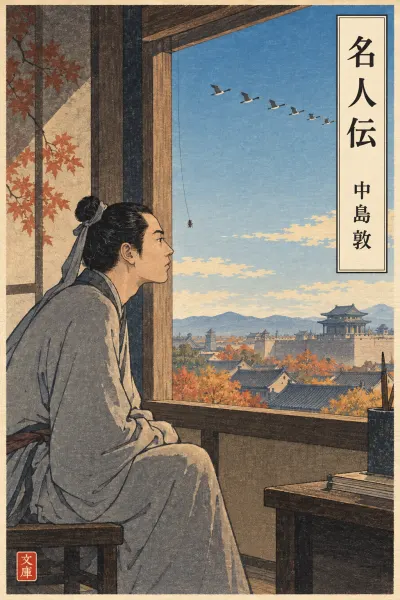
Part 3 of 4 · JLPT N1
名人伝 Meijinden, part 3: The Shot That Needs No Bow
In this part
Kishō travels west and climbs a remote mountain peak to challenge the ancient hermit Kan'yō, and shows off by bringing down five birds with a single arrow. On a rocking stone above a sheer cliff Kishō collapses in terror, while the old man, with no bow or arrow at all, brings down a kite circling high overhead. Kishō stays with him for nine years and returns with a blank, foolish-looking face, and his old teacher Hiei hails him as the true master of the world.
AI translation · independently checked
紀昌はすぐに西に向って旅立つ。Kishō set out at once, heading west.
その人の前に出ては我々の技のごとき児戯にひとしいと言った師の言葉が、彼の自尊心にこたえた。His teacher's words, that in that man's presence an art like theirs was no better than child's play, had stung his pride.
もしそれが本当だとすれば、天下第一を目指す彼の望も、まだまだ前途程遠い訳である。If that were true, then his ambition to be the greatest in the world still had a long, long way to go.
己が業が児戯に類するかどうか、とにもかくにも早くその人に会って腕を比べたいとあせりつつ、彼はひたすらに道を急ぐ。Whether his own skill was no better than child's play or not, he was impatient to meet the man as soon as possible and match his skill against him, and he hurried single-mindedly along the road.
足裏を破り脛を傷つけ、危巌を攀じ桟道を渡って、一月の後に彼はようやく目指す山顛に辿りつく。Splitting the soles of his feet and cutting his shins, scaling perilous crags and crossing plank roads along the cliffs, after a month he at last reached the summit he was seeking.
気負い立つ紀昌を迎えたのは、羊のような柔和な目をした、しかし酷くよぼよぼの爺さんである。The one who greeted the eager, bristling Kishō was an old man with gentle eyes like a sheep's, but terribly frail and doddering.
年齢は百歳をも超えていよう。He must have been well over a hundred years old.
腰の曲っているせいもあって、白髯は歩く時も地に曳きずっている。Partly because his back was bent, his white beard trailed along the ground even as he walked.
相手が聾かも知れぬと、大声に遽だしく紀昌は来意を告げる。Thinking the old man might be deaf, Kishō hurriedly announced the purpose of his visit in a loud voice.
己が技の程を見てもらいたいむねを述べると、あせり立った彼は相手の返辞をも待たず、いきなり背に負うた楊幹麻筋の弓を外して手に執った。Having said that he wished to have the measure of his skill judged, he was so impatient that he did not even wait for an answer, but abruptly took down the bow of willow and hemp sinew he carried on his back and held it in his hands.
そうして、石碣の矢をつがえると、折から空の高くを飛び過ぎて行く渡り鳥の群に向って狙いを定める。Then, fitting an arrow tipped with stone, he took aim at a flock of migrating birds that happened just then to be passing high across the sky.
弦に応じて、一箭たちまち五羽の大鳥が鮮やかに碧空を切って落ちて来た。At the twang of the string, a single arrow sent five great birds cleanly cutting through the blue sky and falling to earth.
一通り出来るようじゃな、と老人が穏かな微笑を含んで言う。"It seems you can manage well enough," said the old man with a gentle smile.
だが、それは所詮射之射というもの、好漢いまだ不射之射を知らぬと見える。"But that, after all, is only the shooting of shooting; it appears, my fine fellow, that you do not yet know the shooting of not-shooting."
ムッとした紀昌を導いて、老隠者は、そこから二百歩ばかり離れた絶壁の上まで連れて来る。Leading the offended Kishō, the old hermit brought him to the top of a cliff some two hundred paces away.
脚下は文字通りの屏風のごとき壁立千仭、遥か真下に糸のような細さに見える渓流をちょっと覗いただけでたちまち眩暈を感ずるほどの高さである。Below their feet the rock wall dropped a thousand fathoms, as sheer as a folding screen in the most literal sense, and the height was such that merely glancing down at the stream far below, which looked as thin as a thread, was enough to make one dizzy at once.
その断崖から半ば宙に乗出した危石の上につかつかと老人は駈上り、振返って紀昌に言う。The old man strode briskly up onto a precarious rock that jutted halfway out into the air from the precipice, then turned and spoke to Kishō.
どうじゃ。"Well, now?"
この石の上で先刻の業を今一度見せてくれぬか。"Will you not show me that feat of yours once more, here on this rock?"
今更引込もならぬ。It was too late now to back down.
老人と入代りに紀昌がその石を履んだ時、石は微かにグラリと揺らいだ。When Kishō stepped onto the rock in the old man's place, it wobbled slightly beneath him.
強いて気を励まして矢をつがえようとすると、ちょうど崖の端から小石が一つ転がり落ちた。As he forced his courage up and tried to fit an arrow to the string, a pebble just then tumbled off the edge of the cliff.
その行方を目で追うた時、覚えず紀昌は石上に伏した。As his eyes followed its fall, Kishō, without meaning to, threw himself flat upon the rock.
脚はワナワナと顫え、汗は流れて踵にまで至った。His legs shook and trembled, and sweat ran down until it reached his heels.
老人が笑いながら手を差し伸べて彼を石から下し、自ら代ってこれに乗ると、では射というものをお目にかけようかな、と言った。Laughing, the old man reached out a hand and helped him down from the rock, then stepped onto it himself in his place and said, "Now then, shall I show you what shooting is?"
まだ動悸がおさまらず蒼ざめた顔をしてはいたが、紀昌はすぐに気が付いて言った。Though his heart was still pounding and his face was pale, Kishō noticed at once and said:
しかし、弓はどうなさる?"But what will you do for a bow?"
弓は?"Your bow?"
老人は素手だったのである。For the old man was empty-handed.
弓?"A bow?"
と老人は笑う。laughed the old man.
弓矢の要る中はまだ射之射じゃ。"So long as one needs a bow and arrows, it is still the shooting of shooting."
不射之射には、烏漆の弓も粛慎の矢もいらぬ。"For the shooting of not-shooting, one needs neither a bow of black lacquer nor the arrows of the Shukushin."
ちょうど彼等の真上、空の極めて高い所を一羽の鳶が悠々と輪を画いていた。Directly above them, very high in the sky, a single kite was leisurely tracing circles.
その胡麻粒ほどに小さく見える姿をしばらく見上げていた甘蠅が、やがて、見えざる矢を無形の弓につがえ、満月のごとくに引絞ってひょうと放てば、見よ、鳶は羽ばたきもせず中空から石のごとくに落ちて来るではないか。Kan'yō gazed up for a while at its form, which looked as small as a sesame seed; then at last he fitted an invisible arrow to a bow that had no shape, drew it back like the full moon, and let it fly with a whistle, and behold! the kite, without even a flap of its wings, came falling like a stone out of the middle of the sky.
紀昌は慄然とした。Kishō shuddered.
今にして始めて芸道の深淵を覗き得た心地であった。He felt that only now, for the first time, had he been able to glimpse the depths of the art.
九年の間、紀昌はこの老名人の許に留まった。For nine years Kishō remained with this old master.
その間いかなる修業を積んだものやらそれは誰にも判らぬ。What training he went through during that time, no one knows.
九年たって山を降りて来た時、人々は紀昌の顔付の変ったのに驚いた。When he came down from the mountain after nine years, people were astonished at how his face had changed.
以前の負けず嫌いな精悍な面魂はどこかに影をひそめ、なんの表情も無い、木偶のごとく愚者のごとき容貌に変っている。The fierce, competitive spirit that had once shown in his features had vanished somewhere, and his face had become expressionless, like a wooden doll's or a simpleton's.
久しぶりに旧師の飛衛を訪ねた時、しかし、飛衛はこの顔付を一見すると感嘆して叫んだ。Yet when, after a long absence, he visited his old teacher Hiei, Hiei took one look at this face and cried out in admiration:
これでこそ初めて天下の名人だ。"Now, at last, you are truly the master of the world."
我儕のごとき、足下にも及ぶものでないと。"The likes of us cannot even come close to you!"
Vocabulary
| Word | Meaning | JLPT |
|---|---|---|
| 児戯じぎ | child's play; something trivialLiterary. 児 = child, 戯 = play. 児戯にひとしい / 児戯に類する = 'no better than child's play'. | — |
| 自尊心じそんしん | pride; self-respect〜にこたえる here means 'to hit hard, to sting'. | N1 |
| 前途ぜんと | the road ahead; one's future prospects前途程遠い = there is still a long way to go. | N1 |
| 辿りつくたどりつく | to finally reach (after a hard journey)dictionary form: 辿り着く | N1 |
| 柔和にゅうわ | gentle, mildNote the unusual reading にゅう for 柔. | — |
| よぼよぼよぼよぼ | doddering, feeble with ageMimetic word for the unsteady weakness of old age. | — |
| 来意らいい | the purpose of one's visitFormal. Typically used as 来意を告げる. | — |
| 所詮しょせん | after all; in the end (it's only…)Usually sets up a dismissive judgement. | — |
| 絶壁ぜっぺき | sheer cliff, precipice | — |
| 眩暈めまい | dizziness, vertigoめまい is often written in kana or as 目まい. | N2 |
| 今更いまさら | now, at this late stageImplies it is too late to change course. | N1 |
| 動悸どうき | pounding heart, palpitations | — |
| 素手すで | empty-handed; bare hands | — |
| 木偶でく | wooden doll; a dull, blank personAlso seen as でくのぼう (blockhead). | — |
Grammar
〜のごとき / 〜のごとく N1 like ~; such as ~
A literary equivalent of 〜のような / 〜のように. ごとき modifies a noun and ごとく modifies a verb; the passage uses both repeatedly (屏風のごとき, 石のごとくに).
我々の技のごとき児戯にひとしい
an art like ours is no better than child's play
〜とすれば N3 if we suppose that ~; if ~ is the case
Sets up a hypothesis, often followed by a logical conclusion. Here the conclusion is introduced with 訳である ('it follows that').
もしそれが本当だとすれば、天下第一を目指す彼の望も、まだまだ前途程遠い訳である。
If that were true, his ambition to be the greatest in the world still had a long way to go.
〜つつ N2 while ~ing
A written-style version of 〜ながら that attaches to the verb stem. It links Kishō's impatient feeling to his hurrying along the road.
腕を比べたいとあせりつつ、彼はひたすらに道を急ぐ。
Impatient to match his skill against him, he hurried on along the road.
〜ではないか N2 why, ~! / just look, ~!
Combined with 見よ ('behold'), this expresses the narrator's astonishment and draws the reader's attention to a surprising fact, rather than asking a real question.
見よ、鳶は羽ばたきもせず中空から石のごとくに落ちて来るではないか。
Behold! The kite, without even a flap of its wings, came falling like a stone from the sky.
〜得る(える) N2 to be able to ~
Attached to a verb stem, 得る expresses possibility or ability in formal or literary style. 覗き得た means 'was able to glimpse'.
今にして始めて芸道の深淵を覗き得た心地であった。
He felt that only now had he been able to glimpse the depths of the art.
〜でこそ N2 it is precisely ~ (that…)
こそ strongly emphasises the preceding element. これでこそ means 'only like this, precisely in this state', and 初めて reinforces the idea of 'only now, for the first time'.
これでこそ初めて天下の名人だ。
Now, at last, you are truly the master of the world.