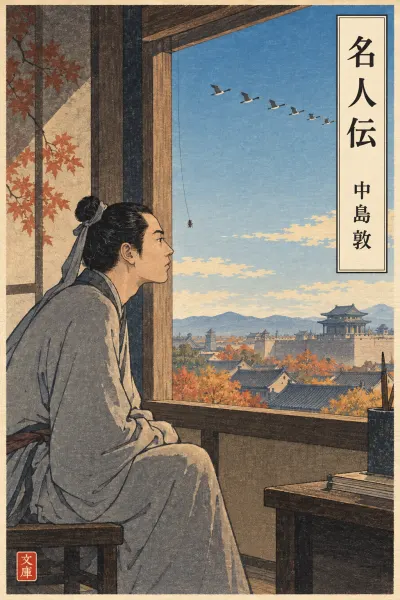
Part 1 of 4 · JLPT N1
名人伝 Meijinden, part 1: Learning Not to Blink, Then to See
In this part
Kishō of Kantan resolves to become the greatest archer in the world and becomes a pupil of the famed marksman Hiei. Hiei first has him train for two years until he never blinks, and then for three years staring at a louse until it looks as big as a horse. When Kishō can shoot the louse through the heart without breaking the hair it hangs from, Hiei finally praises him and begins teaching him every secret of archery.
AI translation · independently checked
趙の邯鄲の都に住む紀昌という男が、天下第一の弓の名人になろうと志を立てた。In Kantan, the capital of Chō, there lived a man named Kishō, who set his heart on becoming the greatest master of the bow under heaven.
己の師と頼むべき人物を物色するに、当今弓矢をとっては、名手・飛衛に及ぶ者があろうとは思われぬ。Looking about for someone he might rely on as his teacher, he concluded that among the archers of the day there could surely be none to equal the expert Hiei.
百歩を隔てて柳葉を射るに百発百中するという達人だそうである。It was said that this adept, shooting at willow leaves from a hundred paces away, hit them with every single arrow.
紀昌は遥々飛衛をたずねてその門に入った。Kishō travelled a long way to call on Hiei and was admitted as his pupil.
飛衛は新入の門人に、まず瞬きせざることを学べと命じた。Hiei ordered his new disciple, before anything else, to learn not to blink.
紀昌は家に帰り、妻の機織台の下に潜り込んで、そこに仰向けにひっくり返った。Kishō went home, crawled under his wife's loom, and lay there flat on his back.
眼とすれすれに機躡が忙しく上下往来するのをじっと瞬かずに見詰めていようという工夫である。His plan was to gaze, without blinking, at the treadle bar as it busily rose and fell a hair's breadth from his eyes.
理由を知らない妻は大いに驚いた。His wife, who did not know the reason, was greatly alarmed.
第一、妙な姿勢を妙な角度から良人に覗かれては困るという。For one thing, she said, she did not like having her husband peer at her odd posture from such an odd angle.
厭がる妻を紀昌は叱りつけて、無理に機を織り続けさせた。Kishō scolded his unwilling wife and made her go on weaving whether she liked it or not.
来る日も来る日も彼はこの可笑しな恰好で、瞬きせざる修練を重ねる。Day after day, in this ridiculous position, he kept up his training in not blinking.
二年の後には、遽だしく往返する牽挺が睫毛を掠めても、絶えて瞬くことがなくなった。After two years, even when the bar darting back and forth brushed against his eyelashes, he no longer blinked at all.
彼はようやく機の下から匍出す。At last he crawled out from under the loom.
もはや、鋭利な錐の先をもって瞼を突かれても、まばたきをせぬまでになっていた。By now he had reached the point where, even if his eyelid were jabbed with the point of a sharp awl, he would not blink.
不意に火の粉が目に飛入ろうとも、目の前に突然灰神楽が立とうとも、彼は決して目をパチつかせない。Though a spark might suddenly fly into his eye, though a cloud of ash might abruptly burst up before his face, he never once fluttered his eyelids.
彼の瞼はもはやそれを閉じるべき筋肉の使用法を忘れ果て、夜、熟睡している時でも、紀昌の目はカッと大きく見開かれたままである。His eyelids had utterly forgotten how to use the muscles meant to close them, and even at night, when he was sound asleep, Kishō's eyes remained wide open, staring.
ついに、彼の目の睫毛と睫毛との間に小さな一匹の蜘蛛が巣をかけるに及んで、彼はようやく自信を得て、師の飛衛にこれを告げた。Finally, when a tiny spider spun its web between his lashes, he at last felt confident, and reported this to his master Hiei.
それを聞いて飛衛がいう。Hearing this, Hiei said:
瞬かざるのみではまだ射を授けるに足りぬ。"Not blinking alone is not yet enough for you to be taught to shoot."
次には、視ることを学べ。"Next, learn to see."
視ることに熟して、さて、小を視ること大のごとく、微を見ること著のごとくなったならば、来って我に告げるがよいと。"When you have mastered seeing, and the small appears to you as large and the faint as plain, then you may come and tell me."
紀昌は再び家に戻り、肌着の縫目から虱を一匹探し出して、これを己が髪の毛をもって繋いだ。Kishō returned home once more, found a single louse in the seam of his undergarment, and tied it up with one of his own hairs.
そうして、それを南向きの窓に懸け、終日睨み暮らすことにした。Then he hung it in his south-facing window and resolved to spend his days glaring at it from morning till night.
毎日毎日彼は窓にぶら下った虱を見詰める。Day after day he stared at the louse dangling in the window.
初め、もちろんそれは一匹の虱に過ぎない。At first, of course, it was nothing more than a louse.
二三日たっても、依然として虱である。After two or three days it was still a louse.
ところが、十日余り過ぎると、気のせいか、どうやらそれがほんの少しながら大きく見えて来たように思われる。But when ten days or more had passed, it seemed, though perhaps it was only his imagination, that it had begun to look ever so slightly larger.
三月目の終りには、明らかに蚕ほどの大きさに見えて来た。By the end of the third month it plainly looked as big as a silkworm.
虱を吊るした窓の外の風物は、次第に移り変る。Outside the window where the louse hung, the scenery gradually changed.
煕々として照っていた春の陽はいつか烈しい夏の光に変り、澄んだ秋空を高く雁が渡って行ったかと思うと、はや、寒々とした灰色の空から霙が落ちかかる。The spring sun that had shone so gently and brightly turned, before he knew it, into the fierce light of summer; no sooner had the wild geese flown high across the clear autumn sky than sleet was already falling from a cold grey one.
紀昌は根気よく、毛髪の先にぶら下った有吻類・催痒性の小節足動物を見続けた。Kishō patiently went on watching the small beaked, itch-inducing arthropod that dangled from the end of a hair.
その虱も何十匹となく取換えられて行く中に、早くも三年の月日が流れた。While dozens upon dozens of lice were replaced one after another, three years had swiftly gone by.
ある日ふと気が付くと、窓の虱が馬のような大きさに見えていた。Then one day he suddenly noticed that the louse in the window looked as big as a horse.
占めたと、紀昌は膝を打ち、表へ出る。"I have it!" Kishō slapped his knee and went outside.
彼は我が目を疑った。He could not believe his eyes.
人は高塔であった。People were lofty towers.
馬は山であった。Horses were mountains.
豚は丘のごとく、雞は城楼と見える。Pigs looked like hills, and chickens like castle turrets.
雀躍して家にとって返した紀昌は、再び窓際の虱に立向い、燕角の弧に朔蓬の簳をつがえてこれを射れば、矢は見事に虱の心の臓を貫いて、しかも虱を繋いだ毛さえ断れぬ。Leaping for joy, Kishō hurried back home and faced the louse by the window once again; he fitted a shaft of northern reed to his bow of En horn and loosed it, and the arrow pierced the louse squarely through the heart, yet did not even break the hair that held it.
紀昌は早速師の許に赴いてこれを報ずる。Kishō went at once to his master's house to report this.
飛衛は高蹈して胸を打ち、初めて「出かしたぞ」と褒めた。Hiei leapt high, beat his breast, and for the first time praised him: "Well done!"
そうして、直ちに射術の奥儀秘伝を剰すところなく紀昌に授け始めた。And straight away he began to pass on to Kishō, holding nothing back, the deepest secrets of the art of archery.
Vocabulary
| Word | Meaning | JLPT |
|---|---|---|
| 志を立てたこころざしをたてる | to set one's heart on a goal; to resolvedictionary form: 志を立てるA fixed, formal expression for making a serious life resolution. | — |
| 名人めいじん | master, virtuosoKey word of the story; the title 名人伝 means 'Biography of a Master'. | N3 |
| 物色ぶっしょく | looking around for a suitable person or thingUsed with する; here it means searching for a suitable teacher. | — |
| 門人もんじん | disciple, pupilCompare 門に入る (sentence 4), 'to enter someone's school; to become their pupil'. | — |
| 機織台はたおりだい | loom機 is read はた when it means a loom, as in 機を織る 'to weave'. | — |
| 工夫くふう | ingenious plan, device, contrivanceA very common word for a clever idea or improvement. Not to be confused with こうふ 'labourer'. | N2 |
| 修練しゅうれん | training, disciplineOften used with 重ねる, 'to keep up repeated training'. | — |
| 掠めてかすめる | to brush lightly past; to grazedictionary form: 掠めるUsually written in kana today. | — |
| 熟睡じゅくすい | deep sleep熟 'ripe, thorough' + 睡 'sleep'. | — |
| 虱しらみ | louseOften written in kana. Kishō's target for three years. | — |
| 依然としていぜんとして | still, as beforeA formal adverb meaning that nothing has changed. | — |
| 占めたしめた | Got it! Just as I hoped!dictionary form: しめたAn exclamation of triumph when things go one's way. It is usually written in kana. | — |
| 雀躍じゃくやく | jumping for joyLiterally 'sparrow-hopping'. It is usually seen as 欣喜雀躍. | — |
| 奥儀秘伝おうぎひでん | the innermost secrets of an art奥儀 (also 奥義) means 'deepest principles' and 秘伝 means 'secret teaching'. | — |
Grammar
〜ざる N1 not ~ (classical negative, before a noun)
ざる is the attributive form of the classical negative ず, attached to the verb's negative stem. Here 瞬きせざること means 'not blinking', a literary equivalent of 瞬きしないこと.
まず瞬きせざることを学べと命じた
ordered him first of all to learn not to blink
〜に足りぬ/〜に足る N1 (not) enough to ~; (not) worth ~
足る means 'to suffice', and the classical negative ぬ turns it into 'is not enough'. The verb before に gives the purpose, so the meaning here is 'not yet enough for archery to be taught'.
瞬かざるのみではまだ射を授けるに足りぬ
Not blinking alone is not yet enough for you to be taught to shoot.
〜ようとも N1 even if ~; no matter whether ~
The volitional form plus とも makes a strong concessive. When it is repeated (〜ようとも、〜ようとも), it lists hypothetical cases, none of which changes the result.
不意に火の粉が目に飛入ろうとも、目の前に突然灰神楽が立とうとも、彼は決して目をパチつかせない
Though a spark might suddenly fly into his eye, though a cloud of ash might burst up before his face, he never once fluttered his eyelids.
〜のごとく N1 like ~; as if ~
〜のごとく: like ~; as if ~. ごとく is the literary adverbial form of ごとし and corresponds to のように. In 小を視ること大のごとく, 大 is the noun being compared to (N+の+ごとく), so the phrase means 'seeing the small as if it were large'. Nothing is dropped before ごとく. The terse, proverb-like effect comes from the compact classical structure, where a verb such as 視る is understood after 大のごとく.
小を視ること大のごとく、微を見ること著のごとくなったならば
when the small appears to you as large and the faint as plain
〜に過ぎない N3 nothing more than ~; merely ~
This pattern stresses that something is only what it is and no more. Here it says the louse is at first just a louse, which sets up the change that comes later.
初め、もちろんそれは一匹の虱に過ぎない
At first, of course, it was nothing more than a louse.
〜かと思うと N2 no sooner ~ than ~
This pattern describes one event followed almost at once by another, often a surprising one. Here it makes the seasons seem to rush past.
澄んだ秋空を高く雁が渡って行ったかと思うと、はや、寒々とした灰色の空から霙が落ちかかる
no sooner had the wild geese flown high across the clear autumn sky than sleet was already falling from a cold grey one