Part 1 of 1 · JLPT N3
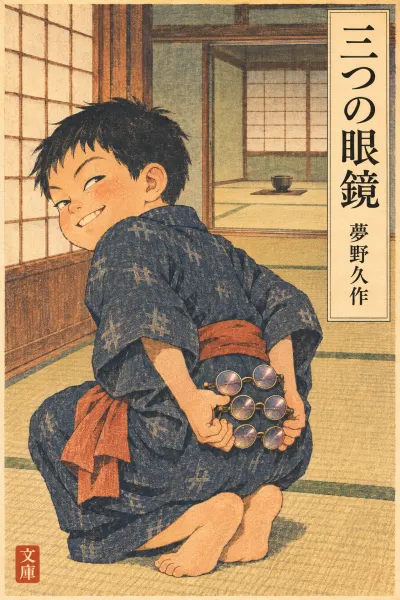
三つの眼鏡 Mitsu no Megane, part 1: The Hidden Spectacles and a Mother's Warning
In this part
After his mother's death, Takeo becomes very naughty. One day he hides the spectacles of his grandmother, his father and his sister, and the household falls into chaos: his sister burns her hand and his grandmother twists her foot. His father shuts him in the storehouse, where he puts on all three pairs of spectacles and sees his mother in a dream, and she gently warns him. From then on Takeo is so well-behaved that everyone is astonished.
AI translation · independently checked
武雄さんはお母さんが亡くなられてから大層わるくなりました。Ever since his mother passed away, Takeo had become very naughty indeed.
今日も何か面白いいたずらは無いかと考えてお座敷に来ましたら、机の上にお祖母さんの眼鏡がありました。Today, too, as he came into the sitting room wondering whether there was some fun mischief to be had, he found Grandmother's spectacles lying on the desk.
武雄さんは手を拍って喜んで、その眼鏡を懐に入れました。Takeo clapped his hands with delight and tucked the spectacles inside the front of his kimono.
それからお父さんとお姉さんの眼鏡も探し出して一所に懐に入れて、どこかへ遊びに行きました。Then he hunted out Father's and Sister's spectacles as well, tucked them into his kimono with the first pair, and went off somewhere to play.
お祖母さんがお座しきに帰って来られますと、眼鏡が無いのでまごまごしておられます。When Grandmother came back to the sitting room, her spectacles were gone, and she fumbled about, not knowing what to do.
お父さんは支度して出かけようとなさいますと、大切な金ぶちが無くなっています。When Father got ready and was about to go out, his precious gold-rimmed spectacles had vanished.
お姉さんが買いものから帰って来られますと、これも眼鏡がありません。When Sister came home from her shopping, her spectacles were missing too.
「ああ、きっと武雄さんよ。あたし困っちまうわ。眼鏡がなくちゃ、晩のお支度が出来やしない」"Oh, it must be Takeo. I just don't know what to do! Without my glasses I can't possibly get supper ready."
「弱ったな。俺も眼鏡が無くちゃ、向うへ行って用が足せない。仕方がない。やめる事にしよう」"What a nuisance. Without my glasses I can't get my business done over there either. It can't be helped. I'll just have to give it up."
「わたしも縫い物が出来やせん。お母さんが亡くなってからほんとに武雄はわるくなった」"I can't do my sewing either. Ever since his mother died, Takeo has really gone bad."
と三人は顔見合わせて困ってしまいました。So saying, the three of them looked at one another, quite at a loss.
仕方がないから何もかもやめて、三人で手探りに晩の支度を初めました。Since there was nothing else for it, they put everything else aside, and the three of them began making supper, feeling their way about.
そのうちに御飯の火を焚き付ける段になると、お姉さんはマッチの箱の蓋がすこし開いているのを気が付かずにマッチを摺ったために、マッチ箱の中のマッチに火がついて一時に燃えて、姉さんは手にやけどをしてしまいました。Before long, when it was time to light the fire for the rice, Sister struck a match without noticing that the lid of the matchbox was slightly open, and so the matches inside the box caught fire and all flared up at once, and she burned her hand.
姉さんが泣き出しましたので、祖母さんがお座しきから出てくると、暗い処で摺鉢につまずいて足をたがわかしてしまいました。When Sister burst into tears, Grandmother came out of the sitting room, tripped over a mortar bowl in the dark, and twisted her foot.
お父さんが驚いて介抱をし、今度は自分で御飯の支度をしようとしますと、今度は肝腎のマッチが無くなりました。Father, alarmed, tended to them both, and when he tried to make supper himself, this time the all-important matches had disappeared.
どこを探しても見当らないので、お父さんは近所までマッチを買いに行かれた留守に、武雄さんが帰って来て、He searched everywhere but could not find them, so Father went out to the neighbourhood shop to buy some, and while he was away Takeo came home,
「御飯御飯」"Supper! Supper!"
と怒鳴りながらお茶の間へ座り込みました。he bawled, and plumped himself down in the tea room.
お姉さんは泣いています。Sister was crying.
お祖母さんはうんうんうなっています。Grandmother was groaning and moaning.
「どうしたのです」"What's the matter?"
といくら尋ねても返事をしません。However many times he asked, nobody answered him.
武雄さんはお腹が空いて泣き出しました。Takeo was so hungry that he began to cry.
「お母ちアん」"Mama-a-a!"
けれどもお母さんは返事も何にもなさいませんでした。But his mother said not a word, nor did anything at all.
そこへお父さんが帰って来られて、Just then Father came home,
「武雄、お母さんが見たければ、その眼鏡を三つとも掛けて見つけろ。そうして御飯を食べさせてもらえ」"Takeo, if you want to see your mother, put on all three of those pairs of spectacles and find her. Then get her to give you your supper."
と云って、お倉の中へ入れられました。he said, and Takeo was shut up in the storehouse.
お倉の中へ入れられた武雄さんは、大あばれにあばれて泣きましたが、そのうちに泣く力も無くなる位お腹が空いてきました。Shut in the storehouse, Takeo kicked up a terrible fuss and cried, but before long he grew so hungry that he had no strength left even to cry.
力も何も無くなって冷たい板張りの上に寝ながら、「ああ、お母さんがいらっしゃると、こんな時には直ぐにあやまって御飯を食べさせて下さるのになあ」と思ってメソメソ泣いておりましたが、その中に不図、最前お父さんが、「そんなにお母さんに会いたければ、その眼鏡を三つともかけて探してみろ」と云われた言葉を思い出しました。Lying on the cold wooden floor with all his strength gone, he whimpered and sobbed, thinking, "Oh, if only Mother were here, at a time like this she would apologise for me straight away and give me my supper," but then all of a sudden he remembered what Father had said a little earlier: "If you want to see your mother so badly, put on all three of those pairs of spectacles and look for her."
武雄さんは眼鏡を取り出して三つとも掛けて見ました。Takeo took out the spectacles and tried putting on all three pairs.
けれどもいつまで待っても何も見えません。But however long he waited, he could see nothing.
しかし他にあてもありませんから、眼鏡をかけたままくら暗の中にじっとして、お母さんが見えるのを待っておりました。Still, he had nothing else to hope for, so he kept the spectacles on and stayed quite still in the darkness, waiting to see his mother.
すると不思議や、くら暗の中になつかしいなつかしいお母さんの姿がありありと見えて来ました。And then, wonder of wonders, there in the darkness the figure of his dear, dear mother appeared, as clear as could be.
お母さんは悲しそうな顔をして、こうおっしゃいました。His mother wore a sorrowful look and spoke these words:
「武雄や、お前はお母さまがいないからといっていたずらをするならば、私はもうお前を児と思いません。"Takeo, my child, if you get up to mischief just because your mother is no longer here, then I shall no longer think of you as my child.
お前がお母さんの事を忘れないように、私の心もお前の傍へいつまでもつきまとうております。Just as you must never forget your mother, so my heart shall stay close by your side for ever and ever.
どんなに蔭でわるい事をしていても、お母さんはちゃんと見ております。お前がわるい事をすればお母さんが笑われるからです。However much wrong you may do behind people's backs, your mother sees it all. For whenever you do wrong, it is your mother who is laughed at.
このことを忘れないで、どうぞよい子になってちょうだい。よいか、武雄さん、忘れてはなりませんよ……」Do not forget this, and please, be a good child. Do you hear me, Takeo? You must never forget……"
と云ううちに、みるみるお母さんの姿は消えて見えなくなりました。And even as she spoke, his mother's figure faded before his eyes until it could be seen no more.
「お母さん、待って頂戴。堪忍して頂戴。アレお母さん」"Mother, please wait! Please forgive me! Oh, Mother!"
と叫んで飛びつこうとしますと、これは夢で、いつの間にか武雄さんは床の上でねむっておりました。he cried, and tried to throw his arms around her, but it had all been a dream: at some point Takeo had fallen asleep on the floor.
その時お倉の戸があいて、お父さんが、At that moment the storehouse door opened, and Father
「さあ武雄、御飯を食べろ。これから悪い事をするときかないぞ」said, "Come along, Takeo, eat your supper. And if you get up to mischief from now on, I won't stand for it."
とおっしゃいました。So said Father.
武雄はそののちこの事をだれにも言いませんでしたが、武雄の音なしくなったのには誰もかれも皆驚いてしまいました。Takeo never told anyone about this afterwards, but everyone, every last one of them, was astonished at how well-behaved he had become.
Vocabulary
| Word | Meaning | JLPT |
|---|---|---|
| 大層たいそう | very, greatlySomewhat old-fashioned adverb, close to とても. | N2 |
| 懐ふところ | the fold at the front of a kimono, used as a pocketAlso used figuratively for 'one's purse' or 'bosom'. | — |
| まごまごまごまごする | to fumble about, not knowing what to dodictionary form: まごまごするOnomatopoeic word for confused, flustered dithering. | — |
| 金ぶちきんぶち | gold rims (here: gold-rimmed spectacles)dictionary form: 金縁縁 (ふち, 'rim') becomes ぶち by rendaku. | — |
| 用が足せないようをたす | to get one's business donedictionary form: 用を足すHere it means running an errand. In modern speech it is also a polite way of saying 'to go to the toilet'. | — |
| 手探りてさぐり | groping, feeling one's wayLiterally 'searching with the hands'. | — |
| 焚き付けるたきつける | to kindle, to light (a fire)Also used figuratively, meaning 'to egg someone on'. | — |
| つまずいてつまずく | to trip, to stumbledictionary form: 躓く | N2 |
| たがわかしてたがわかす | to twist or sprain (a joint) (dialectal)dictionary form: たがわかすRegional word related to たがう / たがえる ('to put out of place'). The standard word is くじく. | — |
| 介抱かいほう | nursing, tending to the injured | N1 |
| 肝腎かんじん | essential, all-importantAlso written 肝心. Literally 'liver and kidneys', both vital organs. | N1 |
| 留守るす | absence from homeHere 〜た留守に means 'while (he) was out'. | N4 |
| 怒鳴りどなる | to shout, to bawldictionary form: 怒鳴る | N2 |
| 堪忍かんにん | forgiveness堪忍して is a pleading, old-fashioned way to say 'forgive me'. | — |
Grammar
〜なくちゃ / 〜ちまう N3 without… / to end up (doing)
なくちゃ is the spoken contraction of なくては ('if… not'), and 困っちまう is the casual form of 困ってしまう. Contractions like these give the sister her colloquial voice.
あたし困っちまうわ。眼鏡がなくちゃ、晩のお支度が出来やしない
I just don't know what to do! Without my glasses I can't possibly get supper ready.
〜やしない / 〜やせん N2 emphatic negative: 'simply cannot / won't'
Verb stem + やしない is a strong spoken negative (from 〜はしない). The grandmother's 出来やせん is the older-sounding version with せん.
眼鏡がなくちゃ、晩のお支度が出来やしない
Without my glasses I can't possibly get supper ready.
〜位 (くらい) N3 to the extent that…
A clause + 位 describes how far a state goes. Here Takeo's hunger reaches the point where he cannot even cry.
泣く力も無くなる位お腹が空いてきました
he grew so hungry that he had no strength left even to cry
〜たければ N4 if you want to…
The conditional ば attached to the たい form gives 'if you want to'. The father follows it with blunt commands (見つけろ, もらえ).
お母さんが見たければ、その眼鏡を三つとも掛けて見つけろ
if you want to see your mother, put on all three of those pairs of spectacles and find her
〜からといって N3 just because…
This pattern rejects a reason as an excuse: being motherless is no justification for mischief.
お前はお母さまがいないからといっていたずらをするならば
if you get up to mischief just because your mother is no longer here
〜てはなりません N3 must not…
This is a formal, slightly old-fashioned prohibition, equivalent to 〜てはいけません. It suits the mother's gentle but solemn way of speaking.
忘れてはなりませんよ
You must never forget