Upper intermediate · JLPT N2
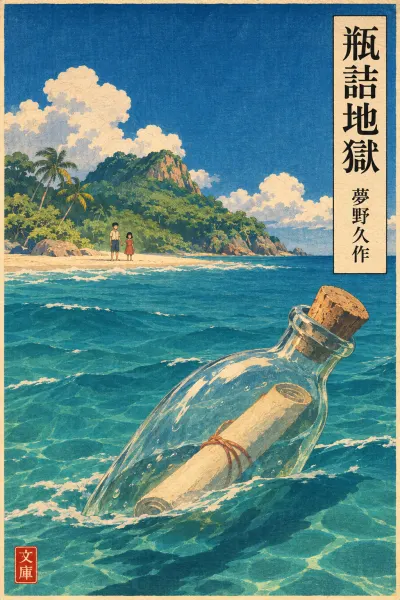
瓶詰地獄Binzumejigoku — Three Bottles from the Sea
- JLPT N2
- 6,655 characters
- 6 parts
- about 55 minutes
瓶詰地獄 is a short, unsettling story told entirely through documents. The messages are printed out of chronological order, so the reader pieces the story together backwards. What begins as a castaway tale of fruit, a hut built from a wrecked boat, daily prayers and a signal pole on the cliff turns into a confession of guilt, desire and terror of God's judgment. Tarō writes in an earnest, feverish voice, full of ellipses, repetitions and Biblical language. For a learner, the text is short and its situation is easy to follow. The challenge is the language. The cover note uses stiff classical letter style, and Tarō's letters mix polite desu/masu with archaic negatives and rare kanji. The last bottle, written entirely in katakana, tests whether you can read Japanese without kanji to separate the words.
Contents
Before you read
- Read the messages knowing they run backwards in time: the first bottle is the last thing written, and the katakana note is the first. Noticing how Tarō's tone changes from bottle to bottle is part of the story.
- Learn the archaic polite negatives and obligations before you start: 〜ませぬ (= 〜ません), 〜ねばならぬ (= 〜なければならない), 〜得ぬ/えぬ (= cannot), and 違いありませぬ (= 違いありません). They appear constantly in Tarō's letters.
- Pre-learn the core vocabulary of sin and faith, which carries the plot: 罪 (sin), 罰 (punishment), 神様 (God), 聖書 (Bible), 救い (rescue/salvation), 清い (pure). Also learn the island words 崖 (cliff) and 鱶 (ふか, shark).
- The opening village-office note is in sōrōbun (候文), a classical bureaucratic letter style. Don't get stuck on it. Read the translation, pick out the key facts (three bottles, found on the shore, sent to the institute), and move on to Tarō's letters.
- For the all-katakana third bottle, read it aloud slowly and mark word boundaries yourself. A child wrote it with no kanji and little punctuation, so it is often clearer once you hear it.
Words to know
The most useful words from the notes across the story.
| Word | Meaning | JLPT |
|---|---|---|
| なやましくなやましい | tormenting; disturbingly alluringdictionary form: 悩ましいOften has a sensual nuance: something that troubles the heart by its attraction. | N1 |
| 淵ふち | deep pool, deep waterNot the same word as 縁 (ふち, edge), although the reading is the same. | — |
| 一思いにひとおもいに | in one go, without hesitationSuggests doing something drastic decisively, before one can think twice. | — |
| 兄ダイきょうだい | siblings; brother and sisterdictionary form: 兄弟The child knows the kanji 兄 but writes the rest in kana. 兄弟 can cover a brother and sister together. | N5 |
| 肥ってふとる | to grow plump, put on fleshdictionary form: 肥るAn older spelling of 太る. | N4 |
| シマしま | islanddictionary form: 島This is the key setting word of the story. | N4 |
| 審判しんぱん | judgement最後の審判 is the Last Judgement. In sport, 審判 means a referee. | N3 |
| 諦らめてあきらめる | to resign oneself, to give updictionary form: 諦めるOlder okurigana. The modern spelling is 諦めて. | N3 |
| 罪つみ | sin, crime罪を犯す means to commit a sin or crime. | N3 |
| 困難こんなん | hardship, sufferingNormally read こんなん; here the author glosses it くるしみ (苦しみ) to give the sense of 'suffering'. | N3 |
| 泉いずみ | spring (of water) | N3 |
| 目標もくひょう | signal, landmarkNormally means 'goal'. The gloss めじるし (目印) gives the sense of 'a mark to be seen by'. | N3 |
| 決心けっしん | resolve, determinationHere Ayako's silent resolve to let the sea take her. | N3 |
| クラシテイマスくらす | to live; to get by day to daydictionary form: 暮らす暮らす is about everyday life, not about where someone lives (住む). | N3 |
| タスケたすける | to rescue, to savedictionary form: 助けるHere it is the ます-stem 助け, used in the pattern 〜に来る. | N3 |
Plot summary
Show the full summary (contains spoilers)
A village office sends three sealed bottles to a marine research institute. He and Ayako will throw themselves from the cliff to the sharks to atone for a sin they will not name. The second message explains the history. The children lived happily for years, studying and praying with their Bible. As they grew up, they fell in love with each other and were tormented by fear of sin. He sealed this letter while they were still 'pure' and begged God for death. The third message, in a young child's katakana, is the earliest: a cheerful plea for their parents to come and rescue them.
About the author
Yumeno Kyūsaku was the pen name of Sugiyama Taidō, a writer from Fukuoka. He is best known for his strange, dreamlike mystery and horror fiction, above all the novel Dogra Magra (ドグラ・マグラ), which is often counted among the great oddities of Japanese literature. Stories such as "Bottled Hell" (瓶詰地獄) also remain widely read. Alongside this darker work, he wrote many children's stories and fables, of which "The Mushrooms Hold a Meeting" is one. His career was cut short by his sudden death in 1936.