Intermediate · JLPT N3
三つの眼鏡Mitsu no Megane — Takeo and the Three Pairs of Spectacles
- JLPT N3
- 1,713 characters
- 1 part
- about 14 minutes
- 2 easier versions
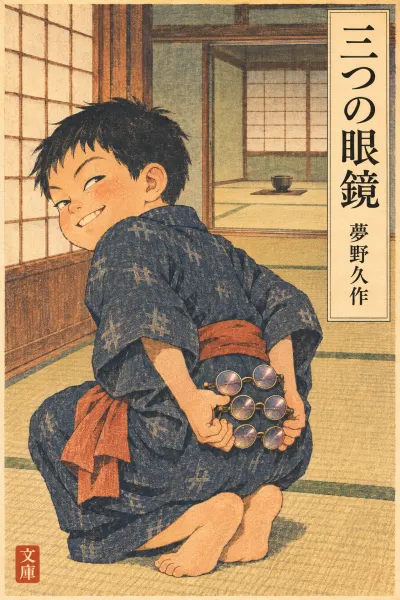
三つの眼鏡 is a short moral tale for children by Yumeno Kyūsaku, a writer best known for strange and unsettling fiction such as ドグラ・マグラ. This story is much gentler. After his mother dies, a small boy named Takeo turns mischievous. One day he hides the spectacles that his grandmother, his father and his sister all depend on, and the whole household is thrown into confusion. The tone is warm and quietly humorous, with a touch of the uncanny when the three pairs of glasses come into play. At about 1,700 characters, the story can be finished in one sitting. The narration uses polite です/ます storybook Japanese with honorifics for the adults, so it is a good place to practise reading respectful verb forms. The challenge is the dialogue. Each family member speaks in a distinct voice: the sister in casual, contracted speech, the father bluntly, the grandmother in old-fashioned forms, and the mother in tender, slightly archaic language. Telling these voices apart is good training for reading real Japanese fiction, where speech style often shows who is talking.
Contents
Easier versions
This story is also retold in simpler Japanese. Reading an easier version first makes the original much more approachable.
Before you read
- Learn to recognise contracted colloquial forms. 〜なくちゃ is short for 〜なくては ('have to'), 〜ちまう is a casual form of 〜てしまう, and 〜やしない (the sister) and 〜やせん (the grandmother) are emphatic negatives meaning 'can't possibly' or 'won't at all'.
- Use speech style to work out who is talking. The father says 俺 and 弱ったな, the sister uses feminine sentence endings such as 〜わ, and the mother in the dream uses formal, archaic phrasing like つきまとうております.
- The mother's warning is the key passage. Review 〜てはなりません ('you must not'), 〜からといって ('just because…'), and the conditional 〜たければ ('if you want to…') before you read it.
- Expect honorific verbs in the narration about the adults, such as なさいます and 帰って来られます. These are respectful forms of する and 帰って来る, not passive forms.
- Learn a few key words first: 眼鏡 (めがね), お祖母さん / 祖母さん (おばあさん), and お座しき (the zashiki, or formal sitting room, written with kana here instead of 座敷). Also note 位 (くらい, 'about' or 'to the extent that'), which recurs in the text.
Words to know
The most useful words from the notes across the story.
| Word | Meaning | JLPT |
|---|---|---|
| 留守るす | absence from homeHere 〜た留守に means 'while (he) was out'. | N4 |
| 大層たいそう | very, greatlySomewhat old-fashioned adverb, close to とても. | N2 |
| つまずいてつまずく | to trip, to stumbledictionary form: 躓く | N2 |
| 怒鳴りどなる | to shout, to bawldictionary form: 怒鳴る | N2 |
| 介抱かいほう | nursing, tending to the injured | N1 |
| 肝腎かんじん | essential, all-importantAlso written 肝心. Literally 'liver and kidneys', both vital organs. | N1 |
| 懐ふところ | the fold at the front of a kimono, used as a pocketAlso used figuratively for 'one's purse' or 'bosom'. | — |
| まごまごまごまごする | to fumble about, not knowing what to dodictionary form: まごまごするOnomatopoeic word for confused, flustered dithering. | — |
| 金ぶちきんぶち | gold rims (here: gold-rimmed spectacles)dictionary form: 金縁縁 (ふち, 'rim') becomes ぶち by rendaku. | — |
| 用が足せないようをたす | to get one's business donedictionary form: 用を足すHere it means running an errand. In modern speech it is also a polite way of saying 'to go to the toilet'. | — |
| 手探りてさぐり | groping, feeling one's wayLiterally 'searching with the hands'. | — |
| 焚き付けるたきつける | to kindle, to light (a fire)Also used figuratively, meaning 'to egg someone on'. | — |
| たがわかしてたがわかす | to twist or sprain (a joint) (dialectal)dictionary form: たがわかすRegional word related to たがう / たがえる ('to put out of place'). The standard word is くじく. | — |
| 堪忍かんにん | forgiveness堪忍して is a pleading, old-fashioned way to say 'forgive me'. | — |
Plot summary
Show the full summary (contains spoilers)
After his mother's death, Takeo becomes very naughty. One day he hides the spectacles of his grandmother, his father and his sister. Without them, nobody can manage: his sister burns her hand and his grandmother twists her foot. His father shuts Takeo in the storehouse. Alone there, Takeo puts on all three pairs of spectacles at once and, in a dream, sees his mother. She speaks to him gently and warns him about the way he has been behaving. From that day on, Takeo is so well-behaved that everyone around him is astonished.
About the author
Yumeno Kyūsaku was the pen name of Sugiyama Taidō, a writer from Fukuoka. He is best known for his strange, dreamlike mystery and horror fiction, above all the novel Dogra Magra (ドグラ・マグラ), which is often counted among the great oddities of Japanese literature. Stories such as "Bottled Hell" (瓶詰地獄) also remain widely read. Alongside this darker work, he wrote many children's stories and fables, of which "The Mushrooms Hold a Meeting" is one. His career was cut short by his sudden death in 1936.