Advanced · JLPT N1
文字禍Mojika — What the Letters Whisper
- JLPT N1
- 6,433 characters
- 4 parts
- about 54 minutes
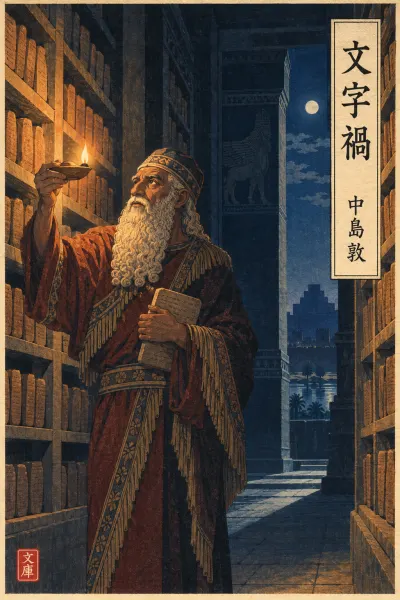
Set in Nineveh, capital of ancient Assyria, this short story begins with a rumour: strange voices are heard whispering in the royal library at night. King Ashur-bani-apal orders an elderly scholar to investigate whether spirits dwell in written characters, and the inquiry slowly turns into an unsettling meditation on what writing does to the people who use it. Nakajima Atsushi tells it with dry, ironic detachment, mixing scholarly pastiche, mock statistics and dark comedy with real questions about language, history and knowledge. The scholar may be on to something, and he may also be its next casualty. For learners the story is demanding, measured at N1. The narration uses formal literary Japanese with classical touches. The scholar's notes are written in stiff kanbun-style katakana, and many long Mesopotamian names appear in katakana. The reward is a story you can actually argue with: its ideas about letters becoming shadows of things, and about analysis draining meaning from the world, are compact enough to reread closely, and most of its difficulty comes from register rather than plot.
Contents
Before you read
- Make a short list of the main names before you start: アシュル・バニ・アパル (the king), ナブ・アヘ・エリバ (the old scholar) and イシュデイ・ナブ (the young historian). Most of the other katakana names (gods, demons, earlier kings) appear only once, and you can skim them without losing the thread.
- Read the scholar's notes as kanbun-style Japanese. They use katakana okurigana and classical forms such as 〜ガ如シ ("is like…"), the same pattern as 〜のごとき in the narration. Rewrite a sentence or two in modern hiragana Japanese to see the structure.
- The old scholar speaks in elderly role-language: わし for 'I', じゃ for だ, and the sentence-final わい. Learn to recognise these as a voice, not as new grammar.
- Watch for the narrator's formal patterns of reasoning: 〜に違いない (must be), 〜訳がない (cannot be), 〜より外はない (there is nothing for it but), the rhetorical どうして〜ようか (how could…?), and 〜こととて (since, being that). The irony often sits in how confidently these conclusions are drawn.
- Expect classical and archaic forms: 〜ねばならなかった (had to), honorific たもう for the king's actions, and old kanji spellings such as 埃及 (Egypt). Treat them as fixed expressions rather than analysing each one.
Words to know
The most useful words from the notes across the story.
| Word | Meaning | JLPT |
|---|---|---|
| 精霊せいれい | spirit, sprite (of nature or things) | — |
| 通っているとおる | to pass as, be accepted asdictionary form: 通る〜として通る: 'to pass for ~'. | N4 |
| 噂うわさ | rumour | N3 |
| 罹られたかかる | to fall ill (with a disease)dictionary form: 罹るUsually written かかる or 掛かる today; 罹 is the kanji specific to illness. Here in the honorific passive form for the king. | N3 |
| 中ったあたる | to be poisoned or affected by (something harmful)dictionary form: 中るAs in 食中毒 or 毒に中る; usually written 当たる today. | N3 |
| 統計とうけい | statisticsAn ironic modern word in an ancient setting. | N2 |
| 臆病おくびょう | cowardly, timid臆病になる = to become cowardly. | N1 |
| 不審ふしん | strange, puzzling, hard to account for不審者 = a suspicious person. | N1 |
| 欺きあざむく | to deceive, trickdictionary form: 欺くWritten-style; everyday speech uses だます (cf. 子供瞞し). | N1 |
| 齎してもたらす | to bring about, causedictionary form: 齎すUsually written in kana today. | N1 |
| 化けてばける | to turn into, transform (into something else)dictionary form: 化けるSame verb used of foxes taking human form. | N1 |
| 霊れい | spirit, soulKey word of the story. 文字の霊 means 'the spirit of letters'. | — |
| 跳梁ちょうりょう | running rampant, running riotLiterary; usually describes evil beings or villains acting freely. | — |
| 謀叛むほん | rebellion, revoltAlso written 謀反. | — |
| 俘囚ふしゅう | captive, prisoner of warOld-fashioned; the modern word is 捕虜 (ほりょ). | — |
Plot summary
Show the full summary (contains spoilers)
Whispering is heard in the royal library at Nineveh, and King Ashur-bani-apal orders the old scholar Nabu-ahe-eriba to find out whether writing has spirits. He stares at one character until it dissolves into meaningless lines, and he concludes that only a spirit gives letters sound and meaning. His survey of newly literate citizens records weaker eyes, baldness, cowardice and poor memory. He suspects that letters are mere shadows of things. He tells the young historian Ishdi-Nabu that only what is written on tablets truly exists. Afterwards he realises he has been praising the very spirits he fears, and that 'analysis' has stripped the world of meaning. He warns the king against worshipping writing and is placed under house arrest for it. Days later an earthquake brings hundreds of clay tablets down on him and crushes him to death.
About the author
Nakajima Atsushi was born in Tokyo into a family of scholars of the Chinese classics, a background that shows clearly in his style. After studying Japanese literature at Tokyo Imperial University, he taught at a girls' school in Yokohama. He later went to Palau, then under Japanese administration, to prepare Japanese-language textbooks for the South Seas Bureau. His small body of work includes several stories drawn from Chinese history and legend, among them Meijinden and Riryō.