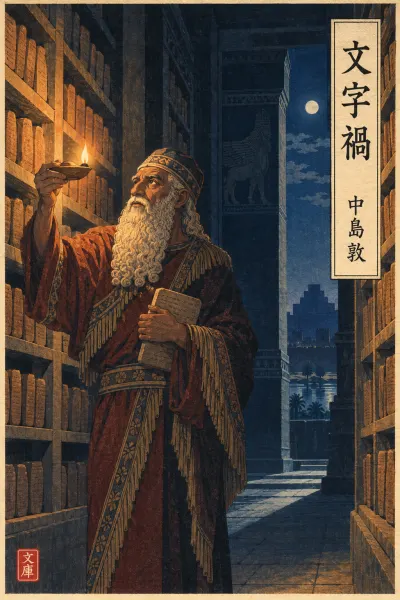
Part 3 of 4 · JLPT N1
文字禍 Mojika, part 3: The Old Scholar on What History Is
In this part
When the king falls ill, his physician dresses in the royal robes to fool the goddess of death. Some young men mock the old custom as irrational, and the old scholar blames their shallow rationalism on the spirits of writing. When the young historian Ishdi-Nabu asks what history really is, the old scholar declares that only what is written on clay tablets truly exists and that humans are servants of the letter-spirits, though he adds that the spirits also do harm, which he is now studying, and that Ishdi-Nabu's own doubts come from being poisoned by them.
AI translation · independently checked
たまたまアシュル・バニ・アパル大王が病に罹られた。It so happened that the Great King Ashur-bani-apal fell ill.
侍医のアラッド・ナナは、この病軽からずと見て、大王のご衣裳を借り、自らこれをまとうて、アッシリヤ王に扮した。The royal physician, Arad-Nana, judging the illness to be no light matter, borrowed the Great King's robes, put them on himself, and disguised himself as the King of Assyria.
これによって、死神エレシュキガルの眼を欺き、病を大王から己の身に転じようというのである。By this means he intended to deceive the eyes of Ereshkigal, goddess of death, and divert the illness from the Great King onto his own person.
この古来の医家の常法に対して、青年の一部には、不信の眼を向ける者がある。Some of the young men turned a sceptical eye on this time-honoured practice of physicians.
これは明らかに不合理だ、エレシュキガル神ともあろうものが、あんな子供瞞しの計に欺かれるはずがあるか、と、彼等は言う。This is plainly irrational, they say: how could a goddess of Ereshkigal's standing possibly be fooled by such a childish trick?
碩学ナブ・アヘ・エリバはこれを聞いて厭な顔をした。The learned Nabu-ahe-eriba heard this and pulled a sour face.
青年等のごとく、何事にも辻褄を合せたがることの中には、何かしらおかしな所がある。In wanting, as these young men do, to make everything add up, there is something faintly absurd.
全身垢まみれの男が、一ヶ所だけ、例えば足の爪先だけ、無闇に美しく飾っているような、そういうおかしな所が。The same sort of absurdity as a man caked in grime from head to foot who has lavishly decorated just one spot, say, the tips of his toes.
彼等は、神秘の雲の中における人間の地位をわきまえぬのじゃ。They simply do not understand man's place amid the clouds of mystery, that's what it is.
老博士は浅薄な合理主義を一種の病と考えた。The old scholar regarded shallow rationalism as a kind of disease.
そして、その病をはやらせたものは、疑もなく、文字の精霊である。And what had spread that disease was, beyond all doubt, the spirit of the letters.
ある日若い歴史家(あるいは宮廷の記録係)のイシュデイ・ナブが訪ねて来て老博士に言った。One day the young historian (or perhaps the court recorder) Ishdi-Nabu came to call and said to the old scholar:
歴史とは何ぞや?"What, pray, is history?"
と。So he asked.
老博士が呆れた顔をしているのを見て、若い歴史家は説明を加えた。Seeing the old scholar's dumbfounded look, the young historian added an explanation.
先頃のバビロン王シャマシュ・シュム・ウキンの最期について色々な説がある。There are various accounts of the end of Shamash-shum-ukin, the late King of Babylon.
自ら火に投じたことだけは確かだが、最後の一月ほどの間、絶望の余り、言語に絶した淫蕩の生活を送ったというものもあれば、毎日ひたすら潔斎してシャマシュ神に祈り続けたというものもある。That he threw himself into the fire is certain enough; but some say that during his last month or so, in the depths of despair, he led a life of unspeakable debauchery, while others say that every day he purified himself with single-minded devotion and prayed without ceasing to the god Shamash.
第一の妃ただ一人と共に火に入ったという説もあれば、数百の婢妾を薪の火に投じてから自分も火に入ったという説もある。One account has him entering the fire with his chief queen alone; another has him casting several hundred maids and concubines into the blazing firewood before going in himself.
何しろ文字通り煙になったこととて、どれが正しいのか一向見当がつかない。At any rate, since he quite literally went up in smoke, there is no telling which version is true.
近々、大王はそれらの中の一つを選んで、自分にそれを記録するよう命じたもうであろう。Before long the Great King will doubtless choose one of them and command me to record it.
これはほんの一例だが、歴史とはこれでいいのであろうか。This is only one example, but is history really all right like this?
賢明な老博士が賢明な沈黙を守っているのを見て、若い歴史家は、次のような形に問を変えた。Seeing the wise old scholar maintain a wise silence, the young historian recast his question in the following form.
歴史とは、昔、在った事柄をいうのであろうか?Does history mean the things that happened long ago?
それとも、粘土板の文字をいうのであろうか?Or does it mean the letters on the clay tablets?
獅子狩と、獅子狩の浮彫とを混同しているような所がこの問の中にある。There was something in this question that confused a lion hunt with a carved relief of a lion hunt.
博士はそれを感じたが、はっきり口で言えないので、次のように答えた。The scholar sensed this, but since he could not put it plainly into words, he answered as follows.
歴史とは、昔在った事柄で、かつ粘土板に誌されたものである。History is that which happened long ago and was moreover inscribed on clay tablets.
この二つは同じことではないか。Are these two not one and the same thing?
書洩らしは?"And the things left out?"
と歴史家が聞く。the historian asks.
書洩らし?"Left out?
冗談ではない、書かれなかった事は、無かった事じゃ。Don't talk rubbish! What was not written never happened.
芽の出ぬ種子は、結局初めから無かったのじゃわい。A seed that never sprouts, when all's said and done, never existed in the first place, I tell you.
歴史とはな、この粘土板のことじゃ。History, my boy, is this clay tablet here."
若い歴史家は情なさそうな顔をして、指し示された瓦を見た。The young historian, looking wretched, gazed at the tablet being pointed out to him.
それはこの国最大の歴史家ナブ・シャリム・シュヌ誌す所のサルゴン王ハルディア征討行の一枚である。It was one tablet of the account of King Sargon's campaign against Haldia, inscribed by Nabu-shalim-shunu, the greatest historian in the land.
話しながら博士の吐き棄てた柘榴の種子がその表面に汚らしくくっついている。Pomegranate seeds, which the scholar had spat out as he talked, clung unpleasantly to its surface.
ボルシッパなる明智の神ナブウの召使いたもう文字の精霊共の恐しい力を、イシュディ・ナブよ、君はまだ知らぬとみえるな。"It seems, Ishdi-Nabu, that you do not yet know the dreadful power of the spirits of the letters, who serve Nabū, god of wisdom at Borsippa.
文字の精共が、一度ある事柄を捉えて、これを己の姿で現すとなると、その事柄はもはや、不滅の生命を得るのじゃ。Once the letter-spirits have seized upon a thing and expressed it in their own shapes, that thing gains a life that can never die.
反対に、文字の精の力ある手に触れなかったものは、いかなるものも、その存在を失わねばならぬ。Conversely, anything at all that has not been touched by the mighty hand of the letter-spirits must lose its existence.
太古以来のアヌ・エンリルの書に書上げられていない星は、なにゆえに存在せぬか?Why is it that the stars not listed in the age-old book of Anu-Enlil do not exist?
それは、彼等がアヌ・エンリルの書に文字として載せられなかったからじゃ。Because they were never set down as letters in the book of Anu-Enlil, that's why.
大マルズック星(木星)が天界の牧羊者(オリオン)の境を犯せば神々の怒が降るのも、月輪の上部に蝕が現れればフモオル人が禍を蒙るのも、皆、古書に文字として誌されてあればこそじゃ。When the great Marduk star (Jupiter) trespasses on the borders of the Heavenly Shepherd (Orion), the wrath of the gods descends; when an eclipse appears on the upper part of the moon's disc, the people of Humōr suffer disaster; and all of it is so only because it stands written in letters in the ancient books.
古代スメリヤ人が馬という獣を知らなんだのも、彼等の間に馬という字が無かったからじゃ。If the ancient Sumerians knew no beast called the horse, that too was because they had no letter for 'horse' among them.
この文字の精霊の力ほど恐ろしいものは無い。There is nothing so fearsome as the power of these spirits of the letters.
君やわしらが、文字を使って書きものをしとるなどと思ったら大間違い。If you think that you and I use letters to do our writing, you are sorely mistaken.
わしらこそ彼等文字の精霊にこき使われる下僕じゃ。It is we who are the servants, worked to the bone by those spirits of the letters.
しかし、また、彼等精霊の齎す害も随分ひどい。And yet the harm those spirits bring is grievous indeed.
わしは今それについて研究中だが、君が今、歴史を誌した文字に疑を感じるようになったのも、つまりは、君が文字に親しみ過ぎて、その霊の毒気に中ったためであろう。I am studying that very matter now, and the fact that you have begun to doubt the letters that record history is, in the end, surely because you have grown too familiar with letters and been struck by the poisonous breath of their spirit."
Vocabulary
| Word | Meaning | JLPT |
|---|---|---|
| 罹られたかかる | to fall ill (with a disease)dictionary form: 罹るUsually written かかる or 掛かる today; 罹 is the kanji specific to illness. Here in the honorific passive form for the king. | N3 |
| 扮したふんする | to dress up as, disguise oneself asdictionary form: 扮するAlso used of actors playing a role. | — |
| 欺きあざむく | to deceive, trickdictionary form: 欺くWritten-style; everyday speech uses だます (cf. 子供瞞し). | N1 |
| 碩学せきがく | great scholar, man of profound learningLiterary and respectful. | — |
| 辻褄を合せたがるつじつまをあわせる | to make things consistent, make everything add up; (〜たがる) to be keen to make everything add updictionary form: 辻褄を合わせる辻褄が合わない = 'doesn't add up, is inconsistent'. | — |
| 浅薄せんぱく | shallow, superficialOf thinking or knowledge; the opposite is 深遠 (しんえん). | — |
| 最期さいご | one's last moments, deathSame sound as 最後 'last', but 最期 refers only to the end of a life. | — |
| 見当がつかないけんとうがつく | to be able to guess; (neg.) to have no ideadictionary form: 見当がつく一向 + negative = 'not at all'. | — |
| 混同こんどうする | to confuse (one thing with another), mix updictionary form: 混同するAとBを混同する = to confuse A with B. | — |
| 浮彫うきぼり | relief carvingdictionary form: 浮き彫りLiterally 'floating carving'. Figuratively 浮き彫りにする = to bring into relief, highlight. | — |
| 不滅ふめつ | immortal, indestructible不 'not' + 滅 'perish'. | — |
| 蒙るこうむる | to suffer (damage, misfortune); to receiveCommonly 被る; e.g. 被害を被る 'to suffer damage'. | — |
| こき使われるこきつかう | to work someone hard, slave-drivedictionary form: こき使うHere passive: 'to be worked to the bone'. | — |
| 中ったあたる | to be poisoned or affected by (something harmful)dictionary form: 中るAs in 食中毒 or 毒に中る; usually written 当たる today. | N3 |
Grammar
〜からず N1 classical negative of an い-adjective: 'not ~'
軽からず is the literary equivalent of 軽くない. The physician judged that the illness was 'not light', i.e. serious.
この病軽からずと見て
judging that this illness was no light matter
〜ともあろうものが N1 someone of such standing as ~ (should not do such a thing)
Attached to a person of high rank or status, it stresses that their behaviour is unworthy of them. Here the young men argue that a goddess like Ereshkigal could hardly be so easily fooled.
エレシュキガル神ともあろうものが、あんな子供瞞しの計に欺かれるはずがあるか
how could a goddess of Ereshkigal's standing possibly be fooled by such a childish trick?
〜というものもあれば、〜というものもある N2 some say ~, and others say ~
〜もあれば〜もある sets two contrasting possibilities side by side. Here it presents conflicting accounts of the Babylonian king's final days.
言語に絶した淫蕩の生活を送ったというものもあれば、毎日ひたすら潔斎してシャマシュ神に祈り続けたというものもある
some say he led a life of unspeakable debauchery, while others say that every day he purified himself and prayed without ceasing to the god Shamash
〜となると N2 once ~ happens; when it comes to ~
It introduces a condition from which a strong consequence follows. Once the letter-spirits capture something in writing, it becomes immortal.
これを己の姿で現すとなると、その事柄はもはや、不滅の生命を得るのじゃ
once they express it in their own shapes, that thing gains a life that can never die
〜ねばならぬ N2 must ~ (literary)
This is the old-fashioned form of 〜なければならない, with ぬ as the classical negative. It gives the old scholar's pronouncement a solemn, archaic ring.
いかなるものも、その存在を失わねばならぬ
anything at all must lose its existence
〜ばこそ N1 precisely because ~; only because ~
The conditional ば plus emphatic こそ singles out the one true reason. The scholar insists that these omens hold only because they are written in the old books.
皆、古書に文字として誌されてあればこそじゃ
all of it is so only because it stands written in letters in the ancient books