Part 1 of 4 · JLPT N1
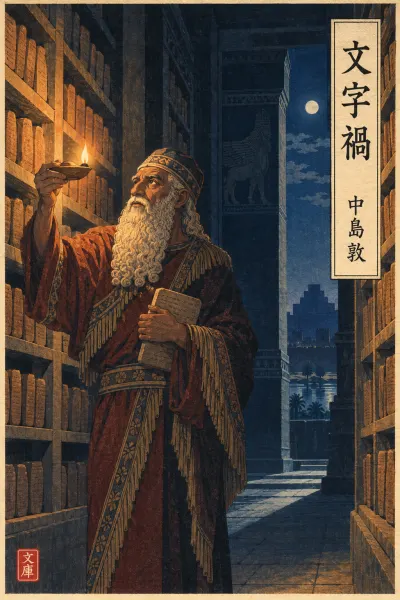
文字禍 Mojika, part 1: Whispers in the Clay Library
In this part
Rumours spread through the court at Nineveh that strange voices whisper in the royal library every night. After other explanations fail, King Ashur-bani-apal orders the old scholar Nabu-ahe-eriba to investigate whether there are spirits of writing. Staring at a single character for days, the scholar finds that it falls apart into meaningless lines, and he concludes that only a spirit can give letters their sound and meaning.
AI translation · independently checked
文字の霊などというものが、一体、あるものか、どうか。Whether such a thing as a spirit of letters really exists at all — who can say?
アッシリヤ人は無数の精霊を知っている。The Assyrians know of countless spirits.
夜、闇の中を跳梁するリル、その雌のリリツ、疫病をふり撒くナムタル、死者の霊エティンム、誘拐者ラバス等、数知れぬ悪霊共がアッシリヤの空に充ち満ちている。Lilu, who runs riot through the darkness at night; Lilitu, his female mate; Namtar, who scatters plague; Etimmu, the spirit of the dead; Labasu the abductor: evil spirits beyond number fill the skies of Assyria to overflowing.
しかし、文字の精霊については、まだ誰も聞いたことがない。Of a spirit of letters, however, no one has yet heard.
その頃――というのは、アシュル・バニ・アパル大王の治世第二十年目の頃だが――ニネヴェの宮廷に妙な噂があった。At that time, around the twentieth year of the reign of the Great King Ashur-bani-apal, a strange rumour was going about the court at Nineveh.
毎夜、図書館の闇の中で、ひそひそと怪しい話し声がするという。Every night, it was said, eerie voices could be heard whispering in the darkness of the library.
王兄シャマシュ・シュム・ウキンの謀叛がバビロンの落城でようやく鎮まったばかりのこととて、何かまた、不逞の徒の陰謀ではないかと探ってみたが、それらしい様子もない。The rebellion of the king's elder brother Shamash-shum-ukin had only just been put down at last with the fall of Babylon, so inquiries were made in case this was once again some plot by lawless men. Nothing of the kind was found.
どうしても何かの精霊どもの話し声に違いない。It could only be the voices of spirits of some sort, talking.
最近に王の前で処刑されたバビロンからの俘囚共の死霊の声だろうという者もあったが、それが本当でないことは誰にも判る。Some said they were the voices of the ghosts of the Babylonian captives lately executed before the king, but anyone could see that this was not so.
千に余るバビロンの俘囚はことごとく舌を抜いて殺され、その舌を集めたところ、小さな築山が出来たのは、誰知らぬ者のない事実である。It was a fact known to every living soul that the Babylonian captives, more than a thousand of them, had all had their tongues torn out before they were killed, and that the gathered tongues had made a small mound.
舌の無い死霊に、しゃべれる訳がない。Ghosts without tongues could not possibly speak.
星占や羊肝卜で空しく探索した後、これはどうしても書物共あるいは文字共の話し声と考えるより外はなくなった。After fruitless searches by astrology and by divination from sheep's livers, there was nothing for it but to conclude that these were the voices of the books, or else of the letters, talking among themselves.
ただ、文字の霊(というものが在るとして)とはいかなる性質をもつものか、それが皆目判らない。Only, what sort of nature a spirit of letters might have (supposing there were such a thing), nobody had the faintest idea.
アシュル・バニ・アパル大王は巨眼縮髪の老博士ナブ・アヘ・エリバを召して、この未知の精霊についての研究を命じたもうた。The Great King Ashur-bani-apal summoned the aged scholar Nabu-ahe-eriba, a man of huge eyes and tightly curled hair, and was graciously pleased to command him to study this unknown spirit.
その日以来、ナブ・アヘ・エリバ博士は、日ごと問題の図書館(それは、その後二百年にして地下に埋没し、更に二千三百年にして偶然発掘される運命をもつものであるが)に通って万巻の書に目をさらしつつ研鑽に耽った。From that day on, Doctor Nabu-ahe-eriba went every day to the library in question (which was fated, two hundred years later, to be buried beneath the earth, and after a further two thousand three hundred years to be dug up by chance), and, exposing his eyes to ten thousand volumes, lost himself in study.
両河地方では埃及と違って紙草を産しない。In the Land of the Two Rivers, unlike Egypt, no papyrus grows.
人々は、粘土の板に硬筆をもって複雑な楔形の符号を彫りつけておった。People carved intricate wedge-shaped signs into tablets of clay with a hard stylus.
書物は瓦であり、図書館は瀬戸物屋の倉庫に似ていた。Books were tiles, and the library resembled the storeroom of a crockery shop.
老博士の卓子(その脚には、本物の獅子の足が、爪さえそのままに使われている)の上には、毎日、累々たる瓦の山がうずたかく積まれた。Every day, upon the old scholar's table (its legs were real lion's feet, claws and all), tiles were piled up in towering heaps.
それら重量ある古知識の中から、彼は、文字の霊についての説を見出そうとしたが、無駄であった。From among all this weighty ancient learning he tried to find some doctrine concerning the spirits of letters, but in vain.
文字はボルシッパなるナブウの神の司りたもう所とより外には何事も記されていないのである。Nothing whatever was recorded except that letters are under the rule of the god Nabū of Borsippa.
文字に霊ありや無しやを、彼は自力で解決せねばならぬ。Whether letters have spirits or not, he must settle by his own efforts.
博士は書物を離れ、ただ一つの文字を前に、終日それと睨めっこをして過した。The scholar left his books, set a single letter before him, and spent whole days in a staring match with it.
卜者は羊の肝臓を凝視することによってすべての事象を直観する。A diviner grasps all things by intuition through gazing fixedly at a sheep's liver.
彼もこれに倣って凝視と静観とによって真実を見出そうとしたのである。Following his example, the scholar too sought to discover the truth through fixed gazing and quiet contemplation.
その中に、おかしな事が起った。Before long, a strange thing happened.
一つの文字を長く見詰めている中に、いつしかその文字が解体して、意味の無い一つ一つの線の交錯としか見えなくなって来る。As he stared at a single letter for a long time, the letter would at some point fall apart, until it looked like nothing but a meaningless tangle of separate lines.
単なる線の集りが、なぜ、そういう音とそういう意味とを有つことが出来るのか、どうしても解らなくなって来る。He could no longer understand at all how a mere bundle of lines could have that particular sound and that particular meaning.
老儒ナブ・アヘ・エリバは、生れて初めてこの不思議な事実を発見して、驚いた。The old scholar Nabu-ahe-eriba discovered this curious fact for the first time in his life, and was astonished.
今まで七十年の間当然と思って看過していたことが、決して当然でも必然でもない。What he had taken for granted and passed over for seventy years was by no means self-evident, nor in any way necessary.
彼は眼から鱗の落ちた思がした。He felt as though scales had fallen from his eyes.
単なるバラバラの線に、一定の音と一定の意味とを有たせるものは、何か?What is it that gives mere scattered lines a fixed sound and a fixed meaning?
ここまで思い到った時、老博士は躊躇なく、文字の霊の存在を認めた。When his thoughts had reached this point, the old scholar acknowledged without hesitation the existence of the spirit of letters.
魂によって統べられない手・脚・頭・爪・腹等が、人間ではないように、一つの霊がこれを統べるのでなくて、どうして単なる線の集合が、音と意味とを有つことが出来ようか。Just as hands, legs, head, nails, belly and the rest are not a human being unless a soul governs them, how could a mere assemblage of lines possess sound and meaning unless a single spirit governed it?
Vocabulary
| Word | Meaning | JLPT |
|---|---|---|
| 霊れい | spirit, soulKey word of the story. 文字の霊 means 'the spirit of letters'. | — |
| 精霊せいれい | spirit, sprite (of nature or things) | — |
| 跳梁ちょうりょう | running rampant, running riotLiterary; usually describes evil beings or villains acting freely. | — |
| 噂うわさ | rumour | N3 |
| 謀叛むほん | rebellion, revoltAlso written 謀反. | — |
| 俘囚ふしゅう | captive, prisoner of warOld-fashioned; the modern word is 捕虜 (ほりょ). | — |
| 皆目かいもく | (not) at allUsed only with a negative: 皆目わからない 'have no idea at all'. | — |
| 耽ったふける | to be absorbed in, to lose oneself indictionary form: 耽るTakes に: 研鑽に耽る 'to be absorbed in study'. | — |
| 楔形くさびがた | wedge-shaped楔形文字 (くさびがたもじ) means cuneiform script. | — |
| 睨めっこにらめっこ | staring match, staring contestColloquial and humorous, set against the formal surrounding prose. | — |
| 凝視ぎょうし | fixed gaze, staring intently | — |
| 看過かんか | overlooking, letting pass without notice | — |
| 躊躇ちゅうちょ | hesitation躊躇なく = without hesitation. | — |
| 統べすべる | to govern, to rule over, to unifydictionary form: 統べる | — |
Grammar
〜たばかり N4 has only just (done)
After the past form of a verb, ばかり marks an action that happened very recently. Here the rebellion had only just been put down, which is why a new plot seemed likely.
バビロンの落城でようやく鎮まったばかりのこととて
since it had only just been quelled at last by the fall of Babylon
〜こととて N1 because, since (it being the case that)
A literary way of giving a reason, close to 〜ことなので. It explains why the court suspected a plot.
ようやく鎮まったばかりのこととて、何かまた、不逞の徒の陰謀ではないかと探ってみたが
since it had only just been quelled, they looked into whether this might again be a plot by lawless men
〜に違いない N3 must be, surely is
Expresses a strong conviction based on reasoning. Together with どうしても it means 'it simply has to be'.
どうしても何かの精霊どもの話し声に違いない。
It could only be the voices of spirits of some sort, talking.
〜訳がない N3 there is no way that…
Flatly denies that something is possible or reasonable. Here a tongueless ghost cannot possibly talk.
舌の無い死霊に、しゃべれる訳がない。
Ghosts without tongues could not possibly speak.
〜より外はない N2 have no choice but to…
Means that there is no other option than the action before より. 外 is read ほか here; the form ほかない is more common today. With なくなった it means 'it came to the point where the only option left was…'.
これはどうしても書物共あるいは文字共の話し声と考えるより外はなくなった。
there was nothing left but to conclude that these were the voices of the books, or else of the letters.
どうして〜ようか N2 how could…? (rhetorical)
The volitional form plus か, after どうして, makes a rhetorical question that implies 'it cannot possibly be so'. The preceding 〜のでなくて gives the condition: 'unless a spirit governs it'.
どうして単なる線の集合が、音と意味とを有つことが出来ようか。
how could a mere assemblage of lines possess sound and meaning?