Part 2 of 4 · JLPT N1
文字禍 Mojika, part 2: The Ills That Letters Bring
In this part
Nabu-ahe-eriba questions newly literate people in Nineveh and compiles statistics: since learning letters, they report weaker eyes, coughs, baldness, dulled skills, cowardice and poor memory. He wonders whether a written character is merely the shadow of the real thing, so that people now grasp shadows instead of realities. His prime example is a book-mad old man who knows every detail of antiquity but nothing of the present, who is badly short-sighted and hunchbacked from reading, yet always oddly happy.
AI translation · independently checked
この発見を手始めに、今まで知られなかった文字の霊の性質が次第に少しずつ判って来た。With this discovery as a starting point, the nature of the spirits of writing, unknown until then, gradually came to light, little by little.
文字の精霊の数は、地上の事物の数ほど多い、文字の精は野鼠のように仔を産んで殖える。The spirits of writing are as numerous as the things upon the earth; they bear young and multiply like field mice.
ナブ・アヘ・エリバはニネヴェの街中を歩き廻って、最近に文字を覚えた人々をつかまえては、根気よく一々尋ねた。Nabu-ahe-eriba walked all over Nineveh, buttonholing people who had recently learned their letters and patiently questioning each one in turn.
文字を知る以前に比べて、何か変ったようなところはないかと。Was there anything about them, he asked, that seemed to have changed compared with the time before they knew letters?
これによって文字の霊の人間に対する作用を明らかにしようというのである。By this means he meant to make clear how the spirits of writing act upon human beings.
さて、こうして、おかしな統計が出来上った。And so, in this way, a curious set of statistics took shape.
それによれば、文字を覚えてから急に蝨を捕るのが下手になった者、眼に埃が余計はいるようになった者、今まで良く見えた空の鷲の姿が見えなくなった者、空の色が以前ほど碧くなくなったという者などが、圧倒的に多い。According to these statistics, overwhelmingly common were those who, since learning letters, had suddenly grown clumsy at catching lice; those who now got more dust in their eyes; those who could no longer see the eagle in the sky that they had once seen clearly; and those who said the sky was not as blue as it used to be.
「文字ノ精ガ人間ノ眼ヲ喰イアラスコト、猶、蛆虫ガ胡桃ノ固キ殻ヲ穿チテ、中ノ実ヲ巧ニ喰イツクスガ如シ」と、ナブ・アヘ・エリバは、新しい粘土の備忘録に誌した。"The Spirit of Letters doth devour the Eye of Man even as the Maggot pierceth the hard Shell of the Walnut and cunningly eateth up the Kernel within," Nabu-ahe-eriba recorded on a fresh clay memorandum.
文字を覚えて以来、咳が出始めたという者、くしゃみが出るようになって困るという者、しゃっくりが度々出るようになった者、下痢するようになった者なども、かなりの数に上る。A considerable number, too, said that since learning letters they had begun to cough, or were plagued by sneezing, or now often had hiccups, or suffered from diarrhoea.
「文字ノ精ハ人間ノ鼻・咽喉・腹等ヲモ犯スモノノ如シ」と、老博士はまた誌した。"The Spirit of Letters, it would seem, doth assail also the Nose, the Throat, the Belly and suchlike of Man," the old scholar noted once more.
文字を覚えてから、にわかに頭髪の薄くなった者もいる。There were some whose hair had suddenly thinned after they learned letters.
脚の弱くなった者、手足の顫えるようになった者、顎がはずれ易くなった者もいる。There were also those whose legs had weakened, those whose hands and feet had begun to tremble, and those whose jaws had become prone to slipping out of joint.
しかし、ナブ・アヘ・エリバは最後にこう書かねばならなかった。In the end, however, Nabu-ahe-eriba was obliged to write the following.
「文字ノ害タル、人間ノ頭脳ヲ犯シ、精神ヲ痲痺セシムルニ至ッテ、スナワチ極マル。」文字を覚える以前に比べて、職人は腕が鈍り、戦士は臆病になり、猟師は獅子を射損うことが多くなった。"The Harm of Letters reacheth its Utmost when it assaileth the Brain of Man and benumbeth his Spirit." Compared with the days before they learned letters, craftsmen's hands had lost their skill, warriors had grown cowardly, and hunters more often missed when they shot at lions.
これは統計の明らかに示す所である。This is what the statistics plainly show.
文字に親しむようになってから、女を抱いても一向楽しゅうなくなったという訴えもあった。There was even a complaint that, since becoming familiar with letters, one no longer took the slightest pleasure in holding a woman.
もっとも、こう言出したのは、七十歳を越した老人であるから、これは文字のせいではないかも知れぬ。Admittedly, the one who said this was an old man past seventy, so perhaps letters were not to blame.
ナブ・アヘ・エリバはこう考えた。Nabu-ahe-eriba reasoned as follows.
埃及人は、ある物の影を、その物の魂の一部と見做しているようだが、文字は、その影のようなものではないのか。The Egyptians, it seems, regard the shadow of a thing as part of that thing's soul; might not a written character be something like that shadow?
獅子という字は、本物の獅子の影ではないのか。Is the character for "lion" not the shadow of a real lion?
それで、獅子という字を覚えた猟師は、本物の獅子の代りに獅子の影を狙い、女という字を覚えた男は、本物の女の代りに女の影を抱くようになるのではないか。Is that not why a hunter who has learned the character for "lion" ends up aiming at a lion's shadow instead of a real lion, and why a man who has learned the character for "woman" ends up embracing a woman's shadow instead of a real woman?
文字の無かった昔、ピル・ナピシュチムの洪水以前には、歓びも智慧もみんな直接に人間の中にはいって来た。In the old days when there was no writing, before the Flood of Pir-napishtim, joy and wisdom alike came straight into people.
今は、文字の薄被をかぶった歓びの影と智慧の影としか、我々は知らない。Now we know only the shadow of joy and the shadow of wisdom, draped in the veil of letters.
近頃人々は物憶えが悪くなった。Lately people's memories have grown poor.
これも文字の精の悪戯である。This too is the mischief of the spirits of writing.
人々は、もはや、書きとめておかなければ、何一つ憶えることが出来ない。People can no longer remember a single thing unless they write it down.
着物を着るようになって、人間の皮膚が弱く醜くなった。Since people took to wearing clothes, human skin has grown weak and ugly.
乗物が発明されて、人間の脚が弱く醜くなった。Since vehicles were invented, human legs have grown weak and ugly.
文字が普及して、人々の頭は、もはや、働かなくなったのである。And now that writing has spread, people's heads simply no longer work.
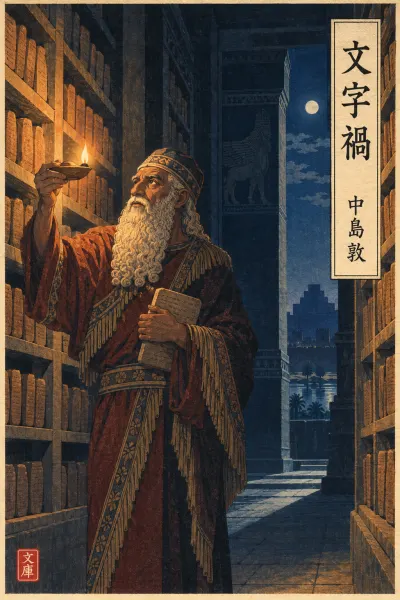
ナブ・アヘ・エリバは、ある書物狂の老人を知っている。Nabu-ahe-eriba knows a certain book-mad old man.
その老人は、博学なナブ・アヘ・エリバよりも更に博学である。This old man is even more learned than the learned Nabu-ahe-eriba himself.
彼は、スメリヤ語やアラメヤ語ばかりでなく、紙草や羊皮紙に誌された埃及文字まですらすらと読む。He reads with ease not only Sumerian and Aramaic but even the Egyptian script written on papyrus and parchment.
およそ文字になった古代のことで、彼の知らぬことはない。Of antiquity, so far as it has been set down in writing, there is nothing he does not know.
彼はツクルチ・ニニブ一世王の治世第何年目の何月何日の天候まで知っている。He knows even what the weather was on such-and-such a day of such-and-such a month in such-and-such a year of the reign of King Tukulti-Ninib I.
しかし、今日の天気は晴か曇か気が付かない。Yet he does not notice whether today is fair or cloudy.
彼は、少女サビツがギルガメシュを慰めた言葉をも諳んじている。He knows by heart even the words with which the maiden Sabitu consoled Gilgamesh.
しかし、息子をなくした隣人を何と言って慰めてよいか、知らない。Yet he does not know what to say to console a neighbour who has lost his son.
彼は、アダッド・ニラリ王の后、サンムラマットがどんな衣装を好んだかも知っている。He knows, too, what garments Sammuramat, queen of King Adad-nirari, liked to wear.
しかし、彼自身が今どんな衣服を着ているか、まるで気が付いていない。Yet he has not the faintest idea what clothes he himself has on at this moment.
何と彼は文字と書物とを愛したであろう!How he must have loved letters and books!
読み、諳んじ、愛撫するだけではあきたらず、それを愛するの余りに、彼は、ギルガメシュ伝説の最古版の粘土板を噛砕き、水に溶かして飲んでしまったことがある。Not content merely to read them, recite them and caress them, he once, out of sheer excess of love, chewed up the clay tablet of the oldest version of the Gilgamesh legend, dissolved it in water and drank it down.
文字の精は彼の眼を容赦なく喰い荒し、彼は、ひどい近眼である。The spirits of writing have ravaged his eyes without mercy, and he is badly short-sighted.
余り眼を近づけて書物ばかり読んでいるので、彼の鷲形の鼻の先は、粘土板と擦れ合って固い胼胝が出来ている。Because he is forever reading with his eyes pressed close to the page, the tip of his hooked, eagle-like nose has rubbed against the clay tablets until it has grown a hard callus.
文字の精は、また、彼の脊骨をも蝕み、彼は、臍に顎のくっつきそうな傴僂である。The spirits of writing have also eaten into his spine, and he is a hunchback whose chin all but touches his navel.
しかし、彼は、恐らく自分が傴僂であることを知らないであろう。Yet he very likely does not know that he is a hunchback.
傴僂という字なら、彼は、五つの異った国の字で書くことが出来るのだが。The word "hunchback," mind you, he could write in the scripts of five different countries.
ナブ・アヘ・エリバ博士は、この男を、文字の精霊の犠牲者の第一に数えた。The learned Nabu-ahe-eriba counted this man foremost among the victims of the spirits of writing.
ただ、こうした外観の惨めさにもかかわらず、この老人は、実に――全く羨ましいほど――いつも幸福そうに見える。And yet, for all his wretched appearance, this old man always looks truly, quite enviably, happy.
これが不審といえば、不審だったが、ナブ・アヘ・エリバは、それも文字の霊の媚薬のごとき奸猾な魔力のせいと見做した。That was strange, if one cared to call it so, but Nabu-ahe-eriba put it down, too, to the sly, love-potion-like sorcery of the spirits of writing.
Vocabulary
| Word | Meaning | JLPT |
|---|---|---|
| 次第にしだいに | gradually, by degreesOften paired with 少しずつ for emphasis, as here. | — |
| 精霊せいれい | spirit, spriteUsed interchangeably with 霊 and 精 in this story for the spirits living in written characters. | — |
| 根気よくこんきよい | patiently, persistentlydictionary form: 根気よい根気 = stamina for tedious work. | — |
| 統計とうけい | statisticsAn ironic modern word in an ancient setting. | N2 |
| 備忘録びぼうろく | memorandum, notebookLiterally 'a record to prepare against forgetting'; here it is a clay tablet. | — |
| 臆病おくびょう | cowardly, timid臆病になる = to become cowardly. | N1 |
| 見做してみなす | to regard as, to considerdictionary form: 見做すAをBと見做す = regard A as B. Usually written みなす today. | — |
| 物憶えものおぼえ | memory, ability to remember thingsdictionary form: 物覚え物覚えが悪い = to have a poor memory. 憶 is an older spelling of 覚. | — |
| 諳んじてそらんじる | to know by heart, to recite from memorydictionary form: 諳んじるLiterary; everyday Japanese says 暗記する. | — |
| 傴僂せむし | hunchbackOld word, now considered offensive and avoided. | — |
| 犠牲者ぎせいしゃ | victim犠牲 = sacrifice; 〜者 = person. | — |
| 不審ふしん | strange, puzzling, hard to account for不審者 = a suspicious person. | N1 |
| 奸猾かんかつ | cunning, wilyRare literary word; 狡猾 (こうかつ) is the common equivalent. | — |
Grammar
〜ては N2 repeatedly do A and then B
The て-form plus は marks an action that happens over and over, each time followed by the next action. Here he keeps catching people and questioning them, one after another.
最近に文字を覚えた人々をつかまえては、根気よく一々尋ねた
buttonholing people who had recently learned their letters and patiently questioning each one in turn
〜ガ如シ / 〜のごとき N1 just as, like
Classical ごとし means 'is like'. Its attributive form ごとき modifies a noun (媚薬のごとき魔力, 'love-potion-like magic' in the last sentence). The katakana note style gives the scholar's records a stiff, archaic flavour.
中ノ実ヲ巧ニ喰イツクスガ如シ
even as it cunningly eateth up the Kernel within
〜ねばならなかった N2 had to, was obliged to
ねば is a literary form of なければ, so 書かねばならなかった equals 書かなければならなかった. It suggests that he wrote this reluctantly, compelled by the evidence.
ナブ・アヘ・エリバは最後にこう書かねばならなかった。
In the end, Nabu-ahe-eriba was obliged to write the following.
AばかりでなくBまで N3 not only A but even B
ばかりでなく adds B to A, and まで stresses that B is surprising or extreme. Here it means 'not only these languages, but even Egyptian script'.
スメリヤ語やアラメヤ語ばかりでなく、紙草や羊皮紙に誌された埃及文字まですらすらと読む
He reads with ease not only Sumerian and Aramaic but even the Egyptian script written on papyrus and parchment
〜の余り(に) N2 out of an excess of, so much that
An excessive feeling leads to an extreme action. The usual form is 愛するあまり; the extra の before 余り is an older literary style.
それを愛するの余りに、彼は、ギルガメシュ伝説の最古版の粘土板を噛砕き
out of sheer excess of love, he chewed up the clay tablet of the oldest version of the Gilgamesh legend
〜にもかかわらず N3 despite, in spite of
It follows a noun or clause and introduces a result that goes against expectation. His wretched appearance would suggest misery, yet he looks happy.
こうした外観の惨めさにもかかわらず、この老人は、実に――全く羨ましいほど――いつも幸福そうに見える
for all his wretched appearance, this old man always looks truly, quite enviably, happy