Part 4 of 4 · JLPT N1
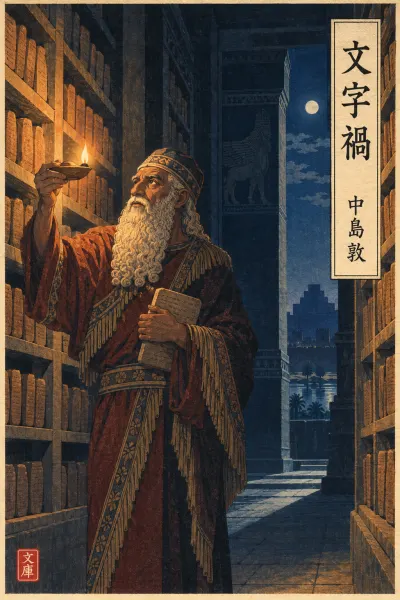
文字禍 Mojika, part 4: The Old Scholar Buried by His Books
In this part
After the young historian leaves, Nabu-ahe-eriba realises he has been praising the spirits of writing himself, and that an illness of 'analysis' has stripped houses, bodies and customs of their meaning. Afraid, he hurries out a report warning the king against blind worship of writing, which angers Ashur-bani-apal and gets him placed under house arrest. A few days later an earthquake strikes, and hundreds of clay tablets fall on him and crush him to death.
AI translation · independently checked
若い歴史家は妙な顔をして帰って行った。The young historian went home with a strange look on his face.
老博士はなおしばらく、文字の霊の害毒があの有為な青年をも害おうとしていることを悲しんだ。For some while longer the old scholar grieved that the poison of the spirits of writing was about to harm even that promising young man.
文字に親しみ過ぎてかえって文字に疑を抱くことは、決して矛盾ではない。To grow so familiar with writing that one comes, on the contrary, to doubt it is by no means a contradiction.
先日博士は生来の健啖に任せて羊の炙肉をほとんど一頭分も平らげたが、その後当分、生きた羊の顔を見るのも厭になったことがある。Only the other day the scholar, giving free rein to his natural hearty appetite, had polished off very nearly a whole sheep's worth of roast mutton, and for some time afterwards could not bear even to look a living sheep in the face.
青年歴史家が帰ってからしばらくして、ふと、ナブ・アヘ・エリバは、薄くなった縮れっ毛の頭を抑えて考え込んだ。A while after the young historian had left, Nabu-ahe-eriba suddenly clutched his thinning, frizzy-haired head and sank into thought.
今日は、どうやら、わしは、あの青年に向って、文字の霊の威力を讃美しはせなんだか?Today, it seems, did I not go and sing the praises of the power of the spirits of writing to that young fellow?
いまいましいことだ、と彼は舌打をした。Confound it! — and he clicked his tongue.
わしまでが文字の霊にたぶらかされておるわ。So even I have been hoodwinked by the spirits of writing, eh!
実際、もう大分前から、文字の霊がある恐しい病を老博士の上に齎していたのである。In truth, for quite some time now, the spirits of writing had been visiting a certain dreadful illness upon the old scholar.
それは彼が文字の霊の存在を確かめるために、一つの字を幾日もじっと睨み暮した時以来のことである。It dated from the time when, to confirm that the spirits of writing existed, he had spent day after day glaring fixedly at a single character.
その時、今まで一定の意味と音とを有っていたはずの字が、忽然と分解して、単なる直線どもの集りになってしまったことは前に言った通りだが、それ以来、それと同じような現象が、文字以外のあらゆるものについても起るようになった。As already related, on that occasion a character that ought to have had a fixed meaning and sound had suddenly come apart and turned into a mere cluster of straight lines; and since then, the same kind of thing had begun to happen with everything else besides writing as well.
彼が一軒の家をじっと見ている中に、その家は、彼の眼と頭の中で、木材と石と煉瓦と漆喰との意味もない集合に化けてしまう。While he stood gazing fixedly at a house, that house would turn, in his eyes and in his head, into a meaningless assembly of timber, stone, brick and plaster.
これがどうして人間の住む所でなければならぬか、判らなくなる。He could no longer tell why this should have to be a place where human beings lived.
人間の身体を見ても、その通り。The same was true when he looked at a human body.
みんな意味の無い奇怪な形をした部分部分に分析されてしまう。It would all be analysed into separate parts of bizarre and meaningless shape.
どうして、こんな恰好をしたものが、人間として通っているのか、まるで理解できなくなる。He became utterly unable to understand how a thing of such shape could pass for a human being.
眼に見えるものばかりではない。Nor was it only things visible to the eye.
人間の日常の営み、すべての習慣が、同じ奇体な分析病のために、全然今までの意味を失ってしまった。The daily business of human life, every custom, had completely lost the meaning it had held until now, all because of the same peculiar disease of analysis.
もはや、人間生活のすべての根柢が疑わしいものに見える。Now the very foundations of human life all looked doubtful.
ナブ・アヘ・エリバ博士は気が違いそうになって来た。Dr. Nabu-ahe-eriba began to feel he was about to lose his mind.
文字の霊の研究をこれ以上続けては、しまいにその霊のために生命をとられてしまうぞと思った。If he carried his research into the spirits of writing any further, he thought, those spirits would end up taking his life.
彼は怖くなって、早々に研究報告を纏め上げ、これをアシュル・バニ・アパル大王に献じた。Growing frightened, he hastily put together a report of his research and presented it to the Great King Ashur-bani-apal.
但し、中に、若干の政治的意見を加えたことはもちろんである。It goes without saying, however, that he added a certain amount of political opinion to it.
武の国アッシリヤは、今や、見えざる文字の精霊のために、全く蝕まれてしまった。Assyria, kingdom of arms, has now been wholly eaten away by the invisible spirits of writing.
しかも、これに気付いている者はほとんど無い。Moreover, scarcely anyone is aware of it.
今にして文字への盲目的崇拝を改めずんば、後に臍を噬むとも及ばぬであろう云々。Should this blind worship of writing not be amended even now, hereafter shall it be too late, though one bite one's own navel in remorse, and so forth.
文字の霊が、この讒謗者をただで置く訳が無い。The spirits of writing were hardly going to let such a slanderer off scot-free.
ナブ・アヘ・エリバの報告は、いたく大王のご機嫌を損じた。Nabu-ahe-eriba's report gravely displeased the Great King.
ナブウ神の熱烈な讃仰者で当時第一流の文化人たる大王にしてみれば、これは当然のことである。For the Great King, an ardent devotee of the god Nabū and a man of culture of the very first rank in his day, this was only natural.
老博士は即日謹慎を命ぜられた。The old scholar was ordered into confinement that very day.
大王の幼時からの師傅たるナブ・アヘ・エリバでなかったら、恐らく、生きながらの皮剥に処せられたであろう。Had he not been Nabu-ahe-eriba, the Great King's tutor since childhood, he would very likely have been sentenced to be flayed alive.
思わぬご不興に愕然とした博士は、直ちに、これが奸譎な文字の霊の復讐であることを悟った。Aghast at this unexpected royal displeasure, the scholar realised at once that it was the revenge of the cunning spirits of writing.
しかし、まだこれだけではなかった。But that was not yet the end of it.
数日後ニネヴェ・アルベラの地方を襲った大地震の時、博士は、たまたま自家の書庫の中にいた。When a great earthquake struck the region of Nineveh and Arbela a few days later, the scholar happened to be in the library of his own house.
彼の家は古かったので、壁が崩れ書架が倒れた。His house was old, so the walls crumbled and the bookshelves toppled.
夥しい書籍が――数百枚の重い粘土板が、文字共の凄まじい呪の声と共にこの讒謗者の上に落ちかかり、彼は無慙にも圧死した。A great mass of books — several hundred heavy clay tablets — came crashing down upon this slanderer amid the terrible cursing voices of the characters, and he was miserably crushed to death.
(昭和十七年二月)(February, 1942)
Vocabulary
| Word | Meaning | JLPT |
|---|---|---|
| 害毒がいどく | poison, harmful influenceFigurative: a corrupting influence rather than literal poison. | — |
| 平らげたたいらげる | to eat up, polish offdictionary form: 平らげるOriginally 'to subdue, pacify'; colloquially 'to finish off a meal'. | — |
| いまいましいいまいましい | annoying, vexing, confoundedExpresses irritation at something one can do nothing about. | — |
| たぶらかされてたぶらかす | to trick, bewitch, lead astraydictionary form: たぶらかすOften used of foxes or spirits deceiving people. | — |
| 齎してもたらす | to bring about, causedictionary form: 齎すUsually written in kana today. | N1 |
| 忽然こつぜん | suddenly, all at onceLiterary; used with と. | — |
| 化けてばける | to turn into, transform (into something else)dictionary form: 化けるSame verb used of foxes taking human form. | N1 |
| 通っているとおる | to pass as, be accepted asdictionary form: 通る〜として通る: 'to pass for ~'. | N4 |
| 蝕まれてむしばむ | to eat away at, corrodedictionary form: 蝕むAs in 虫歯 (decayed tooth); used of illness or corruption. | — |
| 臍を噬むほぞをかむ | to regret bitterly (when it is too late)Idiom: trying to bite one's own navel, which is impossible. | — |
| 讒謗者ざんぼうしゃ | slanderer, detractorVery literary; 讒謗 = slander and abuse. | — |
| 機嫌を損じたきげんをそんじる | to offend, put someone in a bad mooddictionary form: 機嫌を損じるWith ご機嫌 it refers respectfully to a superior's mood. | — |
| 謹慎きんしん | confinement to one's home (as punishment)Also 'good conduct, self-restraint' in other contexts. | — |
| 圧死あっし | being crushed to death | — |
Grammar
〜はせなんだ N1 did (not) …; old-fashioned negative past
なんだ is an old Kansai-flavoured negative past ending, equal to なかった; せなんだ = しなかった. Inserting は (讃美しはせなんだ) adds emphasis, and with か it becomes a rueful 'Didn't I go and…?'
今日は、どうやら、わしは、あの青年に向って、文字の霊の威力を讃美しはせなんだか?
Today, it seems, did I not go and sing the praises of the power of the spirits of writing to that young fellow?
〜ているうち(中)に N3 while …; in the course of …
Marks a period during which a change occurs unnoticed. Here 中 is read うち: while he keeps staring, the house dissolves into parts.
彼が一軒の家をじっと見ている中に、その家は、彼の眼と頭の中で、木材と石と煉瓦と漆喰との意味もない集合に化けてしまう。
While he stood gazing fixedly at a house, that house would turn, in his eyes and in his head, into a meaningless assembly of timber, stone, brick and plaster.
〜ずんば N1 if (one) does not …
Classical conditional from negative ず + は (voiced to ば). 改めずんば means 'unless it is amended', giving the report a stiff, solemn tone.
今にして文字への盲目的崇拝を改めずんば、後に臍を噬むとも及ばぬであろう云々。
Should this blind worship of writing not be amended even now, hereafter shall it be too late, though one bite one's own navel in remorse, and so forth.
〜訳が無い N3 there is no way that …
Denies any possibility strongly. ただで置く訳が無い: there was no chance the spirits would leave him unpunished.
文字の霊が、この讒謗者をただで置く訳が無い。
The spirits of writing were hardly going to let such a slanderer off scot-free.
〜にしてみれば N2 from the standpoint of …; for …
Presents a judgement from a particular person's viewpoint. Here it explains why the king, given who he was, was naturally offended.
ナブウ神の熱烈な讃仰者で当時第一流の文化人たる大王にしてみれば、これは当然のことである。
For the Great King, an ardent devotee of the god Nabū and a man of culture of the very first rank in his day, this was only natural.
〜でなかったら、〜であろう N3 if it had not been …, (X) would probably have …
A counterfactual: the condition did not hold, so the result did not happen. であろう is the formal written form of だろう.
大王の幼時からの師傅たるナブ・アヘ・エリバでなかったら、恐らく、生きながらの皮剥に処せられたであろう。
Had he not been Nabu-ahe-eriba, the Great King's tutor since childhood, he would very likely have been sentenced to be flayed alive.