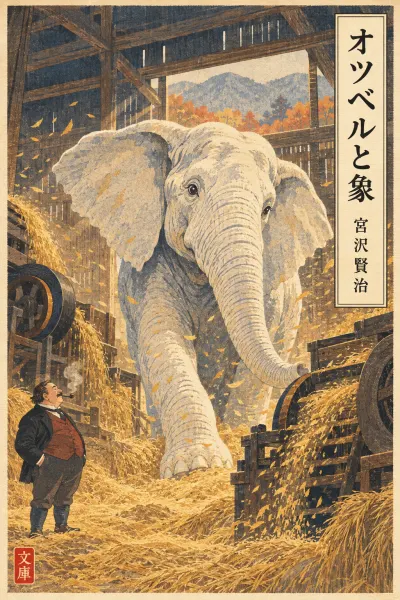
Part 3 of 4 · JLPT N2
オツベルと象(第五日曜) Otsuberu to Zō, part 3: The Moon, the Letter, and the Charge
In this part
Otsuberu treats the elephant more and more cruelly until the elephant collapses and says goodbye to the moon. The moon tells him to write to his friends, and a child in red brings him paper and an inkstone and carries his letter to the mountains. The wild elephants storm toward Otsuberu's mansion; Otsuberu calmly barricades the shed and the gate, while his terrified farmhands tie white cloths to their arms to show they surrender.
AI translation · independently checked
オツベルかね、そのオツベルは、おれも云おうとしてたんだが、居なくなったよ。Otsuberu, you say? Well, that Otsuberu, and I was just about to tell you, he's gone.
まあ落ちついてききたまえ。Now, now, settle down and listen.
前にはなしたあの象を、オツベルはすこしひどくし過ぎた。Otsuberu was a little too rough on that elephant I told you about.
しかたがだんだんひどくなったから、象がなかなか笑わなくなった。The way he treated him got worse and worse, until the elephant hardly smiled anymore.
時には赤い竜の眼をして、じっとこんなにオツベルを見おろすようになってきた。Sometimes he'd get the eyes of a red dragon and stare down at Otsuberu, hard and still, like this.
ある晩象は象小屋で、三把の藁をたべながら、十日の月を仰ぎ見て、One night in the elephant hut, the elephant was eating his three bundles of straw, and he looked up at the ten-day moon
「苦しいです。サンタマリア。」と云ったということだ。and said, "I'm suffering. Santa Maria." That's how the story goes.
こいつを聞いたオツベルは、ことごと象につらくした。When Otsuberu heard that, he was hard on the elephant at every turn.
ある晩、象は象小屋で、ふらふら倒れて地べたに座り、藁もたべずに、十一日の月を見て、One night in the elephant hut, the elephant staggered, dropped down to sit on the bare ground, didn't even eat his straw, looked at the eleven-day moon,
「もう、さようなら、サンタマリア。」と斯う言った。and said, "It's goodbye now, Santa Maria."
「おや、何だって? さよならだ?」月が俄かに象に訊く。"Well, what's this? Goodbye, you say?" the moon suddenly asked the elephant.
「ええ、さよならです。サンタマリア。」"Yes, goodbye. Santa Maria."
「何だい、なりばかり大きくて、からっきし意気地のないやつだなあ。仲間へ手紙を書いたらいいや。」月がわらって斯う云った。"What's this? All that size and not an ounce of backbone! Why not write a letter to your friends?" the moon said with a laugh.
「お筆も紙もありませんよう。」象は細ういきれいな声で、しくしくしくしく泣き出した。"But I haven't got a brush or any paper, no I haven't." And in a thin, pretty little voice, the elephant began to sob and sob and sob.
「そら、これでしょう。」すぐ眼の前で、可愛い子どもの声がした。"Here, this is what you want, isn't it?" came a sweet child's voice right in front of his eyes.
象が頭を上げて見ると、赤い着物の童子が立って、硯と紙を捧げていた。When the elephant lifted his head and looked, there stood a child in a red robe, holding up an inkstone and paper.
象は早速手紙を書いた。The elephant wrote a letter right away.
「ぼくはずいぶん眼にあっている。みんなで出て来て助けてくれ。」"I'm having an awful time. Please all come out here and help me."
童子はすぐに手紙をもって、林の方へあるいて行った。The child took the letter at once and walked off toward the forest.
赤衣の童子が、そうして山に着いたのは、ちょうどひるめしごろだった。It was right around lunchtime when the child in red, going along like that, reached the mountains.
このとき山の象どもは、沙羅樹の下のくらがりで、碁などをやっていたのだが、額をあつめてこれを見た。At that moment the elephants of the mountains were playing go and such in the shade under the sal trees, but they put their heads together and read it.
「ぼくはずいぶん眼にあっている。みんなで出てきて助けてくれ。」"I'm having an awful time. Please all come out here and help me."
象は一せいに立ちあがり、まっ黒になって吠えだした。The elephants all leapt to their feet at once, a solid mass of black, and started to roar.
「オツベルをやっつけよう」議長の象が高く叫ぶと、"Let's crush Otsuberu!" the chairman elephant cried out loudly,
「おう、でかけよう。グララアガア、グララアガア。」みんながいちどに呼応する。and "Yeah, let's go! Grrraa-gaaa! Grrraa-gaaa!" they all answered at once.
さあ、もうみんな、嵐のように林の中をなきぬけて、グララアガア、グララアガア、野原の方へとんで行く。And off they go now, every one of them, crying their way through the forest like a storm, Grrraa-gaaa, grrraa-gaaa, racing off toward the open fields.
どいつもみんなきちがいだ。Every last one of them was raving mad.
小さな木などは根こぎになり、藪や何かもめちゃめちゃだ。Little trees got torn up by the roots, and the bushes and whatnot were smashed to pieces.
グワア グワア グワア グワア、花火みたいに野原の中へ飛び出した。Gwaaa, gwaaa, gwaaa, gwaaa! Like fireworks they shot out into the fields.
それから、何の、走って、走って、とうとう向うの青くかすんだ野原のはてに、オツベルの邸の黄いろな屋根を見附けると、象はいちどに噴火した。Then, my, how they ran and ran, till at last, way off at the edge of the fields, hazy and blue, they spotted the yellow roof of Otsuberu's mansion, and the elephants all erupted at once.
グララアガア、グララアガア。Grrraa-gaaa! Grrraa-gaaa!
その時はちょうど一時半、オツベルは皮の寝台の上でひるねのさかりで、烏の夢を見ていたもんだ。It was half past one just then, and Otsuberu was in the thick of his afternoon nap on his leather bed, dreaming about crows, don't you know.
あまり大きな音なので、オツベルの家の百姓どもが、門から少し外へ出て、小手をかざして向うを見た。The noise was so loud that Otsuberu's farmhands went a little way out past the gate, shaded their eyes with their hands and looked into the distance.
林のような象だろう。Elephants like a whole forest, I tell you.
汽車より早くやってくる。Coming on faster than a train.
さあ、まるっきり、血の気も失せてかけ込んで、Well, the blood drained clean out of their faces, and they came running back in
「旦那あ、象です。押し寄せやした。旦那あ、象です。」と声をかぎりに叫んだもんだ。and hollered at the top of their lungs, "Maaaster, it's elephants! They're a-comin' at us! Maaaster, it's elephants!"
ところがオツベルはやっぱりえらい。But Otsuberu, now, he really is a great man.
眼をぱっちりとあいたときは、もう何もかもわかっていた。The moment his eyes snapped open, he'd already figured out the whole thing.
「おい、象のやつは小屋にいるのか。居る? 居る? 居るのか。よし、戸をしめろ。戸をしめるんだよ。"Hey, is that elephant in the hut? He is? He is? He's in there? Right, shut the door. Shut the door, I said.
早く象小屋の戸をしめるんだ。ようし、早く丸太を持って来い。とじこめちまえ、畜生めじたばたしやがるな、丸太をそこへしばりつけろ。Hurry up and shut the door of the elephant hut. Right, now bring logs, quick. Lock him in! Blast you, quit flapping about! Tie the logs there.
何ができるもんか。わざと力を減らしてあるんだ。ようし、もう五六本持って来い。さあ、大丈夫だ。What can he do? I've made sure he's lost his strength. Right, bring five or six more. There, that'll hold.
大丈夫だとも。あわてるなったら。おい、みんな、こんどは門だ。門をしめろ。かんぬきをかえ。Of course it'll hold. Don't panic, I'm telling you. Hey, everybody, now the gate. Shut the gate. Put the bar across.
つっぱり。つっぱり。そうだ。おい、みんな心配するなったら。しっかりしろよ。」オツベルはもう支度ができて、ラッパみたいないい声で、百姓どもをはげました。Prop it! Prop it! That's it. Hey, everybody, stop worrying, I'm telling you. Pull yourselves together." Otsuberu was already all set, and he cheered on his farmhands in a fine voice like a bugle.
ところがどうして、百姓どもは気が気じゃない。But oh my, the farmhands were beside themselves.
こんな主人に巻き添いなんぞ食いたくないから、みんなタオルやはんけちや、よごれたような白いようなものを、ぐるぐる腕に巻きつける。They had no wish to go down along with a master like that, so every one of them wound towels, handkerchiefs, anything whitish or grubby-white, round and round their arms.
降参をするしるしなのだ。It was a sign that they were giving up.
Vocabulary
| Word | Meaning | JLPT |
|---|---|---|
| 仰ぎ見てあおぎみる | to look up atdictionary form: 仰ぎ見るLiterary. Often suggests looking up with longing or respect. | — |
| からっきしからっきし | (not) at all, utterlyColloquial. Always used with a negative, here 意気地のない. | — |
| 意気地いくじ | backbone, gutsMostly heard in 意気地のない / 意気地なし ("spineless"). The reading いくじ is irregular. | — |
| 童子どうじ | child, boy (often a heavenly or temple attendant)Old-fashioned word. In Buddhist imagery it often means a divine child messenger. | — |
| 硯すずり | inkstoneThe stone on which ink is ground for writing with a brush. | — |
| 捧げてささげる | to hold up respectfully, to offerdictionary form: 捧げる | N1 |
| 額をあつめてひたいをあつめる | to put heads together, to huddle and conferdictionary form: 額を集めるIdiom. Literally "to gather foreheads". | — |
| 呼応こおう | responding in unison, answering a call | — |
| 根こぎねこぎ | uprooted, torn up by the roots | — |
| 小手をかざしてこてをかざす | to shade one's eyes with a hand (to look far off)dictionary form: 小手をかざす | — |
| 押し寄せやしたおしよせる | to surge in, to come charging atdictionary form: 押し寄せる〜やした is a rough, old-style form of 〜ました used by the workers. | N1 |
| かんぬきかんぬき | a bar that bolts a gate or door shutdictionary form: 閂かんぬきをかう means "to put the bar across". | — |
| 気が気じゃないきがきでない | to be beside oneself with worrydictionary form: 気が気でない | — |
| 巻き添いまきぞえ | getting dragged into someone else's troubledictionary form: 巻き添えUsually 巻き添えを食う. 巻き添い is an older variant. | — |
| 降参こうさん | surrender, giving up | — |
Grammar
〜たまえ N1 (do) ..., will you: a mild command
The 〜ます stem plus たまえ gives a casual order from someone who feels superior or friendly to the listener. It is old-fashioned and mostly used by men. The storyteller uses it to address his listener.
まあ落ちついてききたまえ。
Now, now, settle down and listen.
〜ようになってきた N4 came to (do), started to (do)
The dictionary form plus ようになる shows a gradual change in behaviour. 〜てきた adds the sense that this change had been building up until then.
じっとこんなにオツベルを見おろすようになってきた。
He started staring down at Otsuberu, hard and still, like this.
〜ということだ N3 they say that ..., so the story goes
This marks hearsay. The narrator is passing on what he has heard rather than what he saw himself.
「苦しいです。サンタマリア。」と云ったということだ。
He said, "I'm suffering. Santa Maria." That's how the story goes.
〜ずに N3 without (doing)
ず is the literary negative. It attaches to the negative stem (たべ → たべず) and means the same as 〜ないで.
藁もたべずに、十一日の月を見て
didn't even eat his straw, looked at the eleven-day moon
〜もんか N2 as if ...! there's no way ...
This is the casual form of ものか. It turns a question into a strong denial. Otsuberu is saying the elephant can do nothing at all.
何ができるもんか。
What can he do?
〜ちまえ N3 (go ahead and) do it completely!
ちまう is a rough spoken contraction of てしまう, and ちまえ is its command form. It adds force and a sense of finishing the job.
とじこめちまえ
Lock him in!