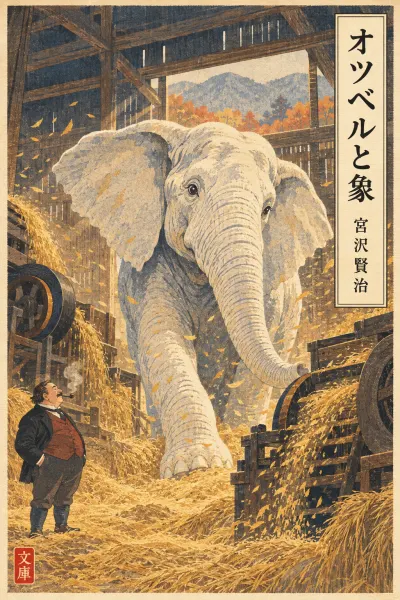
Part 2 of 4 · JLPT N2
オツベルと象(第二日曜) Otsuberu to Zō, part 2: Clocks, Chains and Rising Taxes
In this part
Otsuberu 'gives' the white elephant a tin clock, a heavy chain, paper boots and a huge iron weight, and the elephant happily wears them all. Each day, blaming rising taxes, Otsuberu gives him harder work: hauling water, carrying firewood and blowing on the forge fire. The elephant enjoys the work, but his ration of straw keeps shrinking, and at night he murmurs to the moon and to Santa Maria.
AI translation · independently checked
オツベルときたら大したもんだ。Now, that Otsuberu, he's really something.
それにこの前稲扱小屋で、うまく自分のものにした、象もじっさい大したもんだ。And the elephant he so neatly made his own the other day in the threshing shed? He's really something too.
力も二十馬力もある。He's got a good twenty horsepower in him.
第一みかけがまっ白で、牙はぜんたいきれいな象牙でできている。For a start, he's pure white to look at, and his tusks are made entirely of fine ivory.
皮も全体、立派で丈夫な象皮なのだ。His hide, too, is all splendid, sturdy elephant skin.
そしてずいぶんはたらくもんだ。And my, how that elephant works.
けれどもそんなに稼ぐのも、やっぱり主人が偉いのだ。But if he earns that much, it's because his master is such a great man, of course.
「おい、お前は時計は要らないか。」丸太で建てたその象小屋の前に来て、オツベルは琥珀のパイプをくわえ、顔をしかめて斯う訊いた。"Hey, you, wouldn't you like a clock?" Otsuberu came up to the front of the elephant hut, which was built of logs, clamped his amber pipe between his teeth, screwed up his face and asked him this.
「ぼくは時計は要らないよ。」象がわらって返事した。"I don't need a clock," the elephant answered with a laugh.
「まあ持って見ろ、いいもんだ。」斯う言いながらオツベルは、ブリキでこさえた大きな時計を、象の首からぶらさげた。"Go on, just try having it. It's a fine thing." Saying this, Otsuberu hung a big clock made of tin from the elephant's neck.
「なかなかいいね。」象も云う。"That's rather nice," said the elephant.
「鎖もなくちゃだめだろう。」オツベルときたら、百キロもある鎖をさ、その前肢にくっつけた。"It won't do without a chain, I suppose." And that Otsuberu, he went and fastened a chain weighing a good hundred kilos, mind you, onto the elephant's front leg.
「うん、なかなか鎖はいいね。」三あし歩いて象がいう。"Yes, the chain's rather nice," said the elephant, taking three steps.
「靴をはいたらどうだろう。」"How about putting on some boots?"
「ぼくは靴などはかないよ。」"I don't wear boots or anything like that."
「まあはいてみろ、いいもんだ。」オツベルは顔をしかめながら、赤い張子の大きな靴を、象のうしろのかかとにはめた。"Go on, just try them on. They're fine things." Screwing up his face, Otsuberu fitted a pair of big red papier-mâché boots onto the elephant's hind heels.
「なかなかいいね。」象も云う。"That's rather nice," said the elephant.
「靴に飾りをつけなくちゃ。」オツベルはもう大急ぎで、四百キロある分銅を靴の上から、穿め込んだ。"The boots need decorations." In a great hurry, Otsuberu fitted four-hundred-kilo weights onto the boots from above.
「うん、なかなかいいね。」象は二あし歩いてみて、さもうれしそうにそう云った。"Yes, that's rather nice," said the elephant, trying out two steps and sounding ever so pleased.
次の日、ブリキの大きな時計と、やくざな紙の靴とはやぶけ、象は鎖と分銅だけで、大よろこびであるいて居った。The next day the big tin clock and the flimsy paper boots had torn to pieces, and the elephant went walking about in nothing but his chain and weights, happy as could be.
「済まないが税金も高いから、今日はすこうし、川から水を汲んでくれ。」オツベルは両手をうしろで組んで、顔をしかめて象に云う。"Sorry about this, but taxes are high, so today I'd like you to fetch a bit of water from the river," said Otsuberu, hands clasped behind his back, frowning at the elephant.
「ああ、ぼく水を汲んで来よう。もう何ばいでも汲んでやるよ。」"Oh, I'll go and fetch water. I'll fetch as many loads as you like."
象は眼を細くしてよろこんで、そのひるすぎに五十だけ、川から水を汲んで来た。The elephant narrowed his eyes with delight, and that afternoon he fetched fifty loads of water from the river.
そして菜っ葉の畑にかけた。Then he poured it over the vegetable field.
夕方象は小屋に居て、十把の藁をたべながら、西の三日の月を見て、In the evening the elephant stayed in his hut, eating ten bundles of straw and gazing at the three-day moon in the west,
「ああ、稼ぐのは愉快だねえ、さっぱりするねえ」と云っていた。and he was saying, "Ah, working hard is such fun, it makes you feel so fresh."
「済まないが税金がまたあがる。今日は少うし森から、たきぎを運んでくれ」オツベルは房のついた赤い帽子をかぶり、両手をかくしにつっ込んで、次の日象にそう言った。"Sorry about this, but taxes are going up again. Today I'd like you to carry a bit of firewood in from the forest." Wearing a red cap with a tassel and with both hands stuffed in his pockets, Otsuberu said this to the elephant the next day.
「ああ、ぼくたきぎを持って来よう。いい天気だねえ。ぼくはぜんたい森へ行くのは大すきなんだ」象はわらってこう言った。"Oh, I'll bring the firewood. What lovely weather! I just love going into the forest, you know," said the elephant with a laugh.
オツベルは少しぎょっとして、パイプを手からあぶなく落としそうにしたがもうあのときは、象がいかにも愉快なふうで、ゆっくりあるきだしたので、また安心してパイプをくわえ、小さな咳を一つして、百姓どもの仕事の方を見に行った。Otsuberu gave a little start and nearly dropped the pipe from his hand, but by then the elephant was already ambling off, looking perfectly cheerful, so Otsuberu relaxed again, put the pipe back between his teeth, gave a small cough and went off to look over the peasants' work.
そのひるすぎの半日に、象は九百把たきぎを運び、眼を細くしてよろこんだ。In just that afternoon, half a day, the elephant carried nine hundred bundles of firewood, and he narrowed his eyes with delight.
晩方象は小屋に居て、八把の藁をたべながら、西の四日の月を見てToward nightfall the elephant stayed in his hut, eating eight bundles of straw and gazing at the four-day moon in the west,
「ああ、せいせいした。サンタマリア」と斯うひとりごとしたそうだ。and they say he murmured to himself, "Ah, that felt good. Santa Maria."
その次の日だ、Then came the day after that.
「済まないが、税金が五倍になった、今日は少うし鍛冶場へ行って、炭火を吹いてくれないか」"Sorry about this, but taxes have gone up five times over. Today, won't you go to the smithy and blow on the charcoal fire a bit?"
「ああ、吹いてやろう。本気でやったら、ぼく、もう、息で、石もなげとばせるよ」"Oh, I'll blow on it for you. If I really put my mind to it, why, I could even send stones flying with my breath."
オツベルはまたどきっとしたが、気を落ち付けてわらっていた。Otsuberu's heart jumped again, but he steadied himself and kept on smiling.
象はのそのそ鍛冶場へ行って、べたんと肢を折って座り、ふいごの代りに半日炭を吹いたのだ。The elephant plodded off to the smithy, folded his legs and sat down with a flump, and for half a day he blew on the charcoal in place of the bellows.
その晩、象は象小屋で、七把の藁をたべながら、空の五日の月を見てThat night the elephant, in his elephant hut, eating seven bundles of straw and gazing at the five-day moon in the sky,
「ああ、つかれたな、うれしいな、サンタマリア」と斯う言った。said, "Ah, I'm tired, but I'm happy. Santa Maria."
どうだ、そうして次の日から、象は朝からかせぐのだ。How about that? And from the next day on, the elephant was working from morning onward.
藁も昨日はただ五把だ。As for straw, yesterday he got only five bundles.
よくまあ、五把の藁などで、あんな力がでるもんだ。Imagine getting all that strength out of a mere five bundles of straw!
じっさい象はけいざいだよ。That elephant really is economical, I tell you.
それというのもオツベルが、頭がよくてえらいためだ。And that's all because Otsuberu is so clever and so great.
オツベルときたら大したもんさ。Now, that Otsuberu, he's really something.
Vocabulary
| Word | Meaning | JLPT |
|---|---|---|
| 大したたいした | remarkable, quite something大したもんだ is the narrator's ironic refrain; used here as mock praise. | N3 |
| 稼ぐかせぐ | to work hard and earn; to toilIt usually means 'earn money', but here it means doing productive work. | N3 |
| しかめてしかめる | to screw up (one's face), frowndictionary form: しかめるAlmost always used in the phrase 顔をしかめる. | — |
| 分銅ふんどう | iron weight (as used on scales)Otsuberu calls it a 'decoration', but it is really a shackle. | — |
| やくざなやくざ | shoddy, worthless, flimsydictionary form: やくざThis is an older adjectival use; it is not the modern 'gangster' sense. | — |
| 税金ぜいきん | taxesOtsuberu uses taxes as his excuse for every new task. | N3 |
| 汲んでくむ | to draw or fetch (water)dictionary form: 汲む | N2 |
| たきぎたきぎ | firewooddictionary form: 薪The kanji 薪 is also read まき. | — |
| かくしかくし | pocketdictionary form: 隠しThis is an old-fashioned word; today people say ポケット. | — |
| ぎょっとぎょっと | with a start, taken abackUsually used as ぎょっとする, for a sudden shock or fear. | — |
| せいせいしたせいせいする | to feel refreshed or relieveddictionary form: せいせいするWritten 清々する; it describes a clear, unburdened feeling. | — |
| 鍛冶場かじば | smithy, forge鍛冶 (かじ) means blacksmithing; 鍛冶屋 is a blacksmith. | — |
| ふいごふいご | bellowsA device for blowing air into a forge; the elephant is made to replace it. | — |
| けいざいけいざい | economical, cheap to rundictionary form: 経済This is an older usage meaning 'thrifty'; today one says 経済的. | N4 |
Grammar
〜ときたら N1 as for ~ / when it comes to ~
This pattern introduces a topic the speaker has strong feelings about, usually exasperation. Here the narrator uses it with mock admiration, which gives his praise of Otsuberu an ironic edge.
オツベルときたら大したもんだ。
Now, that Otsuberu, he's really something.
〜なくちゃ(だめだ) N4 must ~, it won't do without ~
なくちゃ is the casual contraction of なくては. With だめだ it means 'it's no good unless ~'. On its own, as in 飾りをつけなくちゃ, the ending is dropped but the meaning is still 'have to'.
鎖もなくちゃだめだろう。
It won't do without a chain, I suppose.
〜てくれ/〜てやる N4 do ~ for me / I'll do ~ for you
Otsuberu gives blunt orders with 〜てくれ. The elephant answers generously with 〜てやる, offering the work as a favour, which shows his innocence.
今日はすこうし、川から水を汲んでくれ。
Today I'd like you to fetch a bit of water from the river.
〜そうにする N3 to almost ~, be on the verge of ~
The verb stem plus そう means 'looking about to ~'. With あぶなく ('nearly') and した, it shows that Otsuberu almost dropped his pipe but did not.
パイプを手からあぶなく落としそうにした
nearly dropped the pipe from his hand
〜そうだ (hearsay) N4 they say ~, apparently ~
When そうだ follows a plain-form verb, it reports what the speaker has heard. The narrator reminds the listener that he is passing on a story.
「ああ、せいせいした。サンタマリア」と斯うひとりごとしたそうだ。
And they say he murmured to himself, "Ah, that felt good. Santa Maria."
〜ためだ N3 it is because of ~
ため after a clause gives the cause. Combined with それというのも ('and the reason is'), it credits Otsuberu's cleverness, again ironically.
それというのもオツベルが、頭がよくてえらいためだ。
And that's all because Otsuberu is so clever and so great.