Upper intermediate · JLPT N2
羅生門Rashōmon — Beneath the Rashōmon
- JLPT N2
- 5,684 characters
- 4 parts
- about 47 minutes
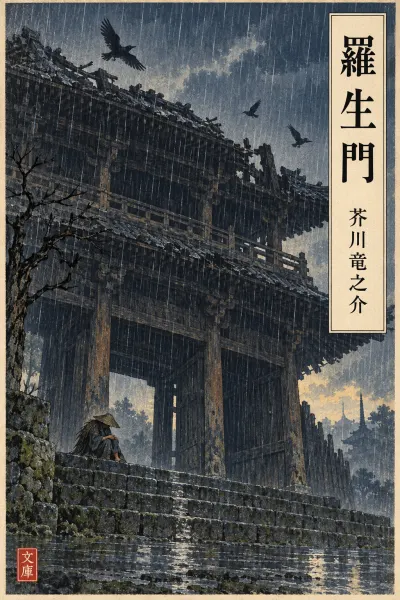
Akutagawa's first major story, published in 1915 and drawn from a tale in the medieval collection Konjaku Monogatarishū, is a short, grim study of how a person talks himself into doing wrong. On a cold, rainy evening in a Kyōto ruined by earthquakes, fires and famine, a recently dismissed servant shelters beneath the crumbling Rashōmon gate. With no money and nowhere to go, he turns over one question: starve, or become a thief? What he finds when he climbs into the gate's upper storey forces the question on him. The tone is cool, precise and unsentimental, and the narrator often steps forward as 'the author' to comment on his own storytelling. For learners, the story is short enough to finish yet dense. It uses plain -dearu narration, Sino-Japanese compounds and some archaic kanji and vocabulary. Much of the plot happens inside the servant's head, so you need to follow shifts in his feelings clause by clause. The small cast and the single setting help, and the dialogue gives useful contrast between two old-fashioned speech styles. Kurosawa's 1950 film takes its title and gate from this story, but its plot comes mainly from Akutagawa's 'In a Grove'.
Contents
Before you read
- Learn the core vocabulary first: 下人 (げにん, servant, which is how the protagonist is always called), 老婆 (ろうば, old woman), 死骸 (しがい, corpse), 盗人 (ぬすびと, thief), 饑死 (うえじに, starving to death) and 勇気 (ゆうき, courage). The whole moral question turns on 饑死 versus 盗人.
- The narration explains and emphasizes with ~のである / ~のだ and uses the archaic negative ~ぬ (知らぬ, 云わぬ). You will also see older kanji such as 云う for 言う. Read ~ぬ as ~ない.
- Decode the old woman's speech with a few equivalences: わし = 'I', じゃ = だ, 思うた = 思った, せねば = しなければ, and sentence-final ぞよ is emphatic. The servant's 己 (おれ, 'I') and おのれ ('you', said with contempt) mark his rough, commanding tone.
- Watch the servant's changing feelings, which the narrator tracks closely: fear, then hatred of evil (悪を憎む心), then cold contempt, then a new courage. The pimple (面皰, にきび) on his cheek that he keeps touching marks each turn in his thinking.
- Passages beginning 作者は are the narrator talking to you directly, not part of the action, and the French word Sentimentalisme appears in one of them. Recognizing these asides will keep you from losing the thread of the plot.
Words to know
The most useful words from the notes across the story.
| Word | Meaning | JLPT |
|---|---|---|
| 盗人ぬすびと | thiefOlder word for 泥棒 (どろぼう). Also read ぬすっと. | — |
| 下人げにん | servant, menial of low rankHistorical word for a low-ranking retainer in a noble household; the story's hero is never named. | — |
| 手段しゅだん | means, method手段を選ばない means 'to stop at nothing'. | N3 |
| 肯定こうてい | affirmation; accepting something as true or rightOpposite of 否定 (ひてい, denial). | N2 |
| 勝敗しょうはい | victory or defeat, outcome | N2 |
| 執拗くしゅうねい | stubborn, persistent, tenacious (adverbial 執拗く: stubbornly)dictionary form: 執拗いOld reading; the modern reading of 執拗 is しつよう. | N2 |
| 始末しまつ | (bad) state of affairsIn その始末 it means 'such a sorry state'. It also means 'dealing with' something, as in 始末する. | N1 |
| 顧るかえりみる | to pay attention to, to care aboutdictionary form: 顧みるModern spelling 顧みる. Here the older okurigana 顧る is used. | N1 |
| 当てあて | aim, plan, something to count on当てがない means 'to have no plan or prospects'. | N1 |
| 反感はんかん | antipathy, revulsion | N1 |
| 未練みれん | lingering attachment, regret何の未練もなく = without the slightest hesitation or regret. | N1 |
| 罵ったののしる | to shout abuse at, reviledictionary form: 罵る | N1 |
| 面皰にきび | pimpleUsually written in kana today; the servant's pimple is a recurring detail in the story. | N1 |
| 雨やみあまやみ | a break in the rain; sheltering until the rain stops雨やみを待つ and 雨やみをする both mean waiting out the rain under cover. Also read あめやみ. | — |
| 災わざわい | calamity, disasterdictionary form: 災いUsually written 災い today; 災害 (さいがい) is the everyday word. | — |
Plot summary
Show the full summary (contains spoilers)
A servant, dismissed by his master, sits under the Rashōmon in the rain, knowing that to survive he must become a thief but unable to bring himself to decide. He climbs to the upper storey, where abandoned corpses lie, and sees an old woman plucking hair from a dead woman's head to make wigs. Filled with hatred of this evil, he seizes her at sword-point. She explains herself: the dead woman used to sell snake meat to palace guards as dried fish so she would not starve, and would surely forgive what the old woman now does for the same reason. Her argument gives the servant the courage he lacked. He strips her of her robe, saying that he too must do this or starve, kicks her down onto the corpses, and vanishes into the night. No one knows where he went.
About the author
Akutagawa Ryūnosuke (1892–1927) was one of the most important writers of modern Japanese short fiction. Born in Tokyo, he studied English literature at Tokyo Imperial University, and his early story 鼻 (The Nose) won praise from Natsume Sōseki. Many of his works retell older Japanese and Chinese tales with modern psychological insight, including 羅生門 (Rashōmon) and 藪の中 (In a Grove), which later inspired Kurosawa Akira's film Rashomon. He died by suicide at the age of 35. The Akutagawa Prize was named in his honour by his friend Kikuchi Kan.