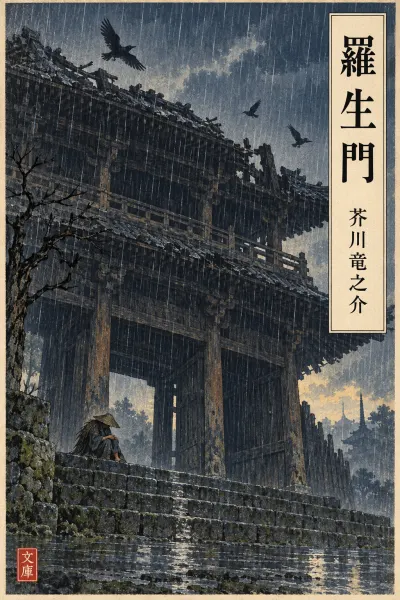
Part 2 of 4 · JLPT N2
羅生門 Rashōmon, part 2: Climbing Toward the Light Above
In this part
Shivering in the cold, the servant decides to spend the night in the tower above the gate and quietly climbs the ladder. He sees a flickering light and finds the floor strewn with rotting corpses. Among them crouches an old woman holding a pine torch, and she begins pulling the hair, one strand at a time, from a dead woman's head.
AI translation · independently checked
下人は、大きな嚔をして、それから、大儀そうに立上った。The servant gave a loud sneeze, and then, as if it were a great effort, got to his feet.
夕冷えのする京都は、もう火桶が欲しいほどの寒さである。With the chill of evening settling over Kyōto, it was already cold enough to make one long for a brazier.
風は門の柱と柱との間を、夕闇と共に遠慮なく、吹きぬける。The wind, together with the dusk, blew unchecked between the pillars of the gate.
丹塗の柱にとまっていた蟋蟀も、もうどこかへ行ってしまった。Even the cricket that had been clinging to the vermilion pillar had gone off somewhere.
下人は、頸をちぢめながら、山吹の汗袗に重ねた、紺の襖の肩を高くして門のまわりを見まわした。Drawing in his neck, the servant hunched the shoulders of the dark blue jacket he wore over his yellow undershirt and looked around the gate.
雨風の患のない、人目にかかる惧のない、一晩楽にねられそうな所があれば、そこでともかくも、夜を明かそうと思ったからである。His thought was that if he could find a place safe from wind and rain, hidden from the eyes of others, where he might sleep in peace for one night, he would at any rate see the night through there.
すると、幸い門の上の楼へ上る、幅の広い、これも丹を塗った梯子が眼についた。Then, by good fortune, his eye fell on a wide ladder, also painted vermilion, leading up to the tower above the gate.
上なら、人がいたにしても、どうせ死人ばかりである。Up there, even if there was anyone, it would only be the dead.
下人はそこで、腰にさげた聖柄の太刀が鞘走らないように気をつけながら、藁草履をはいた足を、その梯子の一番下の段へふみかけた。So, taking care that the plain-hilted sword hanging at his waist did not slip from its sheath, the servant set his straw-sandaled foot on the lowest rung of the ladder.
それから、何分かの後である。Some minutes passed.
羅生門の楼の上へ出る、幅の広い梯子の中段に、一人の男が、猫のように身をちぢめて、息を殺しながら、上の容子を窺っていた。Halfway up the wide ladder that led to the tower of the Rashōmon, a man crouched like a cat, holding his breath, watching to see what was going on above.
楼の上からさす火の光が、かすかに、その男の右の頬をぬらしている。Light from a fire shining down from the tower faintly wet his right cheek.
短い鬚の中に、赤く膿を持った面皰のある頬である。It was a cheek with a red, pus-filled pimple among the short stubble.
下人は、始めから、この上にいる者は、死人ばかりだと高を括っていた。From the start, the servant had taken it for granted that whoever was up there would be nothing but the dead.
それが、梯子を二三段上って見ると、上では誰か火をとぼして、しかもその火をそこここと動かしているらしい。Yet when he had climbed two or three rungs, it seemed that someone above had lit a fire, and was moreover moving it about here and there.
これは、その濁った、黄いろい光が、隅々に蜘蛛の巣をかけた天井裏に、揺れながら映ったので、すぐにそれと知れたのである。He knew this at once because the murky yellow light flickered across the ceiling, whose every corner was hung with cobwebs.
この雨の夜に、この羅生門の上で、火をともしているからは、どうせただの者ではない。Anyone who would light a fire on top of the Rashōmon, on a rainy night like this, could be no ordinary person.
下人は、守宮のように足音をぬすんで、やっと急な梯子を、一番上の段まで這うようにして上りつめた。Muffling his footsteps like a gecko, the servant at last crept up the steep ladder, almost on all fours, until he reached the very top rung.
そうして体を出来るだけ、平にしながら、頸を出来るだけ、前へ出して、恐る恐る、楼の内を覗いて見た。Then, keeping his body as flat as he could and stretching his neck as far forward as he could, he fearfully peered into the tower.
見ると、楼の内には、噂に聞いた通り、幾つかの死骸が、無造作に棄ててあるが、火の光の及ぶ範囲が、思ったより狭いので、数は幾つともわからない。Inside, just as rumor had it, a number of corpses had been carelessly thrown down, but the fire's light reached a smaller area than he had expected, so he could not tell how many there were.
ただ、おぼろげながら、知れるのは、その中に裸の死骸と、着物を着た死骸とがあるという事である。All he could make out, however dimly, was that among them there were naked corpses and corpses in clothes.
勿論、中には女も男もまじっているらしい。Naturally, there seemed to be both women and men mixed among them.
そうして、その死骸は皆、それが、かつて、生きていた人間だと云う事実さえ疑われるほど、土を捏ねて造った人形のように、口を開いたり手を延ばしたりして、ごろごろ床の上にころがっていた。And all those corpses lay sprawled across the floor like dolls made of kneaded clay, some with open mouths, some with outstretched arms, so that one could even doubt they had ever been living people.
しかも、肩とか胸とかの高くなっている部分に、ぼんやりした火の光をうけて、低くなっている部分の影を一層暗くしながら、永久に唖の如く黙っていた。What was more, as the dim firelight fell on the parts that rose up, the shoulders and chests, it made the shadows in the hollows darker still, and they lay silent, as mute as though they would never speak again.
下人は、それらの死骸の腐爛した臭気に思わず、鼻を掩った。At the putrid stench of those corpses, the servant covered his nose without thinking.
しかし、その手は、次の瞬間には、もう鼻を掩う事を忘れていた。But the very next moment, his hand had already forgotten to cover his nose.
ある強い感情が、ほとんどことごとくこの男の嗅覚を奪ってしまったからだ。For a certain powerful emotion had robbed him almost entirely of his sense of smell.
下人の眼は、その時、はじめてその死骸の中に蹲っている人間を見た。It was then that the servant's eyes first saw a human being crouching among the corpses.
檜皮色の着物を着た、背の低い、痩せた、白髪頭の、猿のような老婆である。It was an old woman in a cypress-bark-brown kimono, short, thin, white-haired, and like a monkey.
その老婆は、右の手に火をともした松の木片を持って、その死骸の一つの顔を覗きこむように眺めていた。In her right hand she held a burning sliver of pine, and she was gazing at the face of one of the corpses as if peering right into it.
髪の毛の長い所を見ると、多分女の死骸であろう。Judging by the long hair, it was probably the corpse of a woman.
下人は、六分の恐怖と四分の好奇心とに動かされて、暫時は呼吸をするのさえ忘れていた。Moved by six parts fear and four parts curiosity, the servant for a while forgot even to breathe.
旧記の記者の語を借りれば、「頭身の毛も太る」ように感じたのである。To borrow the words of an old chronicler, he felt as if "the hair of his head and body stood on end."
すると老婆は、松の木片を、床板の間に挿して、それから、今まで眺めていた死骸の首に両手をかけると、丁度、猿の親が猿の子の虱をとるように、その長い髪の毛を一本ずつ抜きはじめた。Then the old woman wedged the sliver of pine between the floorboards, placed both hands on the head of the corpse she had been gazing at, and, just like a parent monkey picking lice from its young, began to pull out the long hair one strand at a time.
髪は手に従って抜けるらしい。The hair seemed to come out easily at her touch.
Vocabulary
| Word | Meaning | JLPT |
|---|---|---|
| 下人げにん | servant; low-ranking retainerThe protagonist has no name and is only ever called this. | — |
| 大儀たいぎ | tiresome; a great effort大儀そうに = looking as if it were a chore; old-fashioned. | — |
| 火桶ひおけ | wooden brazier (for warming hands)An old word; the modern equivalent is 火鉢. | — |
| 楼ろう | tower; upper storey of a gateAlso appears in 鐘楼 (bell tower). | — |
| 窺ってうかがう | to watch secretly; to spy ondictionary form: 窺うDifferent from 伺う, the humble verb for 'to visit/ask'. | — |
| 高を括ってたかをくくる | to assume lightly; to take for granteddictionary form: 高を括るIdiom implying the assumption will turn out wrong. | — |
| 死骸しがい | corpse, dead bodyA key word in this story; 死体 is the more common modern word. | — |
| 無造作むぞうさ | carelessly; without ceremony無造作に = casually, any old how. | — |
| 臭気しゅうき | stench, foul smellFormal; the kanji 臭 means 'stink'. | — |
| 蹲ってうずくまる | to crouch, squat downdictionary form: 蹲るUsually written in kana today. | — |
| 老婆ろうば | old womanWritten-style word; in speech one says おばあさん. | — |
| 好奇心こうきしん | curiosityLiterally 'liking the strange'. | — |
| 暫時ざんじ | for a while, for a momentLiterary; compare しばらく (暫く), which uses the same kanji. | — |
Grammar
〜ほど N3 to the extent that; so … that
Attached to a clause, ほど shows degree. Here 火桶が欲しいほどの寒さ means 'a cold to the extent that one wants a brazier'.
もう火桶が欲しいほどの寒さである。
It was already cold enough to make one long for a brazier.
〜ないように気をつける N4 take care so that something does not happen
The negative form + ように states the result to be avoided, and 気をつける is the effort made to prevent it.
太刀が鞘走らないように気をつけながら
taking care that the sword did not slip from its sheath
〜からは N2 given that; since (so it must be)
A literary form of 〜からには: once a fact is established, a firm conclusion follows. Lighting a fire here means the person can be no ordinary one.
この羅生門の上で、火をともしているからは、どうせただの者ではない。
Anyone who would light a fire on top of the Rashōmon could be no ordinary person.
〜ながら (concessive) N2 although; even if
With adjectives or nouns, ながら means 'while being …, still'. おぼろげながら means 'though only dimly'. It does not mean two actions happening at once here.
ただ、おぼろげながら、知れるのは
All he could make out, however dimly,
〜てある N4 has been done (resulting state)
Te-form of a transitive verb + ある describes a state left by someone's action. 棄ててある stresses that the bodies had been thrown down and left.
幾つかの死骸が、無造作に棄ててある
a number of corpses had been carelessly thrown down
〜ば (conditional) N4 if
借りれば is the ば-conditional of 借りる. The fixed phrase 〜の語を借りれば means 'to borrow the words of …', a set way to introduce a quotation.
旧記の記者の語を借りれば
To borrow the words of an old chronicler