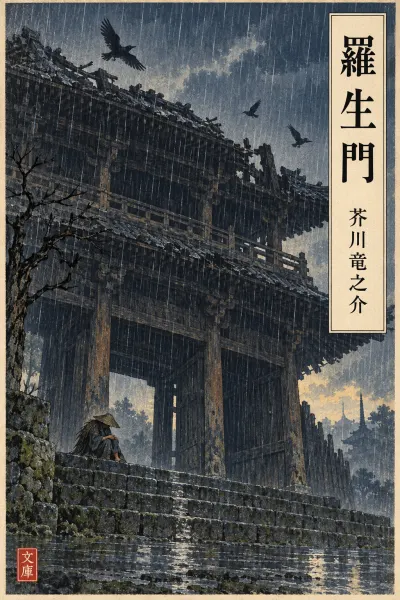
Part 1 of 4 · JLPT N2
羅生門 Rashōmon, part 1: A Servant Waits Beneath the Ruined Gate
In this part
On a rainy evening, a servant recently dismissed by his master shelters alone beneath the Rashōmon. Two or three years of calamities have ruined the capital, and the gate has become a place where foxes and thieves live, crows gather, and unclaimed corpses are dumped. With nowhere to go, he reasons that if he is not choosy he must become a thief, but he cannot yet find the courage to accept it.
AI translation · independently checked
ある日の暮方の事である。It happened one day, toward evening.
一人の下人が、羅生門の下で雨やみを待っていた。A servant was waiting for the rain to stop at the foot of the Rashōmon.
広い門の下には、この男のほかに誰もいない。Under the wide gate there was no one but this man.
ただ、所々丹塗の剥げた、大きな円柱に、蟋蟀が一匹とまっている。There was only a single cricket clinging to a great round pillar whose red lacquer had peeled away in places.
羅生門が、朱雀大路にある以上は、この男のほかにも、雨やみをする市女笠や揉烏帽子が、もう二三人はありそうなものである。Since the Rashōmon stood on Suzaku Ōji, one would have expected two or three others to be sheltering from the rain besides this man, a woman in a broad sedge hat, perhaps, or a man in a soft crumpled eboshi cap.
それが、この男のほかには誰もいない。Yet there was no one here but him.
何故かと云うと、この二三年、京都には、地震とか辻風とか火事とか饑饉とか云う災がつづいて起った。The reason was this: for the past two or three years, one calamity after another had struck Kyōto, earthquakes, whirlwinds, fires and famine.
そこで洛中のさびれ方は一通りではない。As a result, the decay of Rakuchū was no ordinary thing.
旧記によると、仏像や仏具を打砕いて、その丹がついたり、金銀の箔がついたりした木を、路ばたにつみ重ねて、薪の料に売っていたと云う事である。According to the old records, people smashed Buddhist statues and altar fittings, piled up the wood, still coated with red paint or gold and silver leaf, by the roadside, and sold it as firewood.
洛中がその始末であるから、羅生門の修理などは、元より誰も捨てて顧る者がなかった。With Rakuchū in such a state, it goes without saying that no one gave a thought to repairing the Rashōmon; it was simply abandoned.
するとその荒れ果てたのをよい事にして、狐狸が棲む。Then, taking advantage of its ruin, foxes and badgers came to live there.
盗人が棲む。Thieves came to live there.
とうとうしまいには、引取り手のない死人を、この門へ持って来て、棄てて行くと云う習慣さえ出来た。In the end, a custom even arose of carrying the bodies of the dead whom no one would claim to this gate and leaving them there.
そこで、日の目が見えなくなると、誰でも気味を悪るがって、この門の近所へは足ぶみをしない事になってしまったのである。And so, once darkness fell, everyone felt uneasy, and it came about that no one would set foot anywhere near the gate.
その代りまた鴉がどこからか、たくさん集って来た。In their place, crows gathered in great numbers from who knows where.
昼間見ると、その鴉が何羽となく輪を描いて、高い鴟尾のまわりを啼きながら、飛びまわっている。In the daytime you could see countless crows circling and cawing as they flew around the high ridge-end ornaments of the roof.
ことに門の上の空が、夕焼けであかくなる時には、それが胡麻をまいたようにはっきり見えた。Especially when the sky above the gate turned red with the sunset, they stood out clearly, like scattered sesame seeds.
鴉は、勿論、門の上にある死人の肉を、啄みに来るのである。The crows, of course, came to peck at the flesh of the dead bodies lying up in the gate.
――もっとも今日は、刻限が遅いせいか、一羽も見えない。Today, however, perhaps because the hour was late, not a single one could be seen.
ただ、所々、崩れかかった、そうしてその崩れ目に長い草のはえた石段の上に、鴉の糞が、点々と白くこびりついているのが見える。All that could be seen was crow droppings, clinging in white specks to the stone steps, which were crumbling here and there, with tall grass growing in the cracks.
下人は七段ある石段の一番上の段に、洗いざらした紺の襖の尻を据えて、右の頬に出来た、大きな面皰を気にしながら、ぼんやり、雨のふるのを眺めていた。The servant sat on the top of the seven stone steps in his faded, much-washed dark blue robe, fretting over a large pimple that had come up on his right cheek, and gazing vacantly at the falling rain.
作者はさっき、「下人が雨やみを待っていた」と書いた。A little earlier, the author wrote, "A servant was waiting for the rain to stop."
しかし、下人は雨がやんでも、格別どうしようと云う当てはない。But even when the rain stopped, the servant had no particular idea what he would do.
ふだんなら、勿論、主人の家へ帰る可き筈である。Ordinarily, of course, he would have been expected to return to his master's house.
所がその主人からは、四五日前に暇を出された。But four or five days before, that very master had dismissed him.
前にも書いたように、当時京都の町は一通りならず衰微していた。As I wrote earlier, the city of Kyōto at that time had fallen into extraordinary decline.
今この下人が、永年、使われていた主人から、暇を出されたのも、実はこの衰微の小さな余波にほかならない。That this servant had now been dismissed by the master he had served for so many years was, in truth, nothing more than a small ripple of that decline.
だから「下人が雨やみを待っていた」と云うよりも「雨にふりこめられた下人が、行き所がなくて、途方にくれていた」と云う方が、適当である。So rather than say, "A servant was waiting for the rain to stop," it would be more fitting to say, "A servant, trapped by the rain, with nowhere to go, was at his wits' end."
その上、今日の空模様も少からず、この平安朝の下人の Sentimentalisme に影響した。What is more, the look of the sky that day had no small effect on the Sentimentalisme of this servant of the Heian age.
申の刻下りからふり出した雨は、いまだに上るけしきがない。The rain, which had begun a little past the Hour of the Monkey, still showed no sign of letting up.
そこで、下人は、何をおいても差当り明日の暮しをどうにかしようとして――云わばどうにもならない事を、どうにかしようとして、とりとめもない考えをたどりながら、さっきから朱雀大路にふる雨の音を、聞くともなく聞いていたのである。So the servant, trying above all to do something, anything, about how he would live tomorrow, trying, in other words, to do something about what could not be helped, followed rambling thoughts that led nowhere, and for some time had been half listening to the sound of the rain falling on Suzaku Ōji.
雨は、羅生門をつつんで、遠くから、ざあっと云う音をあつめて来る。The rain wrapped itself around the Rashōmon and gathered its roaring sound in from far away.
夕闇は次第に空を低くして、見上げると、門の屋根が、斜につき出した甍の先に、重たくうす暗い雲を支えている。Dusk was gradually bringing the sky lower, and when he looked up, the roof of the gate was holding up heavy, dim clouds on the tips of its tiles, which jutted out at a slant.
どうにもならない事を、どうにかするためには、手段を選んでいる遑はない。To do something about what could not be helped, there was no time to be choosy about the means.
選んでいれば、築土の下か、道ばたの土の上で、饑死をするばかりである。If he were choosy, all that awaited him was to starve to death at the foot of some earthen wall or on the dirt by the roadside.
そうして、この門の上へ持って来て、犬のように棄てられてしまうばかりである。And then all that would remain was to be carried up into this gate and thrown away like a dog.
選ばないとすれば――下人の考えは、何度も同じ道を低徊した揚句に、やっとこの局所へ逢着した。If he were not choosy... the servant's thoughts, after wandering the same path again and again, had at last arrived at this point.
しかしこの「すれば」は、いつまでたっても、結局「すれば」であった。But this "if" remained, however long he waited, only an "if".
下人は、手段を選ばないという事を肯定しながらも、この「すれば」のかたをつけるために、当然、その後に来る可き「盗人になるよりほかに仕方がない」と云う事を、積極的に肯定するだけの、勇気が出ずにいたのである。Though the servant accepted that he could not be choosy about the means, he could not find the courage to settle that "if" by firmly accepting what must naturally follow it: "There is nothing for it but to become a thief."
Vocabulary
| Word | Meaning | JLPT |
|---|---|---|
| 下人げにん | servant, menial of low rankHistorical word for a low-ranking retainer in a noble household; the story's hero is never named. | — |
| 雨やみあまやみ | a break in the rain; sheltering until the rain stops雨やみを待つ and 雨やみをする both mean waiting out the rain under cover. Also read あめやみ. | — |
| 災わざわい | calamity, disasterdictionary form: 災いUsually written 災い today; 災害 (さいがい) is the everyday word. | — |
| 始末しまつ | (bad) state of affairsIn その始末 it means 'such a sorry state'. It also means 'dealing with' something, as in 始末する. | N1 |
| 顧るかえりみる | to pay attention to, to care aboutdictionary form: 顧みるModern spelling 顧みる. Here the older okurigana 顧る is used. | N1 |
| 気味を悪るがってきみわるがる | to feel uneasy, to find something creepydictionary form: 気味悪がる〜がる turns a feeling adjective (気味が悪い) into a verb describing how others show that feeling. | — |
| 暇を出されたひまをだす | to dismiss (a servant), to let godictionary form: 暇を出すOld expression; the passive 暇を出される means 'to be dismissed'. | — |
| 衰微すいび | decline, decayFormal literary word; 衰退 (すいたい) is more common today. | — |
| 当てあて | aim, plan, something to count on当てがない means 'to have no plan or prospects'. | N1 |
| 途方にくれていたとほうにくれる | to be at a loss, to be at one's wits' enddictionary form: 途方に暮れるSet phrase; literally 'to be benighted on one's path'. | — |
| 手段しゅだん | means, method手段を選ばない means 'to stop at nothing'. | N3 |
| 饑死うえじに | death by starvationdictionary form: 飢え死にToday usually written 飢え死に; 饑 is an old variant of 飢. | — |
| 盗人ぬすびと | thiefOlder word for 泥棒 (どろぼう). Also read ぬすっと. | — |
| 肯定こうてい | affirmation; accepting something as true or rightOpposite of 否定 (ひてい, denial). | N2 |
Grammar
〜以上は N2 since, given that
Attached to a plain-form clause, 以上は states a fact and draws a natural conclusion or expectation from it. Here, because the gate stands on the main avenue, one would expect other people to be there.
羅生門が、朱雀大路にある以上は、この男のほかにも、雨やみをする市女笠や揉烏帽子が、もう二三人はありそうなものである。
Since the Rashōmon stood on Suzaku Ōji, one would have expected two or three others to be sheltering from the rain besides this man.
〜たり〜たりした N4 things such as ~ and ~; sometimes ~, sometimes ~
Lists representative examples. Here it describes the wood, some pieces with red paint on them and some with gold or silver leaf.
その丹がついたり、金銀の箔がついたりした木を
the wood, still coated with red paint or gold and silver leaf
〜にほかならない N2 is nothing other than, is none other than
A strong, formal way of saying 'X is precisely Y'. The narrator insists that the servant's dismissal is simply one small effect of the city's decline.
実はこの衰微の小さな余波にほかならない。
was, in truth, nothing more than a small ripple of that decline.
〜ともなく N1 without really meaning to ~; half-~
When the same verb appears in the pattern V-るともなくV, it describes doing something absent-mindedly. 聞くともなく聞く means hearing without really listening.
朱雀大路にふる雨の音を、聞くともなく聞いていたのである。
had been half listening to the sound of the rain falling on Suzaku Ōji.
〜ばかりである N2 nothing but ~ (awaits); all that is left is ~
After a dictionary-form verb, ばかりだ/である says that only one outcome remains, usually a bad one. The servant sees nothing ahead but starvation.
築土の下か、道ばたの土の上で、饑死をするばかりである。
all that awaited him was to starve to death at the foot of some earthen wall or on the dirt by the roadside.
〜よりほかに仕方がない N3 there is no choice but to ~
Dictionary form + よりほかに仕方がない (or よりほかない) means that every other option is ruled out. Here it expresses the conclusion the servant cannot yet bring himself to accept.
「盗人になるよりほかに仕方がない」
"There is nothing for it but to become a thief."