Upper intermediate · JLPT N2
檸檬Remon — One Lemon
- JLPT N2
- 4,932 characters
- 4 parts
- about 41 minutes
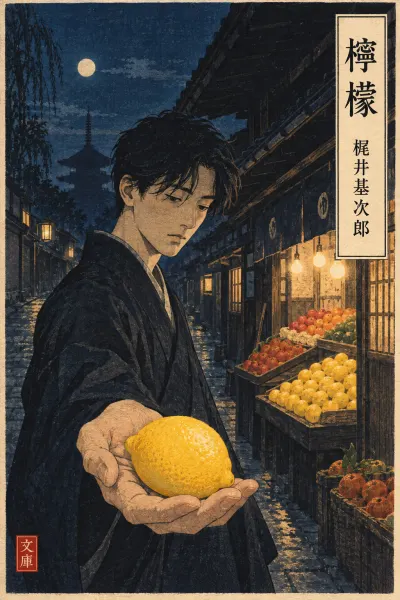
Kajii Motojirō's "Lemon" is a short, first-person prose sketch with almost no plot. A young man is weighed down by a vague, ominous dread and wanders the streets of Kyōto. He cannot bear music or poetry, cannot afford the small pretty things he likes, and feels crushed by Maruzen, a bookshop and import store he once loved. Then, at a fruit shop on Teramachi, he buys a single lemon. The story follows what that small, cool, fragrant object does to his mood. The tone is inward and feverish but also wryly self-mocking. The prose lingers on colour, weight, smell and light, and on streets of cheap fireworks, coloured glass and shabby back alleys. For a learner, the rewards are rich sensory vocabulary and a narrator whose shifts of feeling are traced closely. The challenges are long, drifting sentences, early-twentieth-century literary diction, some archaic kanji, and dated loanword spellings such as カリフォルニヤ. The text is short enough to read closely in one or two sittings.
Contents
Before you read
- Learn the key words of the opening first: えたいの知れない (unaccountable, nameless), 不吉 (ominous), 塊 (lump, mass) and 圧えつける (to press down). The 'ominous lump' returns throughout the story, and tracking when it weighs on him and when it lifts is the story's emotional thread.
- Expect long, clause-stacked sentences. Find the main verb at the end first, then work backwards. Watch for the narrative 〜のだった, which gives explanation or reflection, and 〜たものだ, which marks habitual past ('I used to…'). Both mark his shifts between the story's present and his memories.
- Several older forms appear: 希わくは (こいねがわくは, 'I wish that…'), 罩めて (こめて, 'filled with, charged with'), and the loanword spellings カリフォルニヤ and レモンエロウ ('lemon yellow'). Recognising them keeps you from getting stuck on what are really simple words.
- Pay attention to colour, weight, temperature and smell words such as 冷たさ, 重さ, 匂い and 色彩. The lemon's effect comes almost entirely through the senses, and the climax at Maruzen depends on colours being gathered and 'absorbed'.
- Keep the brief's place names handy, especially 丸善 (Maruzen), 寺町 (Teramachi), 二条 (Nijō) and 京極 (Kyōgoku). The walk through real Kyōto streets gives the drifting narration its structure, and knowing where he is makes the sentences easier to follow.
Words to know
The most useful words from the notes across the story.
| Word | Meaning | JLPT |
|---|---|---|
| 贅沢ぜいたく | luxury, extravaganceUsed both as a noun and as a な-adjective. | N3 |
| 不吉ふきつ | ominous, ill-omenedな-adjective; the opposite of 吉 (good fortune). | N1 |
| 下宿げしゅく | lodgings; a rented roomThe typical housing of students at that time. | N4 |
| 浴衣ゆかた | yukata, a light cotton kimonoWorn in summer and provided by inns as sleepwear. English has no equivalent, so the word is kept. | N2 |
| 慌しくあわただしい | hurried, flustereddictionary form: 慌しいNow usually written 慌ただしい. | N2 |
| 見すぼらしくてみすぼらしい | shabby, run-downdictionary form: 見すぼらしいUsually written みすぼらしい. | N1 |
| 錯覚さっかく | illusion錯覚を起こす: to have (or create) an illusion. | N1 |
| 露骨ろこつ | blatant, undisguised; here 'nakedly, vividly'Usually negative (露骨な嫌味, open sarcasm), but here it is used positively for the fruit's open beauty. | N1 |
| 憂鬱ゆううつ | melancholy, gloomA famously difficult kanji compound. It is often written in kana (ゆううつ). | N1 |
| 見せびらかすみせびらかす | to show off, flauntAlways has a sense of boasting. | N1 |
| 快いこころよい | pleasant, agreeableWritten-style word for a pleasant physical or mental sensation. | N1 |
| 色彩しきさい | colour, colouringMore formal and literary than 色. | N1 |
| 昂奮こうふん | excitementOlder spelling. Today it is normally written 興奮. | N1 |
| 据えつけすえつける | to set firmly in place, to installdictionary form: 据えつけるSuggests placing something carefully so that it stays put. | N1 |
| えたいの知れないえたいのしれない | unidentifiable, of unknown naturedictionary form: 得体の知れないSet phrase for something strange or suspicious whose true nature cannot be grasped. Usually written 得体の知れない. | — |
Plot summary
Show the full summary (contains spoilers)
The narrator is oppressed by a nameless, ominous lump of dread. He drifts through Kyōto's back streets, loving decaying alleys and cheap, pretty things. Maruzen, once a favourite haunt, now feels oppressive to him. After roaming from one friend's lodging to the next, he stops at a beautifully lit fruit shop on Teramachi and buys one lemon. Its coolness and fragrance lift his spirits, and in this rare good mood he goes into Maruzen. There his happiness drains away, and he pulls out art books he cannot bring himself to look at, leaving them in a heap. Then he remembers the lemon. He builds a fantastical castle out of the art books, crowns it with the lemon, and walks out, leaving it behind. Smiling, he imagines the lemon is a bomb about to blow the stuffy shop to pieces.
About the author
Kajii Motojirō was born in Ōsaka and studied at the Third Higher School in Kyōto before entering Tokyo Imperial University to study English literature, which he did not complete. With friends he helped found the coterie magazine Aozora (Blue Sky), where "Lemon" first appeared. His precise, sensuous style later won him a lasting place in modern Japanese literature.