Part 2 of 4 · JLPT N2
檸檬 Remon, part 2: Maruzen, a Fruit Shop, and One Lemon
In this part
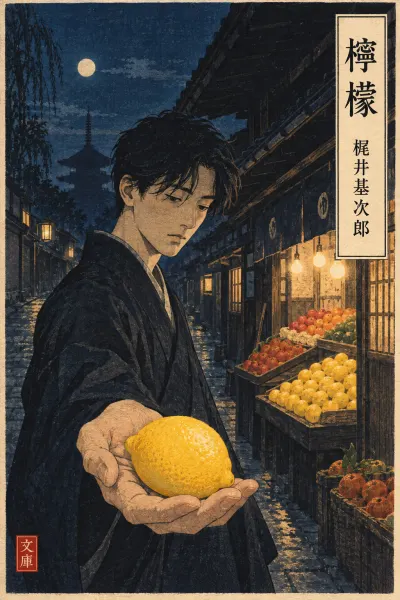
The narrator recalls how Maruzen, once a favourite haunt, had become oppressive, its books, students and counter looking like debt collectors' ghosts. Drifting from one friend's lodging to the next, he wanders Kyōto's streets until he stops at his favourite fruit shop on Teramachi, whose display looks especially beautiful against the dark surroundings. There he buys a single lemon, and holding it, he finds that the ominous weight on his heart eases a little.
AI translation · independently checked
生活がまだ蝕まれていなかった以前私の好きであった所は、たとえば丸善であった。In the days before my life had been eaten away, one of the places I used to love was, for example, Maruzen.
赤や黄のオードコロンやオードキニン。Red and yellow eaux de Cologne and eaux de quinine.
洒落た切子細工や典雅なロココ趣味の浮模様を持った琥珀色や翡翠色の香水壜。Perfume bottles of amber and jade green, with stylish cut-glass work or elegant raised patterns in the Rococo taste.
煙管、小刀、石鹸、煙草。Pipes, pocket knives, soaps, tobacco.
私はそんなものを見るのに小一時間も費すことがあった。I sometimes spent the better part of an hour just looking at such things.
そして結局一等いい鉛筆を一本買うくらいの贅沢をするのだった。And in the end I would indulge myself to the extent of buying a single pencil of the very best quality.
しかしここももうその頃の私にとっては重くるしい場所に過ぎなかった。But by that time, even this place had become nothing more than somewhere heavy and oppressive to me.
書籍、学生、勘定台、これらはみな借金取りの亡霊のように私には見えるのだった。Books, students, the cashier's counter: to me they all looked like the ghosts of debt collectors.
ある朝――その頃私は甲の友達から乙の友達へというふうに友達の下宿を転々として暮らしていたのだが――友達が学校へ出てしまったあとの空虚な空気のなかにぽつねんと一人取り残された。One morning (in those days I was living by moving from one friend's lodging to another, from Friend A to Friend B, and so on) I was left behind all alone in the empty air after my friend had gone off to school.
私はまたそこから彷徨い出なければならなかった。Once again I had to wander out from there.
何かが私を追いたてる。Something drives me on.
そして街から街へ、先に言ったような裏通りを歩いたり、駄菓子屋の前で立ち留まったり、乾物屋の乾蝦や棒鱈や湯葉を眺めたり、とうとう私は二条の方へ寺町を下り、そこの果物屋で足を留めた。And so, from street to street, walking the back lanes I spoke of earlier, stopping in front of cheap sweet shops, gazing at the dried shrimp, dried cod and yuba in the dry-goods stores, I finally went down Teramachi towards Nijō and came to a halt at the fruit shop there.
ここでちょっとその果物屋を紹介したいのだが、その果物屋は私の知っていた範囲で最も好きな店であった。I would like to introduce that fruit shop for a moment here; of all the shops I knew, it was the one I liked best.
そこは決して立派な店ではなかったのだが、果物屋固有の美しさが最も露骨に感ぜられた。It was by no means a fine shop, but there one could feel, more nakedly than anywhere, the beauty that belongs to fruit shops alone.
果物はかなり勾配の急な台の上に並べてあって、その台というのも古びた黒い漆塗りの板だったように思える。The fruit was set out on a stand with quite a steep slope, and that stand, as I recall, was made of old, worn boards lacquered black.
何か華やかな美しい音楽の快速調の流れが、見る人を石に化したというゴルゴンの鬼面――的なものを差しつけられて、あんな色彩やあんなヴォリウムに凝り固まったというふうに果物は並んでいる。The fruit is arranged as if the flow of some brilliant, beautiful piece of music in allegro had been confronted with something like the face of the Gorgon, who turned all who looked at her to stone, and had congealed into those colours and that volume.
青物もやはり奥へゆけばゆくほど堆高く積まれている。The vegetables, too, are piled higher and higher the further back into the shop you go.
――実際あそこの人参葉の美しさなどは素晴しかった。Indeed, the beauty of the carrot leaves there, for one, was marvellous.
それから水に漬けてある豆だとか慈姑だとか。And then there were the beans and arrowhead bulbs left soaking in water.
またそこの家の美しいのは夜だった。But the time that shop was most beautiful was at night.
寺町通はいったいに賑かな通りで――と言って感じは東京や大阪よりはずっと澄んでいるが――飾窓の光がおびただしく街路へ流れ出ている。Teramachi-dōri is on the whole a lively street (though the feel of it is far clearer than in Tōkyō or Ōsaka), and the light from the shop windows streams out in abundance onto the road.
それがどうしたわけかその店頭の周囲だけが妙に暗いのだ。Yet for some reason, only the area around the front of that shop is strangely dark.
もともと片方は暗い二条通に接している街角になっているので、暗いのは当然であったが、その隣家が寺町通にある家にもかかわらず暗かったのが瞭然しない。One side of it forms a corner that meets the dark Nijō-dōri, so it was natural for that to be dark; but why the house next door should be dark as well, despite standing on Teramachi-dōri, I could never make out.
しかしその家が暗くなかったら、あんなにも私を誘惑するには至らなかったと思う。Still, I think that had the shop not been dark, it would never have tempted me as much as it did.
もう一つはその家の打ち出した廂なのだが、その廂が眼深に冠った帽子の廂のように――これは形容というよりも、「おや、あそこの店は帽子の廂をやけに下げているぞ」と思わせるほどなので、廂の上はこれも真暗なのだ。The other thing was the shop's jutting eaves; they were like the brim of a hat pulled down low over the eyes. This is less a figure of speech than a fact, for they were low enough to make you think, "Well, that shop has certainly pulled its hat brim down," and so above the eaves, too, all was pitch dark.
そう周囲が真暗なため、店頭に点けられた幾つもの電燈が驟雨のように浴びせかける絢爛は、周囲の何者にも奪われることなく、ほしいままにも美しい眺めが照らし出されているのだ。Because its surroundings were so utterly dark, the splendour poured out like a sudden shower by the many electric lights lit at the shop front was stolen by nothing around it, and the beautiful scene was lit up freely, just as it pleased.
裸の電燈が細長い螺旋棒をきりきり眼の中へ刺し込んでくる往来に立って、また近所にある鎰屋の二階の硝子窓をすかして眺めたこの果物店の眺めほど、その時どきの私を興がらせたものは寺町の中でも稀だった。Standing in the street, where bare electric bulbs drove long thin spirals piercingly into my eyes, and also gazing through the glass window on the second floor of the nearby Kagiya, I found that few things on all of Teramachi amused me, at one time or another, as much as this view of the fruit shop.
その日私はいつになくその店で買物をした。That day, unusually for me, I bought something at the shop.
というのはその店には珍しい檸檬が出ていたのだ。The reason was that the shop had some lemons out, which was rare.
檸檬などごくありふれている。Lemons and the like are perfectly ordinary.
がその店というのも見すぼらしくはないまでもただあたりまえの八百屋に過ぎなかったので、それまであまり見かけたことはなかった。But that shop, though not exactly shabby, was only a plain greengrocer, and until then I had rarely seen them there.
いったい私はあの檸檬が好きだ。I have always loved lemons.
レモンエロウの絵具をチューブから搾り出して固めたようなあの単純な色も、それからあの丈の詰まった紡錘形の恰好も。That simple colour, as if lemon-yellow paint had been squeezed from the tube and left to harden, and that squat, spindle-shaped form as well.
――結局私はそれを一つだけ買うことにした。In the end I decided to buy just one.
それからの私はどこへどう歩いたのだろう。Where did I walk after that, and how?
私は長い間街を歩いていた。I walked the streets for a long time.
始終私の心を圧えつけていた不吉な塊がそれを握った瞬間からいくらか弛んで来たとみえて、私は街の上で非常に幸福であった。The ominous lump that had been pressing down on my heart all along seemed to have loosened somewhat from the moment I grasped the lemon, and out there in the streets I was extremely happy.
あんなに執拗かった憂鬱が、そんなものの一顆で紛らされる――あるいは不審なことが、逆説的なほんとうであった。That a melancholy so stubborn could be dispelled by a single such fruit: perhaps this dubious thing was a paradoxical truth.
それにしても心というやつはなんという不可思議なやつだろう。Even so, what a mysterious thing the heart is.
Vocabulary
| Word | Meaning | JLPT |
|---|---|---|
| 蝕まれていなかったむしばむ | to eat away at, to erode (health, life)dictionary form: 蝕むUsually passive (蝕まれる), 'to be eaten away'. Related to 虫歯, a decayed tooth. | — |
| 贅沢ぜいたく | luxury, indulgence贅沢をする: to treat yourself. The narrator uses it wryly for a single pencil. | N3 |
| 下宿げしゅく | lodgings; a rented roomThe typical housing of students at that time. | N4 |
| 転々てんてんとする | to move from place to placedictionary form: 転々とする | — |
| 彷徨い出さまよう | to wander, to roam aimlesslydictionary form: 彷徨うUsually written in kana today. | — |
| 湯葉ゆば | yuba, the thin skin that forms on heated soy milkA Kyōto speciality with no English equivalent. It is dried and sold in sheets. | — |
| 露骨ろこつ | blatant, undisguised; here 'nakedly, vividly'Usually negative (露骨な嫌味, open sarcasm), but here it is used positively for the fruit's open beauty. | N1 |
| 勾配こうばい | slope, incline勾配が急: steep. | — |
| 誘惑ゆうわくする | to tempt, to luredictionary form: 誘惑する | — |
| 廂ひさし | eaves; also the brim or peak of a capAlso written 庇. Here the story plays on both senses. | — |
| 絢爛けんらん | dazzling splendour, gorgeousnessOften in 豪華絢爛, 'gorgeous and splendid'. | — |
| ありふれているありふれる | to be commonplace, ordinarydictionary form: ありふれるAlmost always used as ありふれた or ありふれている. | — |
| 不吉ふきつ | ominous, ill-omenedThe 'ominous lump' (不吉な塊) is the story's key image of the narrator's malaise. | N1 |
| 憂鬱ゆううつ | melancholy, gloomA famously difficult kanji compound. It is often written in kana (ゆううつ). | N1 |
Grammar
〜に過ぎない N2 nothing more than; merely
Added to a noun, it reduces the thing to something small or unimportant. Here, the once-beloved Maruzen has become merely an oppressive place.
その頃の私にとっては重くるしい場所に過ぎなかった
to me at that time it was nothing more than an oppressive place
〜のだった N3 narrative explanation or habitual past
The explanatory の plus past だった gives a reflective, looking-back tone. Here it often marks something that used to happen or used to seem so.
借金取りの亡霊のように私には見えるのだった
they looked to me like the ghosts of debt collectors
〜ば〜ほど N3 the more …, the more …
The same verb is repeated, first in the ば-form and then with ほど, to show that one thing increases along with another. The further back you go, the higher the vegetables are piled.
奥へゆけばゆくほど堆高く積まれている
the further back you go, the higher they are piled
〜にもかかわらず N2 despite, in spite of
It marks a situation that the result goes against. The neighbouring house is dark even though it stands on the bright Teramachi-dōri.
寺町通にある家にもかかわらず暗かった
it was dark despite being a house on Teramachi-dōri
〜ないまでも N1 even if not (quite) …; though not …
It grants that a stronger description does not apply and then states a weaker one. The shop was not shabby, but it was still only an ordinary greengrocer.
見すぼらしくはないまでもただあたりまえの八百屋に過ぎなかった
though not shabby, it was just an ordinary greengrocer
〜とみえて N1 apparently; it seems that … and so
It gives an inference drawn from what one observes, followed by its result. The narrator judges from his own happiness that the lump must have loosened.
いくらか弛んで来たとみえて、私は街の上で非常に幸福であった
it seemed to have loosened somewhat, and I was extremely happy out in the streets