Part 4 of 4 · JLPT N2
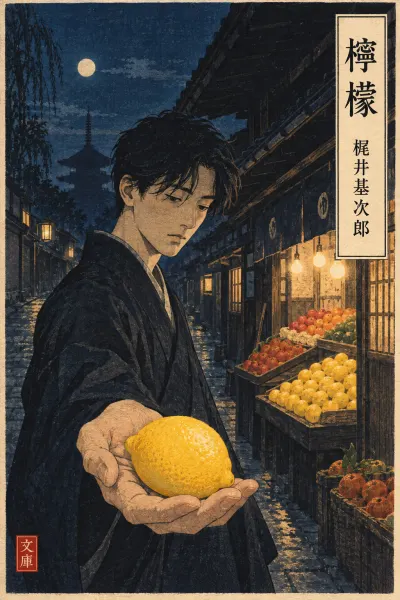
檸檬 Remon, part 4: A Golden Bomb on the Bookshelf
In this part
The narrator remembers the lemon in his sleeve. He piles Maruzen's art books into a strange, colourful castle and sets the lemon on top, where it seems to absorb all the clashing colours and charge the dusty air. He then leaves it there and walks out, smiling at the fantasy that the lemon is a bomb about to blow the stuffy shop to pieces.
AI translation · independently checked
「あ、そうだそうだ」その時私は袂の中の檸檬を憶い出した。"Ah, yes, of course!" At that moment I remembered the lemon in the sleeve of my kimono.
本の色彩をゴチャゴチャに積みあげて、一度この檸檬で試してみたら。What if I piled up the colours of the books in a jumble and tried them, just once, with this lemon?
「そうだ」"Yes, that's it."
私にまた先ほどの軽やかな昂奮が帰って来た。The same light-hearted excitement I had felt earlier came back to me.
私は手当たり次第に積みあげ、また慌しく潰し、また慌しく築きあげた。I piled up whatever came to hand, then hurriedly knocked it down, then hurriedly built it up again.
新しく引き抜いてつけ加えたり、取り去ったりした。I pulled out fresh volumes and added them, or took others away.
奇怪な幻想的な城が、そのたびに赤くなったり青くなったりした。Each time, the weird, fantastical castle turned red, then blue.
やっとそれはでき上がった。At last it was finished.
そして軽く跳りあがる心を制しながら、その城壁の頂きに恐る恐る檸檬を据えつけた。Then, restraining my lightly leaping heart, I timidly set the lemon on the very top of the castle wall.
そしてそれは上出来だった。And it was a triumph.
見わたすと、その檸檬の色彩はガチャガチャした色の階調をひっそりと紡錘形の身体の中へ吸収してしまって、カーンと冴えかえっていた。When I looked it over, the lemon's colour had quietly drawn all the clashing gradations of colour into its spindle-shaped body, and it stood there, cold and clear, as if a bell had been struck.
私は埃っぽい丸善の中の空気が、その檸檬の周囲だけ変に緊張しているような気がした。I had the feeling that the dusty air inside Maruzen had grown strangely tense just around that lemon.
私はしばらくそれを眺めていた。For a while I stood gazing at it.
不意に第二のアイディアが起こった。Suddenly a second idea came to me.
その奇妙なたくらみはむしろ私をぎょっとさせた。The odd little scheme actually gave me a start.
――それをそのままにしておいて私は、なに喰わぬ顔をして外へ出る。I would leave it just as it was, and walk outside as if nothing had happened.
――—
私は変にくすぐったい気持がした。I felt a strange, ticklish feeling.
「出て行こうかなあ。そうだ出て行こう」そして私はすたすた出て行った。"Shall I go out, then? Yes, I'll go out." And I walked briskly out of the shop.
変にくすぐったい気持が街の上の私を微笑ませた。Out in the street, that strangely ticklish feeling made me smile.
丸善の棚へ黄金色に輝く恐ろしい爆弾を仕掛けて来た奇怪な悪漢が私で、もう十分後にはあの丸善が美術の棚を中心として大爆発をするのだったらどんなにおもしろいだろう。What fun it would be if I were a sinister villain who had planted a terrible bomb, glowing gold, on Maruzen's shelves, and if in another ten minutes that Maruzen went up in a great explosion with the art shelves at its centre!
私はこの想像を熱心に追求した。I pursued this fantasy eagerly.
「そうしたらあの気詰まりな丸善も粉葉みじんだろう」"Then even that stifling Maruzen would be blown to smithereens."
そして私は活動写真の看板画が奇体な趣きで街を彩っている京極を下って行った。And I went on down Kyōgoku, where the painted signboards of the moving pictures coloured the street with their curious charm.
Vocabulary
| Word | Meaning | JLPT |
|---|---|---|
| 袂たもと | the long, hanging sleeve of a kimono (used as a pocket)Things were carried in the sleeve's pouch, which is why the lemon is there. | — |
| 色彩しきさい | colour, colouringMore formal and literary than 色. | N1 |
| 昂奮こうふん | excitementOlder spelling. Today it is normally written 興奮. | N1 |
| 手当たり次第てあたりしだい | at random; whatever comes to handLiterally 'in the order the hand touches things'. | — |
| 慌しくあわただしい | hurried, flustereddictionary form: 慌しいNow usually written 慌ただしい. | N2 |
| 奇怪きっかい | weird, bizarreAlso read きかい. きっかい sounds stronger and more literary. | — |
| 据えつけすえつける | to set firmly in place, to installdictionary form: 据えつけるSuggests placing something carefully so that it stays put. | N1 |
| 紡錘形ぼうすいけい | spindle shape紡錘 is a spinning spindle: fat in the middle and tapering at both ends, like a lemon. | — |
| 冴えかえってさえかえる | to be piercingly clear and colddictionary form: 冴えかえる冴える describes crisp, clear sounds, colours or light. かえる intensifies it. | — |
| たくらみたくらみ | scheme, plotdictionary form: 企みUsually suggests something mischievous or sly. | — |
| なに喰わぬ顔なにくわぬかお | an innocent look, as if nothing had happeneddictionary form: 何食わぬ顔Idiom. 喰 is a variant kanji of 食. | — |
| 悪漢あっかん | villain, scoundrelOld-fashioned and a little theatrical. | — |
| 気詰まりきづまり | stifling, uncomfortable, oppressiveDescribes a place or situation that makes you feel constrained. | — |
| 粉葉みじんこっぱみじん | smashed to smithereensdictionary form: 木っ端微塵Usually written 木っ端微塵. This text uses an unusual spelling. | — |
Grammar
〜てみたら N4 What if I tried …?
〜てみる means 'try doing', and たら turns it into a condition. When the sentence stops after たら, it works as a suggestion, here the narrator's own sudden idea.
一度この檸檬で試してみたら。
What if I tried it once with this lemon?
〜たり〜たりする N5 doing things like A and B; alternating between A and B
It lists representative or alternating actions or states. Here the castle keeps switching between red and blue as books are added and removed.
そのたびに赤くなったり青くなったりした。
Each time, it turned red, then blue.
〜ような気がする N3 to feel as though …; to have a feeling that …
It expresses a subjective impression rather than a fact. The narrator senses a tension in the air that he cannot prove is there.
その檸檬の周囲だけ変に緊張しているような気がした。
I felt as though it had grown strangely tense just around that lemon.
volitional + かなあ N4 I wonder if I should …; maybe I'll …
The volitional 行こう plus かなあ shows the speaker musing and hesitating. It is then followed by a firm decision in the plain volitional.
出て行こうかなあ。そうだ出て行こう
Shall I go out, then? Yes, I'll go out.
〜を中心として N3 centred on …; with … at the centre
It marks the central point or focus of an action or area. Here it gives the centre of the imagined explosion.
美術の棚を中心として大爆発をする
go up in a great explosion centred on the art shelves
〜のだったらどんなに〜だろう N3 How … it would be if …!
A hypothetical condition (のだったら) is paired with どんなに〜だろう to exclaim how wonderful or striking an imagined situation would be. It signals daydreaming, not reality.
もう十分後にはあの丸善が美術の棚を中心として大爆発をするのだったらどんなにおもしろいだろう。
How amusing it would be if, in another ten minutes, that Maruzen went up in a great explosion centred on the art shelves!