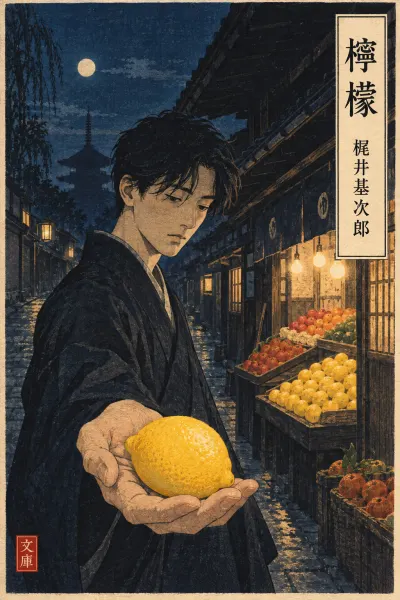
Part 3 of 4 · JLPT N2
檸檬 Remon, part 3: The Lemon's Weight, then Maruzen's Gloom
In this part
Holding the cool, fragrant lemon in his feverish hand, the narrator feels unexpectedly revived and happy, and drifts through the streets toying with fanciful ideas about its weight. His wandering brings him to Maruzen, a shop he usually avoids, but once inside his happiness drains away. He pulls out art book after art book without being able to look at them properly, and he leaves them piled up in weary gloom.
AI translation · independently checked
その檸檬の冷たさはたとえようもなくよかった。The coolness of that lemon was good beyond all comparison.
その頃私は肺尖を悪くしていていつも身体に熱が出た。At that time the tips of my lungs were diseased, and my body was always running a fever.
事実友達の誰彼に私の熱を見せびらかすために手の握り合いなどをしてみるのだが、私の掌が誰のよりも熱かった。In fact, I would try clasping hands with one friend or another to show off my fever, and my palm was hotter than anyone's.
その熱い故だったのだろう、握っている掌から身内に浸み透ってゆくようなその冷たさは快いものだった。Perhaps it was because of that heat that the coolness, which seemed to seep from my gripping palm right through my whole body, was so pleasant.
私は何度も何度もその果実を鼻に持っていっては嗅いでみた。Again and again I lifted the fruit to my nose and breathed in its scent.
それの産地だというカリフォルニヤが想像に上って来る。California, where it was said to have been grown, rose up in my imagination.
漢文で習った「売柑者之言」の中に書いてあった「鼻を撲つ」という言葉が断れぎれに浮かんで来る。The phrase "it strikes the nose," from "The Words of the Orange Seller," which I had studied in classical Chinese, came back to me in broken fragments.
そしてふかぶかと胸一杯に匂やかな空気を吸い込めば、ついぞ胸一杯に呼吸したことのなかった私の身体や顔には温い血のほとぼりが昇って来てなんだか身内に元気が目覚めて来たのだった。And as I drew the fragrant air deep down until my chest was full, the lingering warmth of blood rose into the body and face of one who had never once breathed to the full, and somehow a kind of vigour began to awaken within me.
…………
実際あんな単純な冷覚や触覚や嗅覚や視覚が、ずっと昔からこればかり探していたのだと言いたくなったほど私にしっくりしたなんて私は不思議に思える――それがあの頃のことなんだから。Truly, it strikes me as strange that such simple sensations of coolness, touch, smell and sight suited me so perfectly that I felt like saying this was exactly what I had been searching for all along — and this was in those days, of all times.
私はもう往来を軽やかな昂奮に弾んで、一種誇りかな気持さえ感じながら、美的装束をして街を𤄃歩した詩人のことなど思い浮かべては歩いていた。By now I was bounding along the street with a light excitement, even feeling a kind of pride, and as I walked I kept picturing poets who had strutted about town in aesthetic costume.
汚れた手拭の上へ載せてみたりマントの上へあてがってみたりして色の反映を量ったり、またこんなことを思ったり、I tried setting the lemon on my dirty hand towel, or holding it against my cloak, to gauge how its colour reflected, and I thought things like this:
――つまりはこの重さなんだな。"So in the end, it's this weight, isn't it."
――—
その重さこそ常づね尋ねあぐんでいたもので、疑いもなくこの重さはすべての善いものすべての美しいものを重量に換算して来た重さであるとか、思いあがった諧謔心からそんな馬鹿げたことを考えてみたり――なにがさて私は幸福だったのだ。That very weight was what I had always been searching for in vain; without a doubt this weight was the weight of every good thing and every beautiful thing converted into mass — out of a conceited sense of humour I entertained such foolish ideas — whatever else might be said, I was happy.
どこをどう歩いたのだろう、私が最後に立ったのは丸善の前だった。Where and how I had walked I cannot say, but the place where I finally came to a stop was in front of Maruzen.
平常あんなに避けていた丸善がその時の私にはやすやすと入れるように思えた。Maruzen, which I normally avoided so carefully, seemed to me at that moment a place I could walk into with ease.
「今日は一つ入ってみてやろう」そして私はずかずか入って行った。"Today, I think I'll just go in," and with that I strode straight inside.
しかしどうしたことだろう、私の心を充たしていた幸福な感情はだんだん逃げていった。But what was happening? The happy feeling that had filled my heart gradually slipped away.
香水の壜にも煙管にも私の心はのしかかってはゆかなかった。My heart did not lean toward either the perfume bottles or the pipes.
憂鬱が立て罩めて来る、私は歩き廻った疲労が出て来たのだと思った。Gloom came closing in around me, and I thought it must be the fatigue from all my walking catching up with me.
私は画本の棚の前へ行ってみた。I went over to the shelves of art books.
画集の重たいのを取り出すのさえ常に増して力が要るな!"Even taking out one of these heavy art collections takes more strength than usual!"
と思った。I thought.
しかし私は一冊ずつ抜き出してはみる、そして開けてはみるのだが、克明にはぐってゆく気持はさらに湧いて来ない。Still, I pulled the books out one by one and opened each one, but I felt no desire at all to leaf through them carefully.
しかも呪われたことにはまた次の一冊を引き出して来る。And yet, as if under a curse, I would pull out the next volume.
それも同じことだ。That one was no different.
それでいて一度バラバラとやってみなくては気が済まないのだ。Even so, I could not rest until I had riffled through it once.
それ以上は堪らなくなってそこへ置いてしまう。Then, unable to bear any more, I would simply put it down there.
以前の位置へ戻すことさえできない。I could not even put it back where it had been.
私は幾度もそれを繰り返した。I repeated this over and over.
とうとうおしまいには日頃から大好きだったアングルの橙色の重い本までなおいっそうの堪えがたさのために置いてしまった。In the end I put down even the heavy orange volume of Ingres, which I had always loved, because it was all the more unbearable.
――なんという呪われたことだ。What a cursed state of affairs!
手の筋肉に疲労が残っている。The tiredness lingered in the muscles of my hands.
私は憂鬱になってしまって、自分が抜いたまま積み重ねた本の群を眺めていた。Sunk in gloom, I stood gazing at the heap of books I had pulled out and left piled up.
以前にはあんなに私をひきつけた画本がどうしたことだろう。What on earth was the matter? These were the very art books that had once attracted me so strongly.
一枚一枚に眼を晒し終わって後、さてあまりに尋常な周囲を見廻すときのあの変にそぐわない気持を、私は以前には好んで味わっていたものであった。In the past I used to relish that strangely out-of-place feeling when, having let my eyes pass over every single plate, I would look around at surroundings that were all too ordinary.
…………
Vocabulary
| Word | Meaning | JLPT |
|---|---|---|
| 見せびらかすみせびらかす | to show off, flauntAlways has a sense of boasting. | N1 |
| 快いこころよい | pleasant, agreeableWritten-style word for a pleasant physical or mental sensation. | N1 |
| 断れぎれきれぎれ | in fragments, bit by bitdictionary form: 切れ切れUsually written 切れ切れ today. | — |
| ついぞついぞ | never once (with a negative)Literary; used with a negative verb, as in ついぞ…したことのなかった. | — |
| ほとぼりほとぼり | lingering heat, afterglow of warmthToday mostly heard in ほとぼりが冷める (for a fuss to die down). | — |
| 往来おうらい | street, roadOld-fashioned word for a public street; also means coming and going. | — |
| 𤄃歩かっぽ | to stride, swagger aboutdictionary form: 闊歩Normally written 闊歩; the text uses a rare variant kanji. | — |
| あてがってあてがう | to hold against, apply todictionary form: あてがう | — |
| 尋ねあぐんでたずねあぐむ | to search without success, tire of searchingdictionary form: 尋ねあぐむ〜あぐむ (literary) means to do something to the point of weariness. | — |
| 諧謔心かいぎゃくしん | sense of humour, playful wit諧謔 is a formal word for humour or jest. | — |
| ずかずかずかずか | boldly, without hesitation (of walking in)Onomatopoeic; suggests barging in without ceremony. | — |
| 立て罩めてたてこめる | to hang thickly, close in (of mist, gloom)dictionary form: 立て込めるModern spelling 立ち込める; 罩 is an archaic kanji. | — |
| 克明こくめい | careful, meticulous克明に = in painstaking detail. | — |
| そぐわないそぐわない | out of place, not fittingAlmost always used in the negative form. | — |
Grammar
〜ようもない N2 there is no way to ~
The verb stem plus ようもない (a stronger form of ようがない) means that the action is impossible. たとえようもなく means the coolness could not be compared to anything.
その檸檬の冷たさはたとえようもなくよかった。
The coolness of that lemon was good beyond all comparison.
〜ては N2 repeatedly doing A and then B
The て-form plus は describes a cycle of actions that is repeated. Here the narrator keeps bringing the lemon to his nose and smelling it.
私は何度も何度もその果実を鼻に持っていっては嗅いでみた。
Again and again I lifted the fruit to my nose and breathed in its scent.
〜こそ N3 precisely, this very ~
こそ strongly emphasises the preceding noun, marking it as the one thing that matters.
その重さこそ常づね尋ねあぐんでいたもので
That very weight was what I had always been searching for in vain
〜なくては気が済まない N2 cannot be satisfied unless ~
This pattern describes a compulsion: the speaker feels uneasy until the action has been done. The narrator cannot stop himself from riffling through each book.
それでいて一度バラバラとやってみなくては気が済まないのだ。
Even so, I could not rest until I had riffled through it once.
〜さえ N3 even ~
さえ marks something as a minimal or extreme case. Even the simple act of putting the book back is beyond the narrator.
以前の位置へ戻すことさえできない。
I could not even put it back where it had been.
〜たものであった N2 used to ~ (past habit)
The past tense plus ものだ (here the written form であった) recalls something the speaker did habitually in the past, often with a note of nostalgia.
私は以前には好んで味わっていたものであった。
In the past I used to relish it.