Advanced · JLPT N1
山月記Sangetsuki — Moonset on the Mountain Road
- JLPT N1
- 5,787 characters
- 4 parts
- about 48 minutes
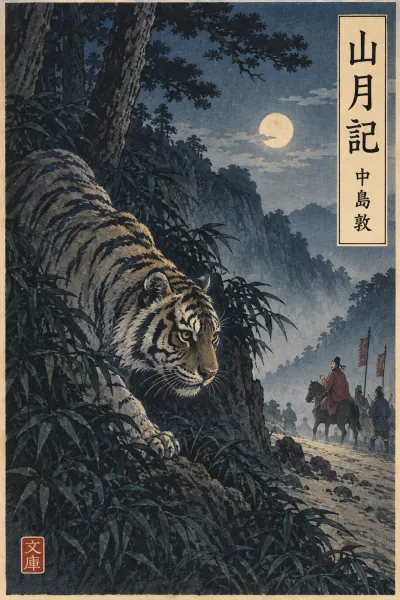
Sangetsuki is a short tale set in Tang-dynasty China, retold by Nakajima Atsushi from an older Chinese story about a man who becomes a tiger. Ri Chō, a gifted and proud scholar, abandons his official career to win fame as a poet, fails, and disappears. A year later his old friend En San, travelling through the mountains, meets a tiger on a moonlit road. It seems about to spring, then draws back into the thicket and speaks with Ri Chō's voice. Most of the story is the conversation that follows, in which a man looks back on how his own character shaped his fate. The tone is grave and restrained, with flashes of bitter self-mockery. This is a demanding text for learners. The prose is kanbun-influenced, dense with classical Chinese compounds and set phrases, and its sentences are long and tightly built. However, the story is short and the plot is simple, and much of it is one speaker explaining himself. Once the core vocabulary is familiar, his reasoning becomes much easier to follow. It is also one of the most widely read works of modern Japanese fiction in Japan.
Contents
Before you read
- Learn the story's key phrases before you start. The most important is 臆病な自尊心と尊大な羞恥心 ('cowardly pride and arrogant shame'), because the whole confession is built around it. Other useful words include 詩人, 虎, 叢 (くさむら, 'thicket'), 人間の心, and 獣.
- Expect kanbun-style literary grammar. Negative forms such as 〜ざる and the expression 〜を潔しとしない ('to disdain doing') appear again and again, together with 〜ねばならない, 〜得る (うる/える), 〜に至る and 〜つつ. Learn these as fixed patterns rather than analysing them every time they appear.
- In Ri Chō's monologue, watch the pronoun shift between 自分 and the more intimate, self-searching 己 (おれ). The shift often marks the moments when he stops explaining and starts confessing.
- Rhetorical questions carry much of Ri Chō's emotion. どうして〜ようか means 'how could I possibly…?', and 〜に忍びない means 'cannot bear to…'. Read these as strong statements, not as real questions.
- The impromptu poem in part 3 is written in classical Chinese (kanshi) with Japanese readings. On a first read it is fine to rely on the notes and translation for it, then return to it once the prose around it makes sense.
Words to know
The most useful words from the notes across the story.
| Word | Meaning | JLPT |
|---|---|---|
| 攫んでつかむ | to grip, to clutchdictionary form: 攫むNormally written 掴む. 攫 also means 'to snatch', as in 攫う (さらう). | N3 |
| 懼れたおそれる | to fear, to dreaddictionary form: 懼れるA literary kanji for 恐れる, suggesting deep, trembling dread. | N3 |
| 果してはたして | sure enough, just as expecteddictionary form: 果たしてIn statements it means 'as predicted'; in questions it means 'really?'. | N2 |
| 漸くようやく | gradually, little by little (also: at last)Implies something long awaited or gradual. | N2 |
| 厚かましいあつかましい | shameless, presumptuousHere used humbly of one's own request. | N2 |
| 自尊心じそんしん | pride, self-respect | N1 |
| 咄嗟にとっさ | in an instant, on the spur of the momentdictionary form: 咄嗟 | N1 |
| 消息しょうそく | news of someone; their whereabouts and circumstancesCommon in 消息を絶つ, 'to vanish without a trace'. | N1 |
| 茫然ぼうぜん | stunned, dazed, at a lossAlso written 呆然. It usually appears as 茫然とする. | N1 |
| 故人とも | old friendNormally 故人 (こじん) means 'the deceased'. Here it follows the classical Chinese sense of 'old friend', which the gloss とも makes clear. | N1 |
| 切なくせつない | heartbreaking, achingly painfuldictionary form: 切ないA painful, wistful ache in the chest. English has no exact equivalent. | N1 |
| 執着しゅうちゃく | attachment, clinging obsessionUsed as 〜に執着する, 'to cling to'. It has a slightly negative, obsessive nuance. | N1 |
| 臆病おくびょう | cowardly, timidA な-adjective. | N1 |
| 最早もはや | now, already (no longer possible to delay)Written/literary; often with a sense of resignation. | N1 |
| 狷介けんかい | stubbornly proud; unwilling to compromise or mix with othersLiterary word describing someone who keeps rigidly to his own standards; the key to Ri Chō's character. | — |
Plot summary
Show the full summary (contains spoilers)
Ri Chō, a brilliant but arrogant scholar, quits his post to devote himself to poetry. Fame never comes, and poverty forces him back into a minor provincial post under men he once despised. On a journey he goes mad one night and vanishes. A year later his friend En San, on an imperial mission, meets a tiger on a forest road. It seems about to spring but retreats into the thicket, and Ri Chō's voice speaks from it. He explains how he became a tiger and says that his human mind returns for fewer hours each day. He asks En San to record his poems, which En San admires but finds subtly lacking. Ri Chō then confesses that his 'cowardly pride and arrogant shame' turned him into a beast. At dawn he asks En San to care for his wife and child, reproaches himself for putting his poems first, and warns En San never to return. From a hilltop, En San's party watches the tiger roar at the fading moon and vanish.
About the author
Nakajima Atsushi was born in Tokyo into a family of scholars of the Chinese classics, a background that shows clearly in his style. After studying Japanese literature at Tokyo Imperial University, he taught at a girls' school in Yokohama. He later went to Palau, then under Japanese administration, to prepare Japanese-language textbooks for the South Seas Bureau. His small body of work includes several stories drawn from Chinese history and legend, among them Meijinden and Riryō.