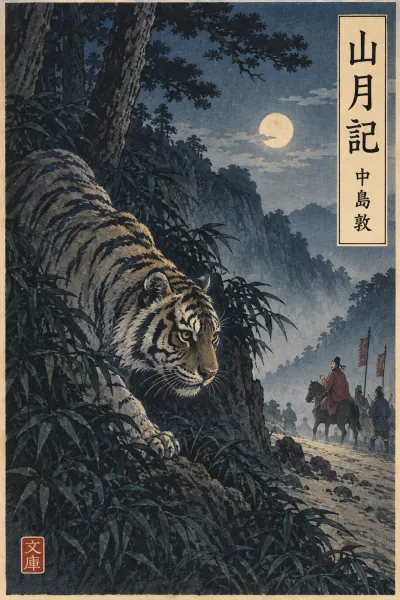
Part 2 of 4 · JLPT N1
山月記 Sangetsuki, part 2: The Voice in the Grass Tells Its Story
In this part
En San halts his escort and talks with the unseen voice as with an old friend, then asks how Ri Chō came to this state. Ri Chō tells how a voice called him into the night, how he found he had become a tiger, and how his human mind returns for only a few hours each day. Those hours are growing shorter, and he fears losing his humanity completely, so before that happens he wants to ask his friend a favour.
AI translation · independently checked
後で考えれば不思議だったが、その時、袁傪は、この超自然の怪異を、実に素直に受容れて、少しも怪もうとしなかった。Looking back afterwards, it seemed strange, but at the time En San accepted this supernatural marvel quite readily and made no attempt to question it.
彼は部下に命じて行列の進行を停め、自分は叢の傍に立って、見えざる声と対談した。He ordered his men to halt the procession, and he himself stood beside the thicket and conversed with the unseen voice.
都の噂、旧友の消息、袁傪が現在の地位、それに対する李徴の祝辞。News of the capital, word of old friends, En San's present position, and Ri Chō's congratulations on it.
青年時代に親しかった者同志の、あの隔てのない語調で、それ等が語られた後、袁傪は、李徴がどうして今の身となるに至ったかを訊ねた。When these things had been spoken of in the open, unguarded tone of men who had been close in their youth, En San asked how Ri Chō had come to be as he now was.
草中の声は次のように語った。The voice in the grass told the following story.
今から一年程前、自分が旅に出て汝水のほとりに泊った夜のこと、一睡してから、ふと眼を覚ますと、戸外で誰かが我が名を呼んでいる。About a year ago, on a night when I had set out on a journey and was lodging on the banks of the Josui, I had slept a while when I suddenly woke, and someone outside was calling my name.
声に応じて外へ出て見ると、声は闇の中から頻りに自分を招く。I answered the voice and went outside, and out of the darkness the voice kept beckoning me.
覚えず、自分は声を追うて走り出した。Without knowing what I did, I began to run after the voice.
無我夢中で駈けて行く中に、何時しか途は山林に入り、しかも、知らぬ間に自分は左右の手で地を攫んで走っていた。As I ran on in a frenzy, the path at some point entered the mountain forest, and, before I knew it, I was running with both hands gripping the ground.
何か身体中に力が充ち満ちたような感じで、軽々と岩石を跳び越えて行った。It was as though my whole body were brimming with strength, and I leapt lightly over rocks and boulders.
気が付くと、手先や肱のあたりに毛を生じているらしい。When I noticed, it seemed that hair had grown on my hands and around my elbows.
少し明るくなってから、谷川に臨んで姿を映して見ると、既に虎となっていた。When it had grown a little lighter, I went down to a mountain stream and looked at my reflection, and I had already become a tiger.
自分は初め眼を信じなかった。At first I did not believe my eyes.
次に、これは夢に違いないと考えた。Next I thought that this must surely be a dream.
夢の中で、これは夢だぞと知っているような夢を、自分はそれまでに見たことがあったから。For I had had dreams before in which, while dreaming, I knew that it was a dream.
どうしても夢でないと悟らねばならなかった時、自分は茫然とした。When I was forced to understand that it was not a dream after all, I was stunned.
そうして懼れた。And I was afraid.
全く、どんな事でも起り得るのだと思うて、深く懼れた。Thinking that truly anything at all could happen, I was deeply afraid.
しかし、何故こんな事になったのだろう。But why had such a thing happened?
分らぬ。I do not know.
全く何事も我々には判らぬ。Truly, we understand nothing at all.
理由も分らずに押付けられたものを大人しく受取って、理由も分らずに生きて行くのが、我々生きもののさだめだ。To accept meekly whatever is forced upon us without knowing why, and to go on living without knowing why: that is the fate of us living creatures.
自分は直ぐに死を想うた。At once I thought of death.
しかし、その時、眼の前を一匹の兎が駈け過ぎるのを見た途端に、自分の中の人間は忽ち姿を消した。But at that moment, the instant I saw a hare run past before my eyes, the man inside me vanished.
再び自分の中の人間が目を覚ました時、自分の口は兎の血に塗れ、あたりには兎の毛が散らばっていた。When the man inside me woke again, my mouth was smeared with the hare's blood, and its fur lay scattered all around.
これが虎としての最初の経験であった。That was my first experience as a tiger.
それ以来今までにどんな所行をし続けて来たか、それは到底語るに忍びない。What deeds I have gone on committing from then until now, I cannot bear to tell.
ただ、一日の中に必ず数時間は、人間の心が還って来る。Only, for some hours in every day, without fail, my human mind returns.
そういう時には、曾ての日と同じく、人語も操れれば、複雑な思考にも堪え得るし、経書の章句を誦んずることも出来る。At such times, just as in former days, I can use human speech, am capable of complex thought, and can even recite passages from the Classics.
その人間の心で、虎としての己の残虐な行のあとを見、己の運命をふりかえる時が、最も情なく、恐しく、憤ろしい。It is when, with that human mind, I see the traces of my cruel deeds as a tiger and look back upon my fate, that I feel most wretched, most afraid and most bitterly angry.
しかし、その、人間にかえる数時間も、日を経るに従って次第に短くなって行く。Yet even those few hours in which I return to being human grow gradually shorter as the days go by.
今までは、どうして虎などになったかと怪しんでいたのに、この間ひょいと気が付いて見たら、己はどうして以前、人間だったのかと考えていた。Until now I had wondered how I could have become such a thing as a tiger, but the other day I suddenly noticed that I was wondering how I had ever been a man before.
これは恐しいことだ。This is a terrible thing.
今少し経てば、己の中の人間の心は、獣としての習慣の中にすっかり埋れて消えて了うだろう。A little more time, and the human mind within me will be wholly buried and lost beneath the habits of a beast.
ちょうど、古い宮殿の礎が次第に土砂に埋没するように。Just as the foundation stones of an old palace are slowly buried under earth and sand.
そうすれば、しまいに己は自分の過去を忘れ果て、一匹の虎として狂い廻り、今日のように途で君と出会っても故人と認めることなく、君を裂き喰うて何の悔も感じないだろう。And then in the end I shall forget my past completely and rage about as a mere tiger, and even if I meet you on the road as I did today, I shall not know you for my old friend, and I shall tear you apart and devour you and feel no remorse at all.
一体、獣でも人間でも、もとは何か他のものだったんだろう。Come to think of it, beasts and men alike were probably all something else to begin with.
初めはそれを憶えているが、次第に忘れて了い、初めから今の形のものだったと思い込んでいるのではないか?At first they remember it, but little by little they forget, until they are convinced that they have always been in their present form, is that not so?
いや、そんな事はどうでもいい。No, such things do not matter.
己の中の人間の心がすっかり消えて了えば、恐らく、その方が、己はしあわせになれるだろう。If the human mind within me vanishes completely, I shall probably be happier that way.
だのに、己の中の人間は、その事を、この上なく恐しく感じているのだ。And yet the man within me finds that prospect more terrible than anything.
ああ、全く、どんなに、恐しく、哀しく、切なく思っているだろう!Ah, truly, how terrible, how sad, how painful it seems to him!
己が人間だった記憶のなくなることを。That the memory of my having been a man should disappear.
この気持は誰にも分らない。No one can understand this feeling.
誰にも分らない。No one can understand it.
己と同じ身の上に成った者でなければ。No one who has not come to share my fate.
ところで、そうだ。Now then—yes.
己がすっかり人間でなくなって了う前に、一つ頼んで置きたいことがある。Before I cease to be human altogether, there is one thing I wish to ask of you.
Vocabulary
| Word | Meaning | JLPT |
|---|---|---|
| 怪異かいい | strange, supernatural occurrence; a wonderLiterary word. 怪 means 'mysterious, suspicious', and 異 means 'strange'. | — |
| 消息しょうそく | news of someone; their whereabouts and circumstancesCommon in 消息を絶つ, 'to vanish without a trace'. | N1 |
| 覚えずおぼえず | without realising it; involuntarilyLiterary form. Modern Japanese uses 思わず. | — |
| 無我夢中むがむちゅう | in a frenzy; completely carried awayFour-character idiom meaning 'no self, in a dream'. It is often followed by で. | — |
| 攫んでつかむ | to grip, to clutchdictionary form: 攫むNormally written 掴む. 攫 also means 'to snatch', as in 攫う (さらう). | N3 |
| 茫然ぼうぜん | stunned, dazed, at a lossAlso written 呆然. It usually appears as 茫然とする. | N1 |
| 懼れたおそれる | to fear, to dreaddictionary form: 懼れるA literary kanji for 恐れる, suggesting deep, trembling dread. | N3 |
| さだめさだめ | fate, destinydictionary form: 定めLiterary and poetic. A near synonym of 運命. | — |
| 所行しょぎょう | deeds, conduct (usually bad)Also written 所業. It carries a negative tone. | — |
| 誦んずるそらんずる | to recite from memoryLiterary. Modern Japanese says 暗記している or 暗唱する. | — |
| 経書けいしょ | the Confucian ClassicsThe canonical texts every scholar-official had to master. | — |
| 埋没まいぼつ | being buried; sinking out of sightAlso used figuratively for talent or people who fade into obscurity. | — |
| 故人とも | old friendNormally 故人 (こじん) means 'the deceased'. Here it follows the classical Chinese sense of 'old friend', which the gloss とも makes clear. | N1 |
| 切なくせつない | heartbreaking, achingly painfuldictionary form: 切ないA painful, wistful ache in the chest. English has no exact equivalent. | N1 |
Grammar
〜ざる N1 not (classical negative before a noun)
ざる is the attributive form of the classical negative ず and modifies a following noun. 見えざる声 means the same as 見えない声.
見えざる声と対談した
conversed with the unseen voice
〜に至る N2 to come to (a situation), to end up
Attached to a verb in the dictionary form, it stresses the end point of a long course of events. Here it frames Ri Chō's transformation as the outcome of a process.
李徴がどうして今の身となるに至ったかを訊ねた
asked how Ri Chō had come to be as he now was
〜ねばならない N2 must, have to
ね is the realis (izenkei) form of the literary negative ぬ, and ねば (izenkei + ば) gives 'if not'. 〜ねばならない is the older equivalent of 〜なければならない, 'must, have to'.
どうしても夢でないと悟らねばならなかった時
when I was forced to understand that it was not a dream after all
〜得る N2 can, be possible
After the verb stem, 得る expresses possibility and is read える or うる. 起り得る means 'can happen'.
どんな事でも起り得るのだと思うて
thinking that anything at all could happen
〜に忍びない N1 cannot bear to do
Attached to a verb in the dictionary form, it expresses that doing something is too painful or shameful to endure. 語るに忍びない means 'I cannot bear to tell'.
それは到底語るに忍びない
that I cannot possibly bear to tell
〜に従って N2 as ~, in proportion to ~
It links two changes that progress together. As the days pass, the human hours shrink.
日を経るに従って次第に短くなって行く
grow gradually shorter as the days go by