Part 1 of 4 · JLPT N1
山月記 Sangetsuki, part 1: A Poet Vanishes, a Tiger Speaks
In this part
Ri Chō, a brilliant but proud scholar, quits his official post to devote himself to poetry, but fame does not come, and poverty forces him back into a minor provincial post under men he once looked down on. Embittered, he goes mad one night while travelling and vanishes into the darkness. A year later his old friend En San, travelling on an imperial mission, is confronted on a forest road by a tiger that seems about to spring but suddenly retreats into the thicket; from it comes Ri Chō's voice, explaining that he has become a creature of another kind.
AI translation · independently checked
隴西の李徴は博学才穎、天宝の末年、若くして名を虎榜に連ね、ついで江南尉に補せられたが、性、狷介、自ら恃むところ頗る厚く、賤吏に甘んずるを潔しとしなかった。Ri Chō of Rōsei was a man of wide learning and brilliant talent; in the last years of the Tianbao era, while still young, he had his name entered on the roll of successful candidates, and was then appointed a district officer in Kōnan; but he was proud and unbending by nature, had great faith in himself, and would not stoop to be content with the post of a lowly official.
いくばくもなく官を退いた後は、故山、虢略に帰臥し、人と交を絶って、ひたすら詩作に耽った。Before long he resigned his office, and afterwards he withdrew to his old home in Kakuryaku, cut off all dealings with others, and gave himself up entirely to writing poetry.
下吏となって長く膝を俗悪な大官の前に屈するよりは、詩家としての名を死後百年に遺そうとしたのである。Rather than become a petty official and bend his knee for years before vulgar high-ranking men, he meant to leave a name as a poet that would last a hundred years after his death.
しかし、文名は容易に揚らず、生活は日を逐うて苦しくなる。His literary fame, however, did not come easily, and his life grew harder day by day.
李徴は漸く焦躁に駆られて来た。Little by little, Ri Chō came to be driven by restless anxiety.
この頃からその容貌も峭刻となり、肉落ち骨秀で、眼光のみ徒らに炯々として、曾て進士に登第した頃の豊頬の美少年の俤は、何処に求めようもない。From about this time his features grew sharp and severe, the flesh fell away and the bones stood out, and only his eyes burned with a fierce but useless light; of the handsome, full-cheeked youth he had been when he passed the imperial examination, no trace could be found anywhere.
数年の後、貧窮に堪えず、妻子の衣食のために遂に節を屈して、再び東へ赴き、一地方官吏の職を奉ずることになった。After some years, unable to bear his poverty, he at last swallowed his pride for the sake of feeding and clothing his wife and child, went east once more, and took up a post as a provincial official.
一方、これは、己の詩業に半ば絶望したためでもある。At the same time, this was also because he had half despaired of his own work as a poet.
曾ての同輩は既に遥か高位に進み、彼が昔、鈍物として歯牙にもかけなかったその連中の下命を拝さねばならぬことが、往年の儁才李徴の自尊心を如何に傷けたかは、想像に難くない。His former fellows had already risen far above him to high rank, and it is not hard to imagine how deeply it wounded the pride of Ri Chō, once so gifted, to have to receive orders from the very men he had long ago dismissed as dullards, not worth a moment's notice.
彼は怏々として楽しまず、狂悖の性は愈々抑え難くなった。He was sullen and joyless, and his wild, perverse temper grew more and more difficult to hold in check.
一年の後、公用で旅に出、汝水のほとりに宿った時、遂に発狂した。A year later, when he set out on official business and lodged beside the river Josui, he finally went mad.
或夜半、急に顔色を変えて寝床から起上ると、何か訳の分らぬことを叫びつつそのまま下にとび下りて、闇の中へ駈出した。One night, at midnight, his expression suddenly changed; he sprang up from his bed and, shouting something no one could make out, leapt straight down outside and ran off into the darkness.
彼は二度と戻って来なかった。He never came back.
附近の山野を捜索しても、何の手掛りもない。Though the surrounding hills and fields were searched, not a single clue was found.
その後李徴がどうなったかを知る者は、誰もなかった。No one knew what had become of Ri Chō after that.
翌年、監察御史、陳郡の袁傪という者、勅命を奉じて嶺南に使し、途に商於の地に宿った。The following year, an imperial censor named En San, of Chingun, was sent to Reinan on the emperor's orders, and on the way he lodged at a place called Shōo.
次の朝未だ暗い中に出発しようとしたところ、駅吏が言うことに、これから先の道に人喰虎が出る故、旅人は白昼でなければ、通れない。The next morning, when he was about to set off while it was still dark, the post-station official told him that a man-eating tiger appeared on the road ahead, so travellers could not pass except in broad daylight.
今はまだ朝が早いから、今少し待たれたが宜しいでしょうと。"It is still early in the morning now, so it would be best if you waited a little longer," he said.
袁傪は、しかし、供廻りの多勢なのを恃み、駅吏の言葉を斥けて、出発した。En San, however, trusting in the size of his retinue, brushed aside the official's words and set out.
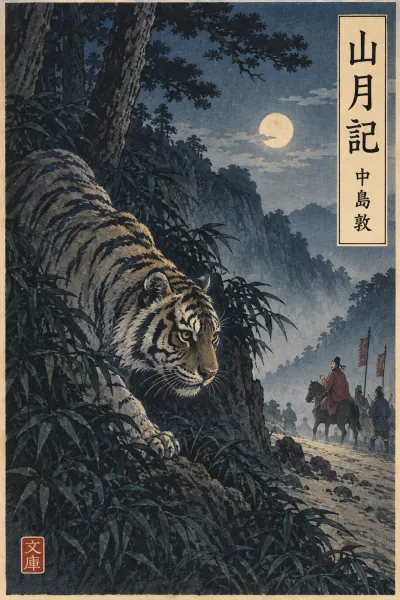
残月の光をたよりに林中の草地を通って行った時、果して一匹の猛虎が叢の中から躍り出た。As they made their way through a grassy clearing in the woods by the light of the lingering moon, sure enough, a fierce tiger leapt out of the thicket.
虎は、あわや袁傪に躍りかかるかと見えたが、忽ち身を飜して、元の叢に隠れた。The tiger seemed on the very point of springing upon En San, but in an instant it turned its body about and hid again in the thicket it had come from.
叢の中から人間の声で「あぶないところだった」と繰返し呟くのが聞えた。From inside the thicket, a human voice could be heard murmuring over and over, "That was close."
その声に袁傪は聞き憶えがあった。En San knew that voice.
驚懼の中にも、彼は咄嗟に思いあたって、叫んだ。Even in the midst of his alarm and fear, it came to him in a flash, and he cried out:
「その声は、我が友、李徴子ではないか?」袁傪は李徴と同年に進士の第に登り、友人の少かった李徴にとっては、最も親しい友であった。"That voice—is it not my friend, Master Ri Chō?" En San had passed the imperial examination in the same year as Ri Chō, and to Ri Chō, who had few friends, he was the closest friend of all.
温和な袁傪の性格が、峻峭な李徴の性情と衝突しなかったためであろう。It was probably because En San's gentle character never clashed with Ri Chō's harsh and severe temperament.
叢の中からは、暫く返辞が無かった。For a while, no answer came from the thicket.
しのび泣きかと思われる微かな声が時々洩れるばかりである。There was only, now and then, a faint sound that might have been muffled weeping.
ややあって、低い声が答えた。After a time, a low voice answered.
「如何にも自分は隴西の李徴である」と。"Indeed, I am Ri Chō of Rōsei."
袁傪は恐怖を忘れ、馬から下りて叢に近づき、懐かしげに久闊を叙した。En San forgot his fear, got down from his horse, approached the thicket, and warmly spoke of how long it had been since they last met.
そして、何故叢から出て来ないのかと問うた。Then he asked why Ri Chō would not come out of the thicket.
李徴の声が答えて言う。Ri Chō's voice answered him, saying:
自分は今や異類の身となっている。I have now become a creature of another kind.
どうして、おめおめと故人の前にあさましい姿をさらせようか。How could I shamelessly expose this wretched form before an old friend?
かつ又、自分が姿を現せば、必ず君に畏怖嫌厭の情を起させるに決っているからだ。What is more, if I showed myself, I would surely rouse in you feelings of dread and loathing.
しかし、今、図らずも故人に遇うことを得て、愧赧の念をも忘れる程に懐かしい。And yet now, having so unexpectedly been granted a meeting with an old friend, I am so moved that I forget even my shame.
どうか、ほんの暫くでいいから、我が醜悪な今の外形を厭わず、曾て君の友李徴であったこの自分と話を交してくれないだろうか。Will you not, just for a little while, overlook my hideous present shape and talk with me, who was once your friend Ri Chō?
Vocabulary
| Word | Meaning | JLPT |
|---|---|---|
| 狷介けんかい | stubbornly proud; unwilling to compromise or mix with othersLiterary word describing someone who keeps rigidly to his own standards; the key to Ri Chō's character. | — |
| 頗るすこぶる | very, exceedinglyFormal or old-fashioned adverb, close in meaning to とても or 非常に. | — |
| 甘んずるあまんずる | to be content with; to resign oneself to (something inferior)Literary form of 甘んじる, usually used with に: 現状に甘んじる. | — |
| 耽ったふける | to be absorbed in, to indulge indictionary form: 耽るUsed with に: 読書に耽る, 物思いに耽る. | — |
| 焦躁しょうそう | restless impatience, anxious frustrationdictionary form: 焦燥Now usually written 焦燥; often used in 焦燥に駆られる, 'to be driven by anxiety'. | — |
| 俤おもかげ | trace (of a former look); remembered imageUsually written 面影 today. | — |
| 進士しんし | successful candidate in the imperial civil-service examinationThe highest degree in the Chinese examination system; 虎榜 in the first sentence is the list of these candidates. | — |
| 歯牙にもかけなかったしがにもかけない | to pay no attention to, to consider beneath noticedictionary form: 歯牙にもかけないIdiom: literally 'not even put between one's teeth'. | — |
| 自尊心じそんしん | pride, self-respect | N1 |
| 勅命ちょくめい | imperial command勅 is used for things coming from the emperor; 勅命を奉じる means 'to carry out the emperor's orders'. | — |
| 果してはたして | sure enough, just as expecteddictionary form: 果たしてIn statements it means 'as predicted'; in questions it means 'really?'. | N2 |
| 叢くさむら | thicket, clump of grassAlso written 草むら. | — |
| 咄嗟にとっさ | in an instant, on the spur of the momentdictionary form: 咄嗟 | N1 |
| 異類いるい | a being of a different kind; a non-human creature異類の身となる means 'to become something other than human'. | — |
Grammar
〜を潔しとしない N1 to think it beneath one; to refuse out of pride
潔し is the classical form of 潔い, meaning 'pure' or 'honourable'. 〜を潔しとしない means 'not to consider X honourable', so the person refuses to accept X. Here X is being content with a lowly post (賤吏に甘んずる).
賤吏に甘んずるを潔しとしなかった。
he would not stoop to be content with the post of a lowly official.
〜よりは N3 rather than ~
よりは marks the option that is rejected, and the preferred choice comes after it. Ri Chō prefers leaving a poet's name to bowing before vulgar officials.
下吏となって長く膝を俗悪な大官の前に屈するよりは、詩家としての名を死後百年に遺そうとしたのである。
Rather than become a petty official and bend his knee for years before vulgar high-ranking men, he meant to leave a name as a poet that would last a hundred years after his death.
〜つつ N2 while ~ing
つつ attaches to the verb stem and is a written equivalent of ながら. Here Ri Chō shouts and leaps down at the same time.
何か訳の分らぬことを叫びつつそのまま下にとび下りて
shouting something no one could make out, he leapt straight down
どうして〜ようか N2 how could I possibly ~? (rhetorical)
どうして followed by a volitional form plus か makes a rhetorical question that expects the answer 'I could not'. The potential form さらせる shows that Ri Chō finds it impossible to show himself.
どうして、おめおめと故人の前にあさましい姿をさらせようか。
How could I shamelessly expose this wretched form before an old friend?
〜に決まっている N3 surely will ~; is bound to ~
This pattern expresses strong certainty. Combined with 必ず, it stresses that Ri Chō is sure his appearance would horrify his friend.
必ず君に畏怖嫌厭の情を起させるに決っているからだ。
because I would surely rouse in you feelings of dread and loathing.