Part 3 of 4 · JLPT N1
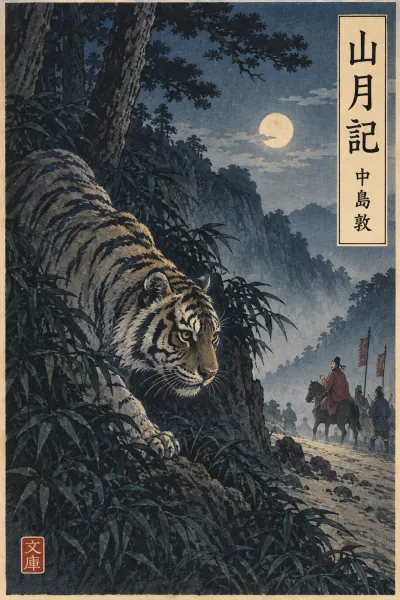
山月記 Sangetsuki, part 3: Poems from the Grass, a Tiger's Confession
In this part
Ri Chō asks En San to record the dozens of poems he can still recite. En San admires them but feels that something subtle is lacking. Ri Chō then self-mockingly recites an impromptu poem about his fate, confesses that his cowardly pride and arrogant shame were the beast within him that made him a tiger, and describes his anguish and lonely roaring at the moon.
AI translation · independently checked
袁傪はじめ一行は、息をのんで、叢中の声の語る不思議に聞入っていた。En San and all his party held their breath and listened intently to the strange tale the voice in the thicket was telling.
声は続けて言う。The voice went on.
他でもない。It is simply this.
自分は元来詩人として名を成す積りでいた。From the start I meant to make my name as a poet.
しかも、業未だ成らざるに、この運命に立至った。Yet before that work was done, I came to this fate.
曾て作るところの詩数百篇、固より、まだ世に行われておらぬ。The several hundred poems I once wrote are, of course, still unknown to the world.
遺稿の所在も最早判らなくなっていよう。By now even the whereabouts of my manuscripts must be lost.
ところで、その中、今も尚記誦せるものが数十ある。But among them there are some dozens that I can still recite from memory.
これを我が為に伝録して戴きたいのだ。I would like you to write these down and pass them on for my sake.
何も、これに仍って一人前の詩人面をしたいのではない。It is not at all that I wish to pass myself off as a full-fledged poet on the strength of them.
作の巧拙は知らず、とにかく、産を破り心を狂わせてまで自分が生涯それに執着したところのものを、一部なりとも後代に伝えないでは、死んでも死に切れないのだ。Whether the work is good or poor I cannot say, but this is the thing I clung to all my life, even to the ruin of my fortune and my reason, and unless I can hand down at least a part of it to later ages, I cannot die in peace.
袁傪は部下に命じ、筆を執って叢中の声に随って書きとらせた。En San gave orders to one of his men, who took up a brush and wrote as the voice in the thicket dictated.
李徴の声は叢の中から朗々と響いた。Ri Chō's voice rang out clear and full from within the grass.
長短凡そ三十篇、格調高雅、意趣卓逸、一読して作者の才の非凡を思わせるものばかりである。There were some thirty poems, long and short, lofty and refined in style, remarkable in conception, every one of them making plain at a single reading that their author's gift was out of the ordinary.
しかし、袁傪は感嘆しながらも漠然と次のように感じていた。Yet even as he admired them, En San had a vague feeling of the following kind.
成程、作者の素質が第一流に属するものであることは疑いない。Certainly there was no doubt that the author's talent was of the very first rank.
しかし、このままでは、第一流の作品となるのには、何処か(非常に微妙な点に於て)欠けるところがあるのではないか、と。Still, as they stood, was there not something lacking somewhere (in some extremely subtle point) that kept them from becoming works of the first rank?
旧詩を吐き終った李徴の声は、突然調子を変え、自らを嘲るか如くに言った。When he had finished pouring out his old poems, Ri Chō's voice suddenly changed its tone, and he spoke as if mocking himself.
羞しいことだが、今でも、こんなあさましい身と成り果てた今でも、己は、己の詩集が長安風流人士の机の上に置かれている様を、夢に見ることがあるのだ。It is shameful to admit, but even now, even now that I have sunk into this wretched form, I sometimes dream of my collected poems lying on the desks of the men of taste in Chōan.
岩窟の中に横たわって見る夢にだよ。It is in dreams I have while lying in a cave among the rocks, you know.
嗤ってくれ。Laugh at me.
詩人に成りそこなって虎になった哀れな男を。At this pitiful man who failed to become a poet and became a tiger instead.
(袁傪は昔の青年李徴の自嘲癖を思出しながら、哀しく聞いていた。)そうだ。(En San listened sadly, remembering young Ri Chō's old habit of mocking himself.) Yes.
お笑い草ついでに、今の懐を即席の詩に述べて見ようか。While I am making a laughingstock of myself, shall I try to put my present feelings into a poem on the spot?
この虎の中に、まだ、曾ての李徴が生きているしるしに。As a sign that the Ri Chō of old still lives inside this tiger.
袁傪は又下吏に命じてこれを書きとらせた。Again En San ordered his clerk to write it down.
その詩に言う。The poem ran as follows.
偶因狂疾成殊類 災患相仍不可逃By chance, through a fit of madness, I became a creature of another kind; calamity upon calamity, and no way to escape.
今日爪牙誰敢敵 当時声跡共相高Today, who would dare to face my claws and fangs? In those days your name and mine stood equally high.
我為異物蓬茅下 君已乗軺気勢豪I have become a strange beast beneath the tangled weeds, while you already ride the envoy's carriage in high estate.
此夕渓山対明月 不成長嘯但成嘷Tonight, facing the bright moon over valley and mountain, I cannot chant a long song, but only howl.
時に、残月、光冷やかに、白露は地に滋く、樹間を渡る冷風は既に暁の近きを告げていた。By then the setting moon shone cold, white dew lay thick on the ground, and the chill wind passing through the trees already announced that dawn was near.
人々は最早、事の奇異を忘れ、粛然として、この詩人の薄倖を嘆じた。The men no longer thought how strange it all was; in solemn silence they grieved over the poet's ill fortune.
李徴の声は再び続ける。Ri Chō's voice went on again.
何故こんな運命になったか判らぬと、先刻は言ったが、しかし、考えように依れば、思い当ることが全然ないでもない。A while ago I said I did not know why this fate had come to me, but, if I think about it, I am not entirely without some idea.
人間であった時、己は努めて人との交を避けた。When I was a man, I deliberately avoided the company of others.
人々は己を倨傲だ、尊大だといった。People called me arrogant and haughty.
実は、それが殆ど羞恥心に近いものであることを、人々は知らなかった。They did not know that in truth it was something very close to shame.
勿論、曾ての郷党の鬼才といわれた自分に、自尊心が無かったとは云わない。Of course, I will not say that I, once called the prodigy of my home district, had no pride.
しかし、それは臆病な自尊心とでもいうべきものであった。But it was what one might call a cowardly pride.
己は詩によって名を成そうと思いながら、進んで師に就いたり、求めて詩友と交って切磋琢磨に努めたりすることをしなかった。Though I meant to make my name through poetry, I never took it upon myself to study under a master, nor did I seek out fellow poets to work at polishing one another's craft.
かといって、又、己は俗物の間に伍することも潔しとしなかった。Yet at the same time I could not bring myself to stand among the common herd either.
共に、我が臆病な自尊心と、尊大な羞恥心との所為である。Both were the fault of my cowardly pride and my arrogant shame.
己の珠に非ざることを惧れるが故に、敢て刻苦して磨こうともせず、又、己の珠なるべきを半ば信ずるが故に、碌々として瓦に伍することも出来なかった。Because I feared I might not be a jewel, I would not labour hard to polish myself; and because I half believed I must be a jewel, I could not bear to take my place idly among the common tiles.
己は次第に世と離れ、人と遠ざかり、憤悶と慙恚とによって益々己の内なる臆病な自尊心を飼いふとらせる結果になった。Little by little I drew away from the world and kept apart from people, and the result was that, through resentment and shamed anger, I fed the cowardly pride within me ever fatter.
人間は誰でも猛獣使であり、その猛獣に当るのが、各人の性情だという。They say every man is a tamer of wild beasts, and the beast in each case is his own nature.
己の場合、この尊大な羞恥心が猛獣だった。In my case, this arrogant shame was the beast.
虎だったのだ。It was a tiger.
これが己を損い、妻子を苦しめ、友人を傷つけ、果ては、己の外形をかくの如く、内心にふさわしいものに変えて了ったのだ。It ruined me, made my wife and child suffer, wounded my friends, and in the end changed my outward shape into this, to match what was within.
今思えば、全く、己は、己の有っていた僅かばかりの才能を空費して了った訳だ。When I think of it now, I have utterly wasted what little talent I had.
人生は何事をも為さぬには余りに長いが、何事かを為すには余りに短いなどと口先ばかりの警句を弄しながら、事実は、才能の不足を暴露するかも知れないとの卑怯な危惧と、刻苦を厭う怠惰とが己の凡てだったのだ。I would toy with glib aphorisms such as 'Life is too long to do nothing, yet too short to do anything,' but in truth a coward's dread that I might expose my lack of talent, and a sloth that shrank from hard work, were all there was to me.
己よりも遥かに乏しい才能でありながら、それを専一に磨いたがために、堂々たる詩家となった者が幾らでもいるのだ。There are any number of men with far less talent than mine who, because they polished it single-mindedly, became poets of true standing.
虎と成り果てた今、己は漸くそれに気が付いた。Only now, having sunk to being a tiger, have I finally realised it.
それを思うと、己は今も胸を灼かれるような悔を感じる。When I think of it, even now I feel a remorse as though my heart were being scorched.
己には最早人間としての生活は出来ない。I can no longer live a human life.
たとえ、今、己が頭の中で、どんな優れた詩を作ったにしたところで、どういう手段で発表できよう。Even if I were now to compose the finest poem in my head, by what means could I make it known?
まして、己の頭は日毎に虎に近づいて行く。What is more, my mind draws closer to a tiger's with every day.
どうすればいいのだ。What am I to do?
己の空費された過去は?And my wasted past?
己は堪らなくなる。I cannot bear it.
そういう時、己は、向うの山の頂の巖に上り、空谷に向って吼える。At such times I climb the rocks on the summit of the mountain over there and roar into the empty valley.
この胸を灼く悲しみを誰かに訴えたいのだ。I want to pour out to someone this grief that burns my heart.
己は昨夕も、彼処で月に向って咆えた。Last night too I roared at the moon from up there.
誰かにこの苦しみが分って貰えないかと。Hoping someone might understand this suffering.
しかし、獣どもは己の声を聞いて、唯、懼れ、ひれ伏すばかり。But the beasts, hearing my voice, only cower in fear and prostrate themselves.
山も樹も月も露も、一匹の虎が怒り狂って、哮っているとしか考えない。The mountains, the trees, the moon and the dew think only that a tiger is raging and roaring in fury.
天に躍り地に伏して嘆いても、誰一人己の気持を分ってくれる者はない。Though I leap toward heaven and throw myself upon the earth in lament, there is not a single one who understands how I feel.
ちょうど、人間だった頃、己の傷つき易い内心を誰も理解してくれなかったように。Just as, when I was a man, no one understood my easily wounded heart.
己の毛皮の濡れたのは、夜露のためばかりではない。It is not only the night dew that has wet my fur.
Vocabulary
| Word | Meaning | JLPT |
|---|---|---|
| 息をのんでいきをのむ | to hold one's breath (in suspense or amazement)dictionary form: 息をのむLiterally 'to swallow one's breath'. Often written 息を呑む. | — |
| 名を成すなをなす | to make a name for oneself, to become famousA key phrase for Ri Chō's ambition. It returns in his confession. | — |
| 執着しゅうちゃく | attachment, clinging obsessionUsed as 〜に執着する, 'to cling to'. It has a slightly negative, obsessive nuance. | N1 |
| 成り果てたなりはてる | to end up as, to sink to (a wretched state)dictionary form: 成り果てる果てる adds the sense of reaching a bad final state. | — |
| 自嘲癖じちょうへき | habit of mocking oneself自嘲 means self-mockery, and 癖 means habit. The same kanji 癖 is read くせ on its own. | — |
| 薄倖はっこう | misfortune, ill fateLiterary. Also written 薄幸. | — |
| 倨傲きょごう | arrogant, haughtyA rare literary word. 尊大, which follows it, means almost the same thing. | — |
| 羞恥心しゅうちしん | sense of shamePaired with 自尊心 (pride) in the story's central phrases 臆病な自尊心 and 尊大な羞恥心. | — |
| 臆病おくびょう | cowardly, timidA な-adjective. | N1 |
| 切磋琢磨せっさたくま | polishing one's skills together with others; mutual improvementA four-character idiom from cutting and polishing jade and bone. | — |
| 潔しとしなかったいさぎよしとする | (negative) to refuse out of pride; to be unable to bring oneself todictionary form: 潔しとするAlmost always used in the negative: 〜を潔しとしない. | — |
| 刻苦こっく | hard toil, painstaking effortLiterary. Compare the set phrase 刻苦勉励, 'diligent study'. | — |
| 空費くうひ | waste, squanderingMade of 空 (empty) and 費 (spend). Used as 空費する. | — |
| 警句けいく | aphorism, witty maxim警句を弄する means to toy with clever sayings. | — |
Grammar
〜ざる N1 classical negative (= 〜ない) modifying a noun or clause
ざる is the attributive form of the classical negative ず. Here 業未だ成らざるに means 'while the work was not yet accomplished'. The same form appears in 珠に非ざる, 'not being a jewel'.
業未だ成らざるに、この運命に立至った。
Before that work was done, I came to this fate.
〜ないでは…ない N2 unless one does X, one cannot…
The pattern 伝えないでは is followed by 死んでも死に切れない. Together they express that failing to do something makes the next thing impossible. 死に切れない means 'cannot die with peace of mind'.
一部なりとも後代に伝えないでは、死んでも死に切れないのだ。
Unless I hand down at least a part of it to later ages, I cannot die in peace.
〜ながらも N2 although, even while
Attached to a verb stem, ながらも shows contrast rather than simultaneous action. En San admires the poems, yet he still has doubts about them.
袁傪は感嘆しながらも漠然と次のように感じていた。
Even as he admired them, En San had a vague feeling of the following kind.
〜が故に N1 because of, on account of
A formal, literary way to give a reason. It is used here twice in parallel clauses to show how two opposite fears led to the same paralysis.
己の珠に非ざることを惧れるが故に、敢て刻苦して磨こうともせず
Because I feared I might not be a jewel, I would not labour hard to polish myself.
〜には余りに… N2 too … for (doing) X
The pattern [verb]には余りに[adjective] means something is excessively so for that purpose. Two contrasting clauses of this kind form the aphorism.
人生は何事をも為さぬには余りに長いが、何事かを為すには余りに短い
Life is too long to do nothing, yet too short to do anything.
たとえ〜にしたところで N1 even if (supposing that) …
This is a strong concessive meaning 'even supposing'. Here it is paired with a rhetorical question (できよう), which implies 'there is no way'.
どんな優れた詩を作ったにしたところで、どういう手段で発表できよう。
Even if I were to compose the finest poem, by what means could I make it known?