Part 1 of 4 · JLPT N1
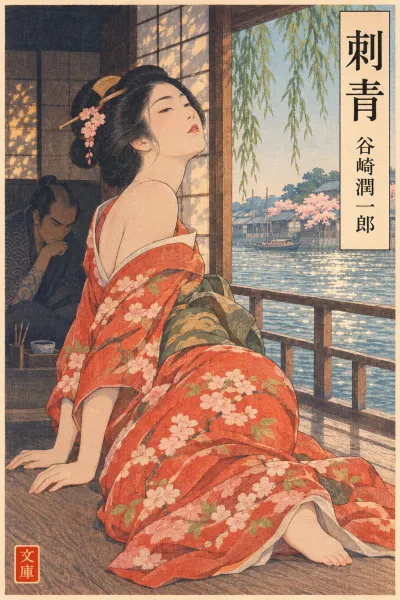
刺青 Shisei, part 1: A Tattooist Who Delights in Pain
In this part
In a leisurely bygone Edo, beauty meant strength, and many people, from gamblers and firemen to townsmen and even the occasional samurai, had themselves tattooed. Seikichi, a former ukiyo-e painter, has become a celebrated tattoo artist who chooses his clients strictly and secretly delights in their pain. For years he has longed to find a radiant beauty, with the right nature as well as the right looks and skin, onto whom he can carve his own soul, but he has not yet found her.
AI translation · independently checked
其れはまだ人々が「愚」と云う貴い徳を持って居て、世の中が今のように激しく軋み合わない時分であった。It was an age when people still possessed that precious virtue called "folly," and the world did not yet grind and chafe against itself as harshly as it does now.
殿様や若旦那の長閑な顔が曇らぬように、御殿女中や華魁の笑いの種が盡きぬようにと、饒舌を売るお茶坊主だの幇間だのと云う職業が、立派に存在して行けた程、世間がのんびりして居た時分であった。It was an age so unhurried that trades such as castle tea attendants and jesters, who sold their chatter so that the serene faces of lords and young masters should never cloud over and the palace maids and courtesans should never run out of things to laugh at, could flourish as perfectly respectable callings.
女定九郎、女自雷也、女鳴神、―――当時の芝居でも草双紙でも、すべて美しい者は強者であり、醜い者は弱者であった。A female Sadakurō, a female Jiraiya, a female Narukami: in the plays and illustrated storybooks of the day, the beautiful were always the strong, and the ugly the weak.
誰も彼も挙って美しからんと努めた揚句は、天稟の体へ絵の具を注ぎ込む迄になった。Everyone strove together to be beautiful, until at last they went so far as to pour pigment into the bodies Heaven had given them.
芳烈な、或は絢爛な、線と色とが其の頃の人々の肌に躍った。Lines and colours, now intensely bold, now dazzlingly splendid, danced upon the skin of the people of that time.
馬道を通うお客は、見事な刺青のある駕籠舁を選んで乗った。Customers travelling the Umamichi would choose palanquin bearers with splendid tattoos to carry them.
吉原、辰巳の女も美しい刺青の男に惚れた。The women of the Yoshiwara and Tatsumi, too, fell for men with beautiful tattoos.
博徒、鳶の者はもとより、町人から稀には侍なども入墨をした。Not only gamblers and firemen but townsmen, and on rare occasions even samurai, had themselves tattooed.
時々両国で催される刺青会では参会者おのおの肌を叩いて、互に奇抜な意匠を誇り合い、評しあった。At the tattoo gatherings held from time to time in Ryōgoku, each of those present would slap his bare skin, and they vied with one another in showing off their striking designs and passing judgement on them.
清吉と云う若い刺青師の腕きゝがあった。There was a skilled young tattoo artist named Seikichi.
浅草のちゃり文、松島町の奴平、こんこん次郎などにも劣らぬ名手であると持て囃されて、何十人の人の肌は、彼の絵筆の下に絖地となって擴げられた。He was acclaimed as a master in no way inferior to Charibun of Asakusa, Yakkohei of Matsushimachō or Konkon Jirō, and the skin of dozens of people had been spread out like satin beneath his brush.
刺青会で好評を博す刺青の多くは彼の手になったものであった。Many of the tattoos that won praise at the tattoo gatherings were the work of his hand.
達磨金はぼかし刺が得意と云われ、唐草権太は朱刺の名手と讃えられ、清吉は又奇警な構図と妖艶な線とで名を知られた。Daruma Kin was said to excel at shaded work and Karakusa Gonta was lauded as a master of vermilion, while Seikichi was known for his daring compositions and bewitching lines.
もと豊国国貞の風を慕って、浮世絵師の渡世をして居たゞけに、刺青師に堕落してからの清吉にもさすが畫工らしい良心と、鋭感とが残って居た。Having once made his living as an ukiyo-e painter devoted to the style of Toyokuni and Kunisada, Seikichi, even after sinking to the trade of tattooist, still kept something of a true painter's conscience and keen sensibility.
彼の心を惹きつける程の皮膚と骨組みとを持つ人でなければ、彼の刺青を購う訳には行かなかった。Unless a person had skin and a frame that captivated him, there was no way to buy one of his tattoos.
たまたま描いて貰えるとしても、一切の構図と費用とを彼の望むがまゝにして、其の上堪え難い針先の苦痛を、一と月も二た月もこらえねばならなかった。Even those fortunate enough to have him draw for them had to leave the entire composition and fee to his wishes, and on top of that endure the unbearable pain of his needle point for a month or even two.
この若い刺青師の心には、人知らぬ快楽と宿願とが潜んで居た。Within the heart of this young tattooist lay hidden a pleasure and a long-cherished desire unknown to anyone.
彼が人々の肌を針で突き刺す時、真紅に血を含んで脹れ上る肉の疼きに堪えかねて、大抵の男は苦しき呻き声を発したが、其の呻きごえが激しければ激しい程、彼は不思議に云い難き愉快を感じるのであった。When he pierced people's skin with his needles, most men, unable to bear the throbbing of the flesh as it swelled crimson with blood, let out agonised groans; and the more violent those groans were, the more he felt a strange, indescribable delight.
刺青のうちでも殊に痛いと云われる朱刺、ぼかしぼり、―――それを用うる事を彼は殊更喜んだ。Vermilion work and shaded work are said to be especially painful among all kinds of tattooing, and it was these above all that he delighted in using.
一日平均五六百本の針に刺されて、色上げを良くする為め湯へ浴って出て来る人は、皆半死半生の体で清吉の足下に打ち倒れたまゝ、暫くは身動きさえも出来なかった。Those who had been pricked by an average of five or six hundred needles a day, and had then soaked in a hot bath to bring out the colours, would all collapse at Seikichi's feet half dead, unable even to stir for some time.
その無残な姿をいつも清吉は冷やかに眺めて、Seikichi would always gaze coldly at that pitiful sight,
「嘸お痛みでがしょうなあ」"I daresay that hurts something terrible, eh?"
と云いながら、快さそうに笑って居る。he would say, laughing with evident pleasure.
意気地のない男などが、まるで知死期の苦しみのように口を歪め歯を喰いしばり、ひいひいと悲鳴をあげる事があると、彼は、When some spineless fellow twisted his mouth and clenched his teeth as if in the agony of his dying hour, and let out shrill shrieks, he would say,
「お前さんも江戸っ児だ。辛抱しなさい。―――この清吉の針は飛び切りに痛えのだから」"You're a son of Edo, aren't you? Bear it. This needle of Seikichi's hurts like nothing else, you know."
こう云って、涙にうるむ男の顔を横目で見ながら、かまわず刺って行った。Saying this, he would glance sideways at the man's tear-filled face and go on tattooing regardless.
また我慢づよい者がグッと胆を据えて、眉一つしかめず怺えて居ると、And when a hardier soul steeled himself and endured without so much as a twitch of the brow,
「ふむ、お前さんは見掛けによらねえ突っ張者だ。―――だが見なさい、今にそろそろ疼き出して、どうにもこうにもたまらないようになろうから」"Hmm, you're a tougher one than you look. But just you wait: before long it'll start throbbing, and then you won't be able to stand it at all."
と、白い歯を見せて笑った。he would say, and laugh, showing his white teeth.
彼の年来の宿願は、光輝ある美女の肌を得て、それへ己れの魂を刺り込む事であった。His long-cherished desire was to obtain the skin of a radiant beauty and carve his own soul into it.
その女の素質と容貌とに就いては、いろいろの注文があった。He had all sorts of requirements as to that woman's nature and looks.
啻に美しい顔、美しい肌とのみでは、彼は中々満足する事が出来なかった。A merely beautiful face and beautiful skin alone could hardly satisfy him.
江戸中の色町に名を響かせた女と云う女を調べても、彼の気分に適った味わいと調子とは容易に見つからなかった。Though he looked into every woman whose name resounded through the pleasure quarters of all Edo, he could not easily find the flavour and tone that suited his taste.
まだ見ぬ人の姿かたちを心に描いて、三年四年は空しく憧れながらも、彼はなお其の願いを捨てずに居た。Picturing in his mind the form of one he had yet to see, he spent three, four years in vain longing, yet still he did not give up that wish.
Vocabulary
| Word | Meaning | JLPT |
|---|---|---|
| 愚おろか | folly, foolishnessdictionary form: 愚かHere ironically called a 'precious virtue': simple, unworldly innocence. | N1 |
| 幇間ほうかん | professional jester who entertained guests at partiesAlso called 太鼓持ち (たいこもち). | — |
| 華魁おいらん | high-ranking courtesandictionary form: 花魁Usually written 花魁; associated with the Yoshiwara quarter. | — |
| 草双紙くさぞうし | illustrated popular storybooks of the Edo period | — |
| 天稟てんぴん | natural endowment; what one is born withLiterary; here the body as Heaven made it. | — |
| 駕籠舁かごかき | palanquin bearerdictionary form: 駕籠舁き駕籠 = palanquin; 舁く (かく) = to carry on the shoulder. | — |
| 惚れたほれる | to fall for, to be smitten withdictionary form: 惚れる | — |
| 博徒ばくと | professional gambler | — |
| 腕きゝうできき | skilled person, expertdictionary form: 腕利きゝ repeats the previous kana: きゝ = きき. | — |
| 持て囃されてもてはやす | to praise highly, to make much ofdictionary form: 持て囃す | — |
| 堕落だらく | degeneration, falling (to a lower state)Tattooing is viewed as a step down from painting. | — |
| 宿願しゅくがん | long-cherished wishA key word of the story; it recurs later. | — |
| 疼きうずく | to throb, to achedictionary form: 疼く | — |
| 憧れあこがれる | to long for, to yearndictionary form: 憧れる | N2 |
Grammar
〜ぬ (negative) N2 classical negative, = 〜ない
ぬ attaches to the negative stem just like ない. Here 曇らぬ and 盡きぬ mean 曇らない and 尽きない, giving the narration a literary tone.
殿様や若旦那の長閑な顔が曇らぬように
so that the serene faces of lords and young masters should never cloud over
〜からん N1 classical volitional/conjectural of an i-adjective
美しからん is the classical volitional/conjectural form of 美しい (美しから + ん, from む). Followed by と努める, it means 'strive to be beautiful'.
誰も彼も挙って美しからんと努めた揚句は
Everyone strove together to be beautiful, until at last
〜だけに N2 precisely because; as one would expect from
Gives a reason that naturally leads to the result. Because Seikichi had been a painter, it is fitting that a painter's conscience remained in him.
浮世絵師の渡世をして居たゞけに
having once made his living as an ukiyo-e painter
〜ねばならない N2 must, have to
A written, classical-flavoured form of 〜なければならない. Here, in the past tense, it means clients had no choice but to endure the pain.
一と月も二た月もこらえねばならなかった
had to endure it for a month or even two
〜ば〜ほど N3 the more ..., the more ...
The same word is repeated in the ば-form and before ほど. The louder the groans, the greater Seikichi's delight.
其の呻きごえが激しければ激しい程、彼は不思議に云い難き愉快を感じるのであった
the more violent those groans were, the more he felt a strange, indescribable delight