Advanced · JLPT N1
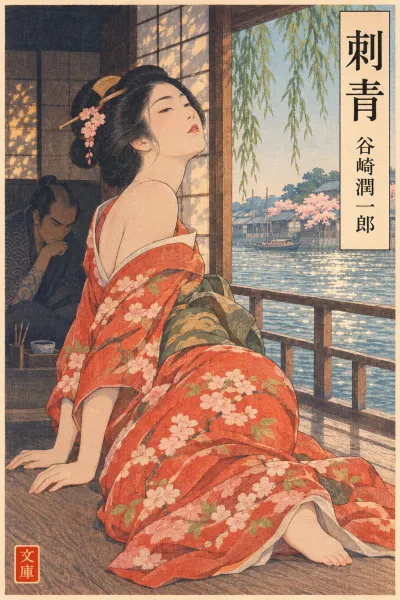
刺青Shisei — Needle and Ink
- JLPT N1
- 5,636 characters
- 4 parts
- about 47 minutes
刺青 ("Needle and Ink") is one of Tanizaki Jun'ichirō's earliest published stories, first printed in 1910. It is set in an imagined, leisurely Edo where beauty was equated with strength and tattooing was in fashion. Seikichi, a former ukiyo-e painter turned celebrated tattoo artist, secretly enjoys his clients' pain. For years he has searched for a woman whose skin, looks and nature are worthy of carrying his soul in ink. One day a glimpse of a perfect bare foot beneath a palanquin blind sets the story in motion. The tale is short, intense and deliberately decadent. It dwells on skin, colour, light on the river and the fascination of cruelty, and it unfolds almost entirely in one room over a single spring day, night and dawn. For learners it is a demanding N1 text. The narration is ornate late-Meiji literary prose, full of archaic kanji, classical verb forms and long, piled-up sentences. The dialogue is brief but colloquial Edo speech. Its compactness makes it manageable, and close reading is rewarded with some of the most vivid, sensuous Japanese of its era.
Contents
Before you read
- Separate the two registers. The narration uses plain da/de aru style mixed with classical forms such as the negative 〜ぬ, 〜からん and 出づべき, while the dialogue is Edo street speech. Seikichi says 己 (ore), 痛え and ねえ; the girl uses geisha-quarter forms like 〜のさ and お呉んなさい. Expect contractions such as 〜え for 〜い.
- Learn the recurring literary patterns before you start, since they carry much of the description: 〜が如く ('like, as if'), 〜こそ (emphasis), 〜ば〜ほど ('the more… the more'), 〜だけに ('precisely because'), 〜たさに ('out of a desire to') and 〜ねばならない.
- Read the long descriptive sentences by locating the final verb first, then working backward through the stacked modifiers. Tanizaki often piles several noun-modifying clauses onto a single noun such as 肌, 足 or 女.
- Pre-learn the core vocabulary of the craft and the senses: 刺青 / 彫り物 (tattoo), 針 (needle), 墨 (ink), 朱 / 琉球朱 (vermilion), ぼかし (shading), 肌 (skin), 麻酔剤 (anaesthetic), 女郎蜘蛛 (female spider), 肥料 (fertilizer).
- Don't get stuck on proper names. Part 1 lists famous tattooists (ちゃり文, 奴平, 達磨金 and others), and later passages name Edo districts such as 深川, 佐賀町 and 霊岸島. Use the name list for readings and keep moving; these names set the atmosphere but do not drive the plot.
Words to know
The most useful words from the notes across the story.
| Word | Meaning | JLPT |
|---|---|---|
| 器量きりょう | looks, beauty (of a woman)It also means 'ability', but here it refers to appearance. | — |
| 凱歌かちどき | がいかThe usual reading is がいか. かちどき (勝鬨) is the native word for a victory cry. | — |
| 後生だからごしょう | for pity's sake; I beg youdictionary form: 後生Literally 'the next life'. 後生だから is a set phrase for a desperate plea. | — |
| 劣らぬおとる | to be inferior to; (negative) to be no less thandictionary form: 劣る〜にも劣らぬ means 'not inferior even to ~', in other words 'just as fine as ~'. | N3 |
| 容易ようい | easy, simpleFormal word. 容易でない means 'far from easy'. | N3 |
| 恢復かいふく | recovery, regainingOlder spelling of 回復. | N3 |
| 憧れあこがれる | to long for, to yearndictionary form: 憧れる | N2 |
| 物凄いものすごい | uncanny, frightening, eerieToday it usually means 'tremendous', but here it keeps its older sense of something chilling. | N2 |
| 漸くようやく | at last, finallyImplies a long effort or wait before the result. | N2 |
| 愚おろか | folly, foolishnessdictionary form: 愚かHere ironically called a 'precious virtue': simple, unworldly innocence. | N1 |
| 似通ってにかよう | to resemble closely, to grow alikedictionary form: 似通う | N1 |
| 白状はくじょう | confession, owning up白状する: 'to confess'. | N1 |
| 一心にいっしん | intently, with total concentrationdictionary form: 一心Literally 'one heart': the whole mind is fixed on one thing. | N1 |
| 肥料ひりょう | こやしHere read こやし, the older word for manure or fertiliser. It is used figuratively: men will nourish her. | N1 |
| 辛抱しんぼう | endurance, putting up with somethingClose to 我慢 (also used in this passage). | N1 |
Plot summary
Show the full summary (contains spoilers)
In old Edo, Seikichi has long sought a woman worthy of his art. In the fourth year of his search he glimpses a flawless foot beneath a palanquin blind outside the Hirasei restaurant, but he loses track of her. The next spring a young girl arrives with an errand from a geisha, and he recognises the foot. He shows her two scrolls: one of a cruel ancient consort watching an execution, and one called "Fertilizer", in which a woman gazes proudly over the corpses of men who died for her. The girl admits she shares that woman's nature and begs to leave. Seikichi drugs her with an anaesthetic from a Dutch doctor and tattoos a huge female spider across her back through the night. When she wakes she endures the painful bath that sets the colours. She emerges proud and commanding, and declares Seikichi the first man to feed her beauty. As she shows him her back, the morning sun makes the spider blaze.
About the author
Tanizaki Jun'ichirō was born in Nihonbashi, Tōkyō, and became one of the major novelists of modern Japanese literature. His early stories, such as 刺青 (The Tattooer), are known for their aestheticism and their fascination with beauty, obsession and transgression, qualities that are also on display in 秘密. After the Great Kantō Earthquake he moved to the Kansai region, and his later writing turned increasingly toward traditional Japanese culture. His best-known works include 痴人の愛 (Naomi), 蓼喰ふ蟲 (Some Prefer Nettles), 細雪 (The Makioka Sisters) and the essay 陰翳礼讃 (In Praise of Shadows). He also produced modern Japanese translations of The Tale of Genji.