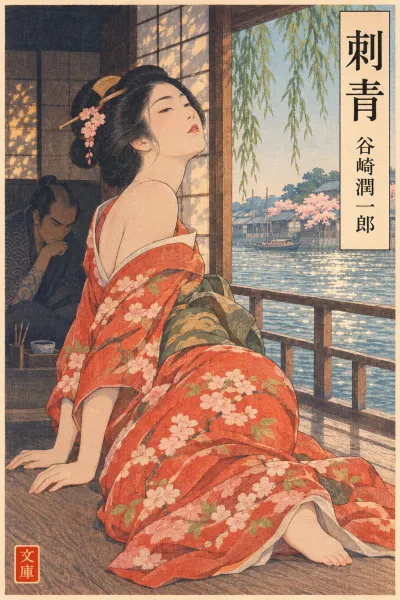
Part 2 of 4 · JLPT N1
刺青 Shisei, part 2: The Foot Behind the Palanquin Blind
In this part
In the fourth year of his search, Seikichi glimpses a woman's perfect bare foot beneath a palanquin blind outside the Hirasei restaurant, but he loses track of her. The following spring, a young girl comes to his lodgings with a haori coat sent by a geisha he knows, and he recognises her foot as the one he saw. He leads her upstairs and unrolls a scroll showing a cruel ancient consort watching a man about to be executed.
AI translation · independently checked
丁度四年目の夏のとあるゆうべ、深川の料理屋平清の前を通りかゝった時、彼はふと門口に待って居る駕籠の簾のかげから、真っ白な女の素足のこぼれて居るのに気がついた。It was one evening in the summer of exactly the fourth year. As he happened to pass the Hirasei, a restaurant in Fukagawa, he suddenly noticed a woman's bare foot, pure white, spilling out from behind the bamboo blind of a palanquin waiting at the gate.
鋭い彼の眼には、人間の足はその顔と同じように複雑な表情を持って映った。To his keen eye, a human foot appeared to hold an expression as intricate as that of a face.
その女の足は、彼に取っては貴き肉の宝玉であった。To him, that woman's foot was a precious jewel of flesh.
拇指から起って小指に終る繊細な五本の指の整い方、絵の島の海辺で獲れるうすべに色の貝にも劣らぬ爪の色合い、珠のような踵のまる味、清洌な岩間の水が絶えず足下を洗うかと疑われる皮膚の潤沢。There was the shapeliness of the five delicate toes, beginning at the great toe and ending at the smallest, and the tint of the nails, no less lovely than the pale pink shells gathered on the shores of Enoshima. There was the pearl-like roundness of the heel, and a moist lustre in the skin that made one wonder whether clear, cold water from among the rocks was forever washing about its feet.
この足こそは、やがて男の生血に肥え太り、男のむくろを蹈みつける足であった。This, truly, was a foot that would one day grow fat on the warm blood of men and trample on their corpses.
この足を持つ女こそは、彼が永年たずねあぐんだ、女の中の女であろうと思われた。The woman who owned this foot, it seemed to him, must surely be the woman of women he had searched for so long and so wearily.
清吉は躍りたつ胸をおさえて、其の人の顔が見たさに駕籠の後を追いかけたが、二三町行くと、もう其の影は見えなかった。Holding down his leaping heart, Seikichi chased after the palanquin, longing to see her face, but after two or three blocks there was no longer any trace of it.
清吉の憧れごゝちが、激しき恋に変って其の年も暮れ、五年目の春も半ば老い込んだ或る日の朝であった。Seikichi's longing turned into a violent passion, and that year came to its end. Then came a morning in the fifth year, when spring was already half spent.
彼は深川佐賀町の寓居で、房楊枝をくわえながら、錆竹の濡れ縁に萬年青の鉢を眺めて居ると、庭の裏木戸を訪うけはいがして、袖垣のかげから、ついぞ見馴れぬ小娘が這入って来た。At his lodgings in Sagachō, Fukagawa, he was gazing at a potted omoto plant on the veranda of weathered bamboo, a willow toothbrush between his teeth, when he sensed someone at the back gate of the garden. From behind the low wing fence there came in a young girl he had never seen before.
それは清吉が馴染の辰巳の藝妓から寄こされた使の者であった。She was a messenger sent by a Tatsumi geisha whom Seikichi knew well.
「姐さんから此の羽織を親方へお手渡しゝて、何か裏地へ絵模様を畫いて下さるようにお頼み申せって………」"Big Sister told me to hand this haori to you, master, and to ask if you would kindly paint some sort of picture on the lining…"
と、娘は鬱金の風呂敷をほどいて、中から岩井杜若の似顔畫のたとうに包まれた女羽織と、一通の手紙とを取り出した。With that, the girl untied a turmeric-yellow wrapping cloth. From it she took out a woman's haori, folded in a paper wrapper printed with a portrait of the actor Iwai Tojaku, together with a letter.
其の手紙には羽織のことをくれぐれも頼んだ末に、使の娘は近々に私の妹分として御座敷へ出る筈故、私の事も忘れずに、この娘も引き立てゝやって下さいと認めてあった。The letter earnestly repeated her request about the haori. It went on to say that the girl who brought it was soon to begin attending banquets as the writer's younger sister in the trade. It asked that he not forget the writer herself, and that he look kindly on this girl as well.
「どうも見覚えのない顔だと思ったが、それじゃお前は此の頃此方へ来なすったのか」"I thought I didn't know that face. So you've only lately come over this way, have you?"
こう云って清吉は、しげしげと娘の姿を見守った。So saying, Seikichi studied the girl closely from head to foot.
年頃は漸う十六か七かと思われたが、その娘の顔は、不思議にも長い月日を色里に暮らして、幾十人の男の魂を弄んだ年増のように物凄く整って居た。She looked barely sixteen or seventeen. Yet her face had, strangely, the eerie perfection of a seasoned woman who had spent long years in the pleasure quarters and toyed with the souls of dozens of men.
それは国中の罪と財との流れ込む都の中で、何十年の昔から生き代り死に代ったみめ麗しい多くの男女の、夢の数々から生れ出づべき器量であった。It was a beauty that could only have been born from the countless dreams of the many fair men and women who had lived and died there, one after another, for decades past, in this capital into which flowed all the sins and riches of the land.
「お前は去年の六月ごろ、平清から駕籠で帰ったことがあろうがな」"Some time around the sixth month of last year, you went home from the Hirasei in a palanquin, didn't you?"
こう訊ねながら、清吉は娘を縁へかけさせて、備後表の台に乗った巧緻な素足を仔細に眺めた。As he asked this, Seikichi had the girl sit on the edge of the veranda. He then examined in minute detail her exquisite bare feet as they rested on clogs topped with Bingo matting.
「えゝ、あの時分なら、まだお父さんが生きて居たから、平清へもたびたびまいりましたのさ」"Why, yes. Back then my father was still alive, so I often went to the Hirasei."
と、娘は奇妙な質問に笑って答えた。The girl laughed at the odd question as she answered.
「丁度これで足かけ五年、己はお前を待って居た。顔を見るのは始めてだが、お前の足にはおぼえがある。―――お前に見せてやりたいものがあるから、上ってゆっくり遊んで行くがいゝ」"It's going on five years now that I've been waiting for you. This is the first time I've seen your face, but I remember your foot. ――There's something I want to show you, so come on up and take your time."
と、清吉は暇を告げて帰ろうとする娘の手を取って、大川の水に臨む二階座敷へ案内した後、巻物を二本とり出して、先ず其の一つを娘の前に繰り展げた。The girl had said goodbye and was about to leave, but Seikichi took her by the hand and led her to the upstairs room overlooking the waters of the Ōkawa. Then he brought out two scrolls and first unrolled one of them before her.
それは古の暴君紂王の寵妃、末喜を描いた絵であった。It was a painting of Bakki, beloved consort of the ancient tyrant Chū-ō.
瑠璃珊瑚を鏤めた金冠の重さに得堪えぬなよやかな体を、ぐったり勾欄に靠れて、羅綾の裳裾を階の中段にひるがえし、右手に大杯を傾けながら、今しも庭前に刑せられんとする犠牲の男を眺めて居る妃の風情と云い、鉄の鎖で四肢を銅柱へ縛いつけられ、最後の運命を待ち構えつゝ、妃の前に頭をうなだれ、眼を閉じた男の顔色と云い、物凄い迄に巧に描かれて居た。The consort's slender body could scarcely bear the weight of her golden crown, studded with lapis lazuli and coral. She leaned limply against a balustrade, the hem of her gauze and damask robes fluttering over the middle of the steps, and she tilted a great wine cup in her right hand as she watched the victim about to be put to death in the courtyard below. The man's limbs were bound with iron chains to a bronze pillar, and he awaited his final fate before her with bowed head and closed eyes. Her bearing and the look on his face were both painted with an almost frightening skill.
Vocabulary
| Word | Meaning | JLPT |
|---|---|---|
| 素足すあし | bare foot素 means 'plain, uncovered', as in 素顔 (a face without make-up). | — |
| 駕籠かご | palanquin; a covered litter carried on polesThe everyday taxi of the Edo period. | — |
| 劣らぬおとる | to be inferior to; (negative) to be no less thandictionary form: 劣る〜にも劣らぬ means 'not inferior even to ~', in other words 'just as fine as ~'. | N3 |
| 蹈みつけるふみつける | to trample on, to stamp down ondictionary form: 踏みつける蹈 is an old variant of 踏. | — |
| たずねあぐんだたずねあぐむ | to search until one is worn outdictionary form: 尋ねあぐむ〜あぐむ added to a verb stem means 'to tire of doing, to be at a loss with'. It is literary. | — |
| 寓居ぐうきょ | temporary lodging; one's humble dwellingA literary word for where one lives. | — |
| 萬年青おもと | omoto, an evergreen ornamental plant (Rohdea japonica)A popular potted plant in Edo. The kanji literally mean 'ten-thousand-year green'. | — |
| 羽織はおり | haori, a short jacket worn over a kimonoThe lining was often decorated with hidden designs. | — |
| 姐さんねえさん | 'Big Sister'; a senior geishaJunior geisha address their senior and mentor this way. | — |
| 引き立てゝひきたてる | to favour, to support someone's careerdictionary form: 引き立てるゝ repeats the preceding kana, so 立てゝ = 立てて. | — |
| 年増としま | a mature woman past her first youthIn Edo usage this could mean a woman in her twenties. | — |
| 器量きりょう | looks, beauty (of a woman)It also means 'ability', but here it refers to appearance. | — |
| 物凄いものすごい | uncanny, frightening, eerieToday it usually means 'tremendous', but here it keeps its older sense of something chilling. | N2 |
Grammar
〜こそ N3 it is precisely ~; ~ indeed
こそ strongly singles out the noun before it. Here こそは insists that this very foot, and no other, is the destined one.
この足こそは、やがて男の生血に肥え太り、男のむくろを蹈みつける足であった。
This, truly, was a foot that would one day grow fat on the warm blood of men and trample on their corpses.
〜たさに N1 out of a desire to ~
The たい form becomes a noun (見たさ, 'the wish to see'), and に marks it as the motive. The result means 'driven by wanting to see'.
其の人の顔が見たさに駕籠の後を追いかけた
longing to see her face, he chased after the palanquin
〜ぬ (classical negative) N2 not ~ (= 〜ない)
ぬ is the literary negative ending and attaches to the same stem as ない. 見馴れぬ means 'not familiar', and ついぞ strengthens it to 'never once'.
ついぞ見馴れぬ小娘が這入って来た
a young girl he had never seen before came in
〜がいい N3 you should ~; go ahead and ~
Verb plain form + がいい gives an invitation or command with a lordly, somewhat old-fashioned tone. It suits Seikichi's brusque speech.
上ってゆっくり遊んで行くがいゝ
come on up and take your time
〜ん(と)する N1 to be about to ~
ん is the classical volitional ending (= う/よう), so 刑せられんとする equals modern 刑されようとする, 'about to be executed'. 今しも adds 'at this very moment'.
今しも庭前に刑せられんとする犠牲の男を眺めて居る
watching the victim about to be put to death in the courtyard below