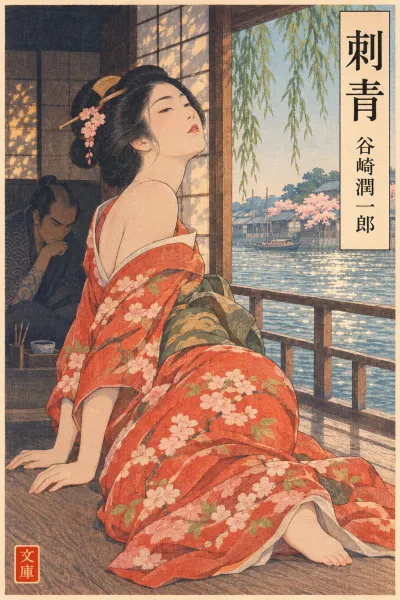
Part 3 of 4 · JLPT N1
刺青 Shisei, part 3: Two Scrolls and a Sleeping Girl
In this part
Seikichi shows the girl a second scroll, 'Fertilizer', in which a young woman gazes proudly over the corpses of men who died for her, and tells her it shows her future. She admits she has the nature of the woman in the picture, then begs to be sent home. Instead, Seikichi draws out a bottle of anaesthetic he once got from a Dutch doctor; soon she is asleep, and through a long spring afternoon he tattoos her back, pouring his soul into the ink.
AI translation · independently checked
娘は暫くこの奇怪な絵の面を見入って居たが、知らず識らず其の瞳は輝き其の唇は顫えた。For some time the girl gazed into the face of this strange picture, but without her knowing it her eyes began to shine and her lips to tremble.
怪しくも其の顔はだんだんと妃の顔に似通って来た。Uncannily, her face grew little by little to resemble the consort's.
娘は其処に隠れたる真の「己」を見出した。In it the girl had found her own true "self", hidden there.
「この絵にはお前の心が映って居るぞ」"Your heart is mirrored in this picture."
こう云って、清吉は快げに笑いながら、娘の顔をのぞき込んだ。So saying, Seikichi laughed with satisfaction and peered into the girl's face.
「どうしてこんな恐ろしいものを、私にお見せなさるのです」"Why do you show me such a dreadful thing?"
と、娘は青褪めた額を擡げて云った。said the girl, lifting her pale forehead.
「この絵の女はお前なのだ。この女の血がお前の体に交って居る筈だ」"The woman in this picture is you. Her blood must be mingled in your veins."
と、彼は更に他の一本の畫幅を展げた。With that, he unrolled yet another scroll.
それは「肥料」と云う畫題であった。Its title was "Fertilizer."
畫面の中央に、若い女が桜の幹へ身を倚せて、足下に累々と斃れて居る多くの男たちの屍骸を見つめて居る。In the centre of the picture a young woman leans against the trunk of a cherry tree, gazing down at the corpses of many men lying fallen in heaps at her feet.
女の身辺を舞いつゝ凱歌をうたう小鳥の群、女の瞳に溢れたる抑え難き誇りと歓びの色。A flock of little birds flutters about her, singing songs of triumph; in her eyes overflows a look of pride and joy that cannot be held back.
それは戦の跡の景色か、花園の春の景色か。Was it the scene after a battle, or a flower garden in spring?
それを見せられた娘は、われとわが心の底に潜んで居た何物かを、探りあてたる心地であった。Shown this, the girl felt as though she had searched out something that had lain hidden at the very bottom of her own heart.
「これはお前の未来を絵に現わしたのだ。此処に斃れて居る人達は、皆これからお前の為めに命を捨てるのだ」"This picture shows your future. The men lying fallen here are all the men who will throw away their lives for your sake from now on."
こう云って、清吉は娘の顔と寸分違わぬ畫面の女を指さした。So saying, Seikichi pointed at the woman in the picture, whose face did not differ a hair's breadth from the girl's own.
「後生だから、早く其の絵をしまって下さい」"For pity's sake, put that picture away quickly."
と、娘は誘惑を避けるが如く、畫面に背いて畳の上へ突俯したが、やがて再び唇をわなゝかした。said the girl. As if fleeing temptation, she turned her back on the picture and threw herself face down on the tatami, but presently her lips began to quiver once more.
「親方、白状します。私はお前さんのお察し通り、其の絵の女のような性分を持って居ますのさ。―――だからもう堪忍して、其れを引っ込めてお呉んなさい」"Master, I'll confess it. Just as you guessed, I've a nature like the woman in that picture. So please, have mercy and put it away."
「そんな卑怯なことを云わずと、もっとよく此の絵を見るがいゝ。それを恐ろしがるのも、まあ今のうちだろうよ」"Don't talk like a coward. You'd do better to take a closer look at this picture. You'll only be frightened of it for a little while yet, I'd say."
こう云った清吉の顔には、いつもの意地の悪い笑いが漂って居た。As Seikichi said this, his usual malicious smile hovered about his face.
然し娘の頭は容易に上らなかった。But the girl would not easily raise her head.
襦袢の袖に顔を蔽うていつまでも突俯したまゝ、Hiding her face in the sleeve of her under-kimono and lying face down on and on,
「親方、どうか私を帰しておくれ。お前さんの側に居るのは恐ろしいから」"Master, please let me go home. I'm frightened to be near you,"
と、幾度か繰り返した。she repeated, again and again.
「まあ待ちなさい。己がお前を立派な器量の女にしてやるから」"Now, just wait. I'm going to make you a woman of real beauty."
と云いながら、清吉は何気なく娘の側に近寄った。As he said this, Seikichi casually drew close to the girl.
彼の懐には嘗て和蘭医から貰った麻睡剤の壜が忍ばせてあった。Hidden in the fold of his kimono was a bottle of anaesthetic that a Dutch doctor had once given him.
日はうらゝかに川面を射て、八畳の座敷は燃えるように照った。The sun shone brightly on the surface of the river, and the eight-mat room glowed as if it were on fire.
水面から反射する光線が、無心に眠る娘の顔や、障子の紙に金色の波紋を描いてふるえて居た。Light reflected from the water traced trembling golden ripples on the face of the girl, sleeping unaware, and on the paper of the sliding screens.
部屋のしきりを閉て切って刺青の道具を手にした清吉は、暫くは唯恍惚としてすわって居るばかりであった。Having shut the partitions of the room and taken up his tattooing tools, Seikichi for a while could only sit there, entranced.
彼は今始めて女の妙相をしみじみ味わう事が出来た。Now for the first time he could savour to the full the wondrous beauty of the woman's face.
その動かぬ顔に相対して、十年百年この一室に静坐するとも、なお飽くことを知るまいと思われた。It seemed to him that, facing that motionless face, he could sit quietly in this one room for ten years, for a hundred years, and still never tire of it.
古のメンフィスの民が、荘厳なる埃及の天地を、ピラミッドとスフィンクスとで飾ったように、清吉は清浄な人間の皮膚を、自分の恋で彩ろうとするのであった。Just as the people of ancient Memphis adorned the majestic land of Egypt with pyramids and sphinxes, so Seikichi meant to colour pure human skin with his love.
やがて彼は左手の小指と無名指と拇指の間に挿んだ絵筆の穂を、娘の背にねかせ、その上から右手で針を刺して行った。Presently he laid the tip of the brush, held between the little finger, ring finger and thumb of his left hand, against the girl's back, and with his right hand he began driving the needle in from above it.
若い刺青師の霊は墨汁の中に溶けて、皮膚に滲んだ。The young tattooist's soul dissolved into the ink and seeped into her skin.
焼酎に交ぜて刺り込む琉球朱の一滴々々は、彼の命のしたゝりであった。Every single drop of Ryūkyū vermilion that he mixed with distilled spirits and pricked into her was a drop of his own life.
彼は其処に我が魂の色を見た。In it he saw the colour of his own soul.
いつしか午も過ぎて、のどかな春の日は漸く暮れかゝったが、清吉の手は少しも休まず、女の眠りも破れなかった。Before he knew it, noon had passed and the mild spring day was at last drawing toward dusk, yet Seikichi's hand did not rest for a moment, and the woman's sleep was never broken.
娘の帰りの遅きを案じて迎いに出た箱屋迄が、Even the box-bearer, who had come to fetch the girl, worried that she was so late returning,
Vocabulary
| Word | Meaning | JLPT |
|---|---|---|
| 奇怪きっかい | strange, uncanny, bizarreAlso read きかい. きっかい is the more emphatic, literary reading. | — |
| 見入ってみいる | to gaze intently at, to be absorbed in looking atdictionary form: 見入るCompare 見とれる, 'to be lost in admiration while looking'. | — |
| 似通ってにかよう | to resemble closely, to grow alikedictionary form: 似通う | N1 |
| 屍骸むくろ | しがいUsually read しがい (also written 死骸). むくろ is a literary word. | — |
| 凱歌かちどき | がいかThe usual reading is がいか. かちどき (勝鬨) is the native word for a victory cry. | — |
| 寸分すんぶん | the slightest bit, a hair's breadthUsed with negatives: 寸分違わぬ means 'identical in every detail'. | — |
| 後生だからごしょう | for pity's sake; I beg youdictionary form: 後生Literally 'the next life'. 後生だから is a set phrase for a desperate plea. | — |
| 白状はくじょう | confession, owning up白状する: 'to confess'. | N1 |
| 性分しょうぶん | one's nature, dispositionRefers to an inborn temperament. It is close to 性格. | — |
| 堪忍かんにん | forgiveness, forbearance堪忍して is a pleading 'have mercy, spare me', common in Edo and Kansai speech. | — |
| 器量きりょう | looks, beauty (of a woman)Can also mean 'ability' or 'calibre'. Here it refers to appearance. | — |
| 麻睡剤ますいざい | anaesthetic, narcoticdictionary form: 麻酔剤Modern spelling is 麻酔剤. | — |
| 恍惚うっとり | こうこつNormally read こうこつ. Here the kanji are glossed with the native word うっとり. | — |
| 箱屋はこや | box-bearerA man who escorted a geisha and carried her shamisen in its box. | — |
Grammar
〜たる (classical attributive) N1 that is / that has done (modifying a noun)
たる is the classical attributive form of the auxiliary たり. Here 隠れたる works like modern 隠れている before a noun. It gives the narration a formal, old-fashioned tone.
娘は其処に隠れたる真の「己」を見出した。
In it the girl had found her own true 'self', hidden there.
〜筈だ N4 must be, should be (by reasoning)
はずだ expresses the speaker's confident conclusion from what he knows. Seikichi is certain that the consort's blood runs in the girl.
この女の血がお前の体に交って居る筈だ
Her blood must be mingled in your veins.
〜が如く N1 as if, like
如く is the literary equivalent of ように. Attached to a verb with が, it describes the manner of an action: she turns away as though fleeing temptation.
娘は誘惑を避けるが如く、畫面に背いて畳の上へ突俯した
As if fleeing temptation, she turned her back on the picture and threw herself face down on the tatami.
〜ずと / 〜がいい N1 without doing… / you'd better…
ずと is an archaic/literary form of ないで (ずに), meaning 'without doing'. Here 云わずと means 'without saying such cowardly things'. Separately, 見るがいい is a strong, slightly superior suggestion, 'you'd do well to look'. Combined in one sentence, they give Seikichi's pressing, insistent tone.
そんな卑怯なことを云わずと、もっとよく此の絵を見るがいゝ。
Don't talk like a coward. You'd do better to take a closer look at this picture.
〜てやる N4 to do something for someone (from a superior stance)
てやる marks an action done for someone of lower standing. Here it sounds both patronising and menacing, since Seikichi alone decides what he will 'do for' her.
己がお前を立派な器量の女にしてやるから
I'm going to make you a woman of real beauty.
〜とも…まい N1 even if… surely would not…
とも after a verb is a literary 'even if'. まい expresses a negative conjecture. Together they mean that even after a hundred years he would surely never tire of it.
十年百年この一室に静坐するとも、なお飽くことを知るまい
He could sit quietly in this one room for ten years, for a hundred years, and still never tire of it.