Part 1 of 4 · JLPT N2
ツェねずみ Tsuenezumi, part 1: Tse Demands Amends from the Weasel
In this part
A weasel tells Tse the mouse that sugar candies are spilling from the cupboard, but when Tse gets there, soldier ants are already guarding them and drive him away. Feeling cheated, Tse goes to the weasel's home and whines over and over that the weasel must make amends. The disgusted weasel finally throws him some of its own candies and curses him, and Tse carries them home and eats them.
AI translation · independently checked
ある古い家の、まっくらな天井裏に、「ツェ」という名まえのねずみがすんでいました。In the pitch-dark space above the ceiling of a certain old house, there lived a mouse by the name of Tse.
ある日ツェねずみは、きょろきょろ四方を見まわしながら、床下街道を歩いていますと、向こうからいたちが、何かいいものをたくさんもって、風のように走って参りました。One day, as Tse the mouse was walking along the Underfloor Highway, glancing nervously all around him, a weasel came running toward him like the wind, carrying lots of something good.
そしてツェねずみを見て、ちょっとたちどまって早口に言いました。On seeing Tse the mouse, the weasel stopped for a moment and spoke very quickly.
「おい、ツェねずみ。お前んとこの戸棚の穴から、金米糖がばらばらこぼれているぜ。早く行ってひろいな。」"Hey, Tse. There are sugar candies spilling out all over from a hole in the cupboard at your place. Hurry up and go pick them up."
ツェねずみは、もうひげもぴくぴくするくらいよろこんで、いたちにはお礼も言わずに、いっさんにそっちへ走って行きました。Tse the mouse was so delighted that even his whiskers twitched, and without so much as a thank-you to the weasel, he ran off in that direction as fast as he could go.
ところが戸棚の下まで来たとき、いきなり足がチクリとしました。But when he got to the bottom of the cupboard, he suddenly felt a sharp prick in his foot.
そして、「止まれ、だれかっ。」と言う小さな鋭い声がします。Then a small, sharp voice cried, "Halt! Who goes there?"
ツェねずみはびっくりしてよく見ますと、それは蟻でした。Tse the mouse was startled, and when he looked closely, he saw that it was an ant.
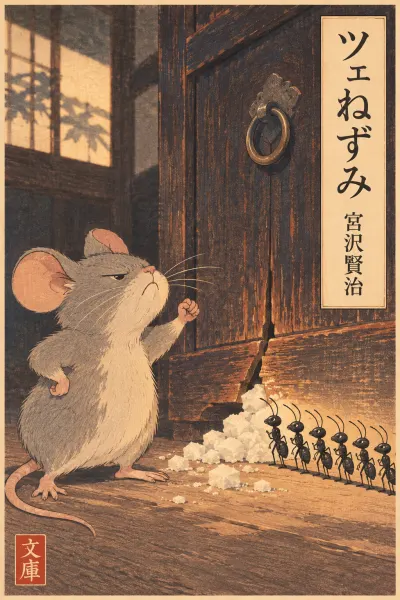
蟻の兵隊は、もう金米糖のまわりに四重の非常線を張って、みんな黒いまさかりをふりかざしています。The ant soldiers had already set up a fourfold cordon around the sugar candies, and every one of them was brandishing a black battle-axe.
二三十匹は金米糖を片っぱしから砕いたり、とかしたりして、巣へはこぶしたくです。Twenty or thirty of them were breaking up and melting down the candies one after another, getting ready to carry them back to their nest.
ツェねずみはぶるぶるふるえてしまいました。Tse the mouse began to tremble all over.
「ここから内へはいってならん。早く帰れ。帰れ、帰れ。」蟻の特務曹長が、低い太い声で言いました。"No entry past this point. Go back at once. Back, back!" said the ant sergeant major in a low, deep voice.
ねずみはくるっと一つまわって、いちもくさんに天井裏へかけあがりました。The mouse spun round once and dashed headlong back up into the space above the ceiling.
そして巣の中へはいって、しばらくねころんでいましたが、どうもおもしろくなくて、おもしろくなくて、たまりません。Then he went into his nest and lay there for a while, but he felt so put out, so terribly put out, that he could not bear it.
蟻はまあ兵隊だし、強いからしかたもないが、あのおとなしいいたちめに教えられて、戸棚の下まで走って行って蟻の曹長にけんつくを食うとは、なんたるしゃくにさわることだとツェねずみは考えました。The ants were soldiers, after all, and strong, so that couldn't be helped; but to have been told by that meek little weasel, to have run all the way to the bottom of the cupboard, and then to have been snapped at by an ant sergeant—how infuriating it was, thought Tse the mouse.
そこでねずみは巣からまたちょろちょろはい出して、木小屋の奥のいたちの家にやって参りました。So the mouse came scurrying out of his nest again and made his way to the weasel's home at the back of the woodshed.
いたちはちょうど、とうもろこしのつぶを、歯でこつこつかんで粉にしていましたが、ツェねずみを見て言いました。The weasel was just then grinding grains of corn into flour, crunch, crunch, with its teeth, but when it saw Tse the mouse, it said:
「どうだ。金米糖がなかったかい。」"Well? Weren't the sugar candies there?"
「いたちさん。ずいぶんお前もひどい人だね。私のような弱いものをだますなんて。」"Mr. Weasel, you're a cruel one, you are. Fancy tricking a weak little thing like me."
「だましゃせん。たしかにあったのや。」"I didn't trick you. They were there, sure enough."
「あるにはあっても、もう蟻が来てましたよ。」"They may have been there, but the ants had already come."
「蟻が、へい。そうかい。早いやつらだね。」"The ants, eh? Is that so? Quick little fellows, aren't they?"
「みんな蟻がとってしまいましたよ。私のような弱いものをだますなんて、償うてください。償うてください。」"The ants took every last one. Fancy tricking a weak little thing like me. Make amends to me! Make amends to me!"
「それはしかたない。お前の行きようが少しおそかったのや。」"That can't be helped. You were just a bit slow getting there."
「知らん、知らん。私のような弱いものをだまして。償うてください。償うてください。」"I don't care, I don't care. You tricked a weak little thing like me. Make amends to me! Make amends to me!"
「困ったやつだな。ひとの親切をさかさまにうらむとは。よしよし。そんならおれの金米糖をやろう。」"What a pest you are. Fancy turning someone's kindness upside down and holding a grudge over it. All right, all right. In that case, I'll give you some of my sugar candies."
「償うてください。償うてください。」"Make amends to me! Make amends to me!"
「えい、それ。持って行け。てめえの持てるだけ持ってうせちまえ。てめえみたいな、ぐにゃぐにゃした男らしくもねえやつは、つらも見たくねえ。早く持てるだけ持ってどっかへうせろ。」いたちはプリプリして、金米糖を投げ出しました。"Bah, there! Take them. Grab as many as you can carry and get lost. A limp, gutless wretch like you—I don't even want to see your mug. Hurry up, grab what you can carry and clear off somewhere." Fuming, the weasel flung the sugar candies down.
ツェねずみはそれを持てるだけたくさんひろって、おじぎをしました。Tse the mouse picked up as many of them as he could carry and bowed.
いたちはいよいよおこって叫びました。The weasel grew angrier still and shouted:
「えい、早く行ってしまえ。てめえの取った、のこりなんかうじむしにでもくれてやらあ。」"Bah, get out of here! Whatever you leave behind, I'll toss to the maggots!"
ツェねずみは、いちもくさんに走って、天井裏の巣へもどって、金米糖をコチコチ食べました。Tse the mouse ran off as fast as he could, went back to his nest above the ceiling, and ate the sugar candies, crunch, crunch.
Vocabulary
| Word | Meaning | JLPT |
|---|---|---|
| 天井裏てんじょううら | the space above the ceiling; attic crawlspace裏 = the back or hidden side of something. | — |
| きょろきょろきょろきょろ | looking around restlessly or nervouslyMimetic word, usually with 見る/見まわす. | — |
| 参りましたまいる | to come (humble/polite)dictionary form: 参るUsed here by the polite narrator instead of 来る. | N4 |
| 戸棚とだな | cupboard (with doors) | N2 |
| 金米糖こんぺいとう | konpeitō, small knobbly sugar candiesFrom Portuguese confeito; also written 金平糖. Translated here as 'sugar candies'. | — |
| 非常線ひじょうせん | cordon, emergency line非常線を張る = to set up a cordon. | — |
| まさかりまさかり | broad axe, battle-axeThe ants' black mandibles pictured as axes. | — |
| 片っぱしからかたっぱしから | one after another, every single onedictionary form: 片っ端からColloquial form of 片端から. | — |
| いちもくさんにいちもくさんに | at full speed, headlong (running away)dictionary form: 一目散に | — |
| けんつくを食うけんつくをくう | to be snapped at, get a harsh scoldingdictionary form: 剣突を食うOld-fashioned idiom; 食う here means 'to receive' something unpleasant. | — |
| しゃくにさわるしゃくにさわる | to be infuriating, get on one's nervesdictionary form: 癪に障る | — |
| 償うてまどう | to make amends, compensate (まどう is an archaic/dialectal word for つぐなう; 償うて is the western-style te-form of 償って)dictionary form: 償うOld reading of 償う (modern: つぐなう); うて is the western/old て-form of 〜う verbs. | — |
| うせちまえうせる | to get lost, clear off (rude)dictionary form: 失せるちまえ = rough form of てしまえ. | — |
| くれてやらあくれてやる | to give away (contemptuously)dictionary form: くれてやるやらあ is a rough Edo-style form of やる. | — |
Grammar
〜ますと N4 when / as (and then something happened)
The と conditional after a polite verb sets the scene for an unexpected event that follows. It is common in polite storytelling.
床下街道を歩いていますと、向こうからいたちが、何かいいものをたくさんもって、風のように走って参りました。
As he was walking along the Underfloor Highway, a weasel came running toward him like the wind, carrying lots of something good.
〜ずに N3 without doing
ず is the classical negative; 〜ずに means the same as 〜ないで. 言わずに = without saying.
いたちにはお礼も言わずに、いっさんにそっちへ走って行きました。
Without so much as a thank-you to the weasel, he ran off in that direction as fast as he could go.
〜たり〜たりする N4 doing things like A and B
This lists representative actions without claiming the list is complete. Here the ants are both breaking up and melting the candy.
金米糖を片っぱしから砕いたり、とかしたりして
breaking up and melting down the candies one after another
〜とは N2 to think that…! (surprise or indignation)
とは after a clause marks the situation as shocking or outrageous. Here it is followed by なんたる〜ことだ ('what a … thing').
蟻の曹長にけんつくを食うとは、なんたるしゃくにさわることだ
and then to have been snapped at by an ant sergeant—how infuriating it was
AにはAても N2 it's true that A, but…
Repeating the verb concedes the point before contradicting it. Tse admits the candy was there but complains that it did him no good.
あるにはあっても、もう蟻が来てましたよ。
They may have been there, but the ants had already come.
〜(ら)れるだけ N3 as much as one can
The potential form plus だけ means 'to the limit of what is possible'. 持てるだけ = as many as you can carry.
てめえの持てるだけ持ってうせちまえ。
Grab as many as you can carry and get lost.