Part 4 of 4 · JLPT N2
ツェねずみ Tsuenezumi, part 4: The Trap Snaps Shut on Tse
In this part
Still angry at being wrongly suspected of eating the bait, the mousetrap is baited again with rotten fish cake. Tse arrives grumbling, finds the bait spoiled and demands amends, and the furious trap rattles its wires so hard that its door snaps shut. After a night of uproar, the manservant finds Tse caught and gleefully orders him out.
AI translation · independently checked
「もらわん。もらわん。あんまり人を見そこなうな。」とねずみ捕りはどなりましたが、もちろん、下男の耳には聞こえません。"I won't take it! I won't take it! Don't you misjudge me like that!" bellowed the mousetrap, but of course the manservant could not hear a word.
きょうも腐った半ぺんをくっつけていきました。Today, too, he stuck on a piece of rotten fish cake and went away.
ねずみ捕りは、とんだ疑いを受けたので、一日ぷんぷんおこっていました。Having fallen under such an outrageous suspicion, the mousetrap fumed and fumed all day long.
夜になりました。Night came.
ツェねずみが出て来て、さも大儀らしく言いました。Out came Tse the mouse, and with a great show of weariness he said:
「あああ、毎日ここまでやって来るのも、並みたいていのこっちゃない。それにごちそうといったら、せいぜい魚の頭だ。いやになっちまう。しかしまあ、せっかく来たんだからしかたない。食ってやるとしようか。ねずみ捕りさん。今晩は。」"Oh, dear me, trudging all the way over here every day is no small business. And for all that, the feast is a fish head at best. It's enough to make you sick. Still, well, since I've come all this way, it can't be helped. I suppose I'll be good enough to eat it. Good evening, Mr Mousetrap."
ねずみ捕りは、はりがねをぷりぷりさせておこっていましたので、ただ一こと、The mousetrap was so cross that its wires were bristling, and so it said just one word:
「お食べ。」と言いました。"Eat."
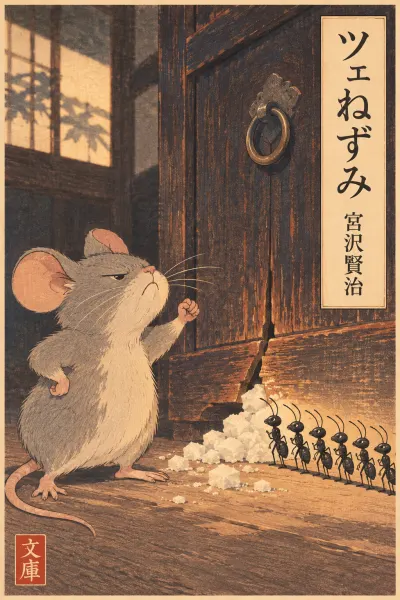
ツェねずみはすぐプイッと飛びこみましたが、半ぺんのくさっているのを見て、おこって叫びました、。Tse hopped straight in with a flick, but when he saw that the fish cake was rotten, he cried out angrily:
「ねずみとりさん。あんまりひどいや。この半ぺんはくさってます。僕のような弱いものをだますなんて、あんまりだ。償ってください。償ってください。」"Mr Mousetrap, that's too cruel! This fish cake has gone bad. Tricking a poor weak creature like me, it's just too much. Make amends to me! Make amends to me!"
ねずみ捕りは、思わず、はり金をりゅうりゅうと鳴らすくらい、おこってしまいました。Before it knew it, the mousetrap had grown so angry that its wires went twang, twang.
そのりゅうりゅうが悪かったのです。And that twang, twang was the trouble.
「ピシャッ。シインン。」えさについていたかぎがはずれて、ねずみ捕りの入り口が閉じてしまいました。"Snap! Shiiinnn." The catch that held the bait came loose, and the mousetrap's door slammed shut.
さあもうたいへんです。Well, now there was real trouble.
ツェねずみはきちがいのようになって、Tse went quite frantic, as if he had lost his mind, and
「ねずみ捕りさん。ひどいや。ひどいや。うう、くやしい。ねずみ捕りさん。あんまりだ。」と言いながら、はりがねをかじるやら、くるくるまわるやら、地だんだふむやら、わめくやら、泣くやら、それはそれは大さわぎです。crying, "Mr Mousetrap, how cruel! How cruel! Ooh, it's so unfair! Mr Mousetrap, this is too much!", what with gnawing at the wires, spinning round and round, stamping his feet, howling and weeping, oh, what an uproar there was.
それでも、償ってください、償ってくださいは、もう言う力がありませんでした。And yet he no longer had the strength to say, "Make amends to me, make amends to me."
ねずみ捕りの方も、痛いやら、しゃくにさわるやら、ガタガタ、ブルブル、リュウリュウとふるえました。The mousetrap, for its part, what with the pain and the vexation, shook and shook: rattle-rattle, shiver-shiver, twang-twang.
一晩そうやってとうとう朝になりました。They carried on like that the whole night, until at last morning came.
顔のまっ赤な下男が来て見て、こおどりして言いました。The red-faced manservant came, took one look, and jumped for joy, saying:
「しめた。しめた。とうとう、かかった。意地の悪そうなねずみだな。さあ、出て来い。こぞう。」"Got him! Got him! Caught at last. Nasty-looking little mouse, ain't ya? Come on, out you come, you little brat."
Vocabulary
| Word | Meaning | JLPT |
|---|---|---|
| 見そこなうみそこなう | to misjudge, to think worse of someone than they deservedictionary form: 見損なうあんまり人を見そこなうな means 'don't take me for that sort of person'. | — |
| 下男げなん | manservant, male servantAn old-fashioned word for a hired man who did household chores. | — |
| とんだとんだ | outrageous, terrible, uncalled-forUsed before a noun for something unexpected and bad: とんだ疑い 'an outrageous suspicion'. | N1 |
| ぷんぷんぷんぷん | fuming, in a huffMimetic word for being openly angry. | — |
| 大儀たいぎ | tiresome, a great effort, wearisomeOld-fashioned. さも大儀らしく means 'with a great show of weariness'. | — |
| 並みたいていなみたいてい | ordinary, common (並大抵ではない: no easy matter)dictionary form: 並大抵Almost always negative: 並大抵のことではない 'no small matter'. | — |
| せいぜいせいぜい | at most, at bestdictionary form: 精々 | N3 |
| 償ってまどう | to make amends, to compensatedictionary form: 償うまどう is an old reading of 償う. The modern word is つぐなう. This is Tse's refrain. | — |
| きちがいきちがい | madman; (のようになる) to go franticdictionary form: 気違いCommon in older texts, but now considered offensive. Avoid it in speech. | — |
| 地だんだじだんだ | stamping one's feet in frustrationdictionary form: 地団駄Usually 地団駄を踏む 'to stamp one's feet'. | — |
| しゃくにさわるしゃくにさわる | to be irritating, to get on one's nervesdictionary form: 癪に障る | — |
| こおどりこおどり | jumping for joydictionary form: 小躍りこおどりする: to dance with delight. | — |
| しめたしめた | Got it! I've done it! (from 占める 'to take possession')Colloquial. It comes from 締める 'to tie up', as in 'that's done'. | — |
| 意地いじ | disposition, nature (意地が悪い: spiteful, ill-natured)意地が悪い means 'spiteful, nasty'. Here it is 意地の悪そう 'nasty-looking'. | N1 |
Grammar
〜やら〜やら N2 what with A and B; A, B and so on
This pattern lists several actions or feelings happening in a confused jumble, often with the sense of 'it was too much'. Here a whole string of やら paints Tse's frantic uproar.
はりがねをかじるやら、くるくるまわるやら、地だんだふむやら、わめくやら、泣くやら、それはそれは大さわぎです。
What with gnawing at the wires, spinning round and round, stamping his feet, howling and weeping, oh, what an uproar there was.
〜とする(としようか) N3 to decide to do; I suppose I'll ...
Verb + とする expresses deciding on an action. In the volitional question としようか it means 'shall I, then?'. Combined with 〜てやる 'do as a favour', it shows Tse's condescending attitude.
食ってやるとしようか。
I suppose I'll do it the favour of eating it.
〜こっちゃない(=ことではない) N2 it is not (a ... matter)
こっちゃ is a casual spoken contraction of ことじゃ, so こっちゃない = ことじゃない (ことではない). 並みたいていのこっちゃない is a colloquial form of 並大抵のことではない, 'it's no small matter'.
毎日ここまでやって来るのも、並みたいていのこっちゃない。
Trudging all the way over here every day is no small business.
〜なんて N3 to do such a thing as ...; the very idea of ...
Placed after a clause, なんて presents the action as shocking or outrageous. Tse uses it to complain that tricking someone weak like him is unforgivable.
僕のような弱いものをだますなんて、あんまりだ。
Tricking a poor weak creature like me, it's just too much.
Verb (dictionary form) + な N4 Don't ...! (blunt prohibition)
Adding な to the dictionary form of a verb makes a strong, rough command not to do something. The angry mousetrap uses it toward the manservant.
あんまり人を見そこなうな。
Don't you misjudge me like that!
〜てしまう/〜ちまう N4 to end up doing; to do completely (often with regret)
〜てしまう marks an action that is completed or unfortunate. The door 'went and shut'. ちまう in Tse's いやになっちまう is a casual spoken contraction of てしまう.
えさについていたかぎがはずれて、ねずみ捕りの入り口が閉じてしまいました。
The catch that held the bait came loose, and the mousetrap's door slammed shut.