Upper intermediate · JLPT N2
ツェねずみTsuenezumi — Tse the Mouse Wants Amends
- JLPT N2
- 4,851 characters
- 4 parts
- about 40 minutes
- 3 easier versions
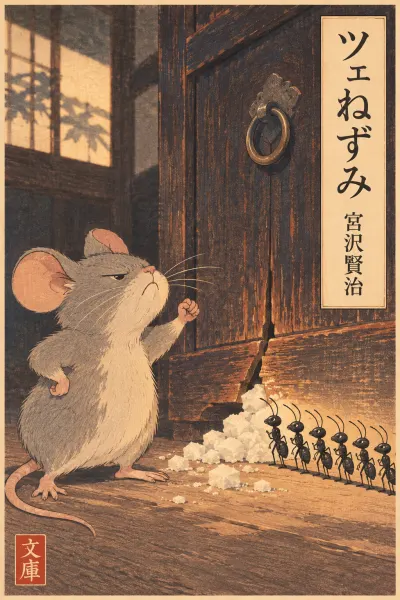
Tse the Mouse Wants Amends is a short animal fable by Miyazawa Kenji, told in four parts and seen from a mouse's level: the dark ceiling space of an old house, the passage under the floor, a cupboard and a woodshed. Its hero, Tse, is not brave or clever. He is a self-pitying little mouse who cannot accept that anything is his own fault. When things go wrong, and they often do, he whines that someone must make amends. A weasel, a pillar, a dustpan, a bucket and finally a wire mousetrap each come up against this side of him, and the story follows where his habit leads. The narrator tells all this gently and politely in です/ます form, with onomatopoeia and the occasional wry aside, so the moral comes through humour rather than lecturing. For learners, the narration is clear and repetitive in a helpful way, since the same kind of scene and the same refrain come back again and again. The dialogue is harder. Each speaker has a distinct voice, from rough, contracted colloquial speech to Tse's old-fashioned whining, which makes it a good, demanding piece for practising how Japanese marks character through speech style.
Contents
Easier versions
This story is also retold in simpler Japanese. Reading an easier version first makes the original much more approachable.
Before you read
- Learn 償う (つぐなう, to make amends) before you start. It is the heart of Tse's refrain, and he uses the old-fashioned form 償うてください instead of the modern 償ってください. Once you recognise it, you will spot every one of his complaints at once.
- The narration often links events with 〜ますと ("when / upon doing..."), the polite storytelling version of 〜と. When you see it, expect what happens next as a result, which is often a small mishap that sets Tse off.
- Tse's grievances pile up through listing patterns such as 〜だの〜だの and 〜たり〜たりする. Read these as strings of complaints or actions rather than as separate clauses, and the whining rhythm of his speech becomes easier to follow.
- Expect each character to sound different. The weasel and the manservant use rough, contracted colloquial forms, the household objects speak kindly and plainly, and the mousetrap is sweet and coaxing. If a line looks ungrammatical, try reading it aloud and expanding the contractions before you reach for a dictionary.
- Useful vocabulary for the setting: いたち (weasel), 柱 (pillar), ちりとり (dustpan), バケツ (bucket), ねずみとり (mousetrap) and 天井裏 (the space above the ceiling). Most episodes centre on one of these, so knowing them in advance makes each part's scene clear from its first lines.
Words to know
The most useful words from the notes across the story.
| Word | Meaning | JLPT |
|---|---|---|
| 償うてまどう | to make amends, compensate (まどう is an archaic/dialectal word for つぐなう; 償うて is the western-style te-form of 償って)dictionary form: 償うOld reading of 償う (modern: つぐなう); うて is the western/old て-form of 〜う verbs. | — |
| 参りましたまいる | to come (humble/polite)dictionary form: 参るUsed here by the polite narrator instead of 来る. | N4 |
| しゃくにさわるしゃくにさわる | to be infuriating, get on one's nervesdictionary form: 癪に障る | — |
| 下男げなん | manservantOld word for a male household servant. | — |
| もっとももっとも | reasonable; quite rightHere a na-adjective (尤も). Don't confuse it with the superlative 最も. | N4 |
| 交際こうさい | friendship; keeping companyA formal word. Its use for a mouse and a broom adds gentle humour. | N3 |
| 最中もなか | monaka, a sweet of bean paste between crisp rice wafersWith the reading さいちゅう, the same kanji means 'in the middle of'. | N3 |
| 味方みかた | ally; someone on your side〜の味方 = on the side of ~. | N3 |
| えさえさ | bait; animal feeddictionary form: 餌Also figurative: a lure. | N3 |
| 感心かんしん | admirable, praiseworthy感心だ = that deserves credit; 感心する = to be impressed. | N3 |
| せいぜいせいぜい | at most, at bestdictionary form: 精々 | N3 |
| 戸棚とだな | cupboard (with doors) | N2 |
| わびましたわびる | to apologisedictionary form: 詫びるMore formal and heartfelt than 謝る. | N2 |
| あきれてあきれる | to be fed up; to be dumbfoundeddictionary form: 呆れる | N2 |
| こらえてこらえる | to hold back, bear, enduredictionary form: こらえるOften written 堪える; 無理にこらえる = force oneself to hold back. | N2 |
Plot summary
Show the full summary (contains spoilers)
A weasel tells Tse that sugar candies are spilling from the cupboard. When Tse arrives, soldier ants are already guarding them and drive him off. Feeling cheated, Tse pesters the weasel to make amends until the disgusted weasel throws him some of its own candies and curses him. Shunned by the other animals, Tse befriends household objects instead. Whenever one of them does him a kindness and a small mishap follows, he demands amends, until the pillar, the dustpan and the bucket all give up and every object turns away from him. Only the wire mousetrap, which secretly sympathises with mice, still invites him. Tse eats its bait two nights running, acting as though he is doing it a favour, and the manservant suspects the trap of taking bribes. Angry at being wrongly suspected, the trap is baited again, this time with rotten fish cake. When Tse finds the bait spoiled and demands amends, the furious trap rattles so hard that its door snaps shut. In the morning the manservant finds Tse caught and gleefully orders him out.
About the author
Miyazawa Kenji was a poet and writer of children's stories from Hanamaki in Iwate Prefecture. He studied agricultural science in Morioka and later taught at an agricultural school. He devoted much of his life to helping local farmers improve their methods and their cultural lives. He was a devout Buddhist, and his faith, love of nature and interest in science run through his writing. His fame came after his death, with works such as 銀河鉄道の夜, 風の又三郎 and the poem 雨ニモマケズ.