Part 2 of 4 · JLPT N2
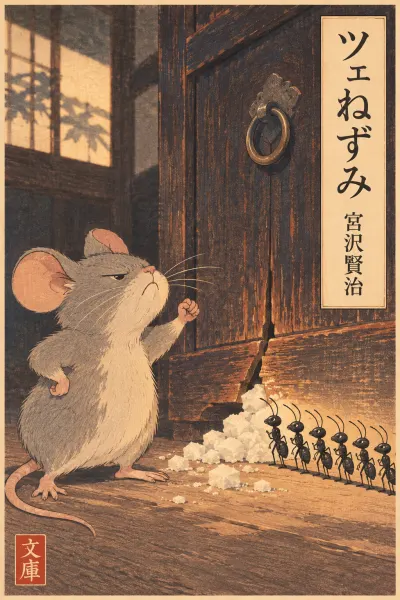
ツェねずみ Tsuenezumi, part 2: Tse Wears Out His Last Friends
In this part
Shunned by the other animals, Tse makes friends with the household objects instead. Each time one of them does him a kindness, a small mishap follows, and he whines endlessly that they must make amends. The pillar, the dustpan and the bucket each end up crying or giving up, until every object turns away whenever Tse appears.
AI translation · independently checked
こんなぐあいですから、ツェねずみはだんだんきらわれて、たれもあんまり相手にしなくなりました。Things being what they were, Tse the mouse grew more and more disliked, until hardly anyone would have anything to do with him.
そこでツェねずみはしかたなしに、こんどは、柱だの、こわれたちりとりだの、バケツだの、ほうきだのと交際をはじめました。So, having no other choice, Tse began keeping company this time with things like the pillar, a broken dustpan, the bucket and the broom.
中でも柱とは、いちばん仲よくしていました。Of them all, he got on best with the pillar.
柱がある日、ツェねずみに言いました。One day the pillar said to Tse:
「ツェねずみさん、もうじき冬になるね。ぼくらはまたかわいてミリミリ言わなくちゃならない。"Mr. Tse, it'll soon be winter, won't it? We'll be drying out again and creaking away.
お前さんも今のうちに、いい夜具のしたくをしておいた方がいいだろう。幸いぼくのすぐ頭の上に、すずめが春持って来た鳥の毛やいろいろ暖かいものがたくさんあるから、いまのうちに、すこしおろして運んでおいたらどうだい。You'd do well to get some good bedding ready while there's still time. Luckily, just above my head there are bird feathers the sparrows brought in the spring, and lots of other warm things, so why not take some down and carry them off now, while you can?
僕の頭は、まあ少し寒くなるけれど、僕は僕でまたくふうをするから。」My head will get a bit cold, I suppose, but I'll think of something for myself."
ツェねずみはもっともと思いましたので、さっそく、その日から運び方にかかりました。Tse thought this very sensible, so that same day he set straight to work carrying things.
ところが、途中に急な坂が一つありましたので、ねずみは三度目に、そこからストンところげ落ちました。But there was one steep slope along the way, and on his third trip the mouse went tumbling down it, thump!
柱もびっくりして、The pillar was quite startled too, and,
「ねずみさん、けがはないかい。けがはないかい。」と一生けん命、からだを曲げながら言いました。"Mr. Mouse, are you hurt? Are you hurt?" it said, bending itself over as hard as it could.
ねずみはやっと起き上がって、それからかおをひどくしかめながら言いました。At last the mouse picked himself up, and then, pulling a terribly sour face, he said:
「柱さん。お前もずいぶんひどい人だ。僕のような弱いものをこんな目にあわすなんて。」"Mr. Pillar, you're a very cruel fellow too. Fancy treating a weak little thing like me this way!"
柱はいかにも申しわけがないと思ったので、The pillar felt truly sorry, so
「ねずみさん、すまなかった。ゆるしてください。」と一生けん命わびました。"Mr. Mouse, I'm sorry. Please forgive me," it apologised with all its heart.
ツェねずみは図にのって、Tse, getting carried away, said:
「許してくれもないじゃないか。お前さえあんなこしゃくなさしずをしなければ、私はこんな痛い目にもあわなかったんだよ。償っておくれ。償っておくれ。さあ、償っておくれよ。」"'Forgive me,' indeed! If only you hadn't given me such cheeky orders, I'd never have got hurt like this, you know. Make amends to me. Make amends to me. Come on now, make amends to me!"
「そんなことを言ったって困るじゃありませんか。許してくださいよ。」"But saying that only puts me in a fix, doesn't it? Please, forgive me."
「いいや、弱いものをいじめるのは私はきらいなんだから、償っておくれ。償っておくれ。さあ、償っておくれ。」"No, no. I can't abide bullying the weak, so make amends to me. Make amends to me. Come on now, make amends to me."
柱は困ってしまって、おいおい泣きました。The pillar was at its wits' end and burst out sobbing.
そこでねずみも、しかたなく、巣へかえりました。So the mouse, too, had no choice but to go back to his nest.
それからは、柱はもうこわがって、ねずみに口をききませんでした。After that the pillar was too frightened to speak to the mouse any more.
さてそののちのことですが、ちりとりはある日、ツェねずみに半分になった最中を一つやりました。Now, some time after that, the dustpan gave Tse a monaka wafer cake that had been broken in half.
するとちょうどその次の日、ツェねずみはおなかが痛くなりました。And the very next day, Tse got a stomachache.
さあ、いつものとおりツェねずみは、まどっておくれを百ばかりも、ちりとりに言いました。Well, as usual, Tse said "make amends to me" to the dustpan a hundred times or so.
ちりとりもあきれて、もうねずみとの交際はやめました。The dustpan was so fed up that it gave up its friendship with the mouse.
また、そののちのことですが、ある日バケツはツェねずみに、せんたくソーダのかけらをすこしやって、And some time after that, one day the bucket gave Tse a few flakes of washing soda,
「これで毎朝お顔をお洗いなさい。」と言いましたら、ねずみはよろこんで次の日から、毎日それで顔を洗っていましたが、そのうちにねずみのおひげが十本ばかり抜けました。saying, "Wash your face with this every morning." The mouse was delighted, and from the next day on he washed his face with it every day, but before long about ten of his whiskers fell out.
さあツェねずみは、さっそくバケツへやって来て、償っておくれ償っておくれを、二百五十ばかり言いました。Well! Tse came straight over to the bucket and said "make amends to me, make amends to me" some two hundred and fifty times.
しかしあいにくバケツにはおひげもありませんでしたし、償うわけにも行かず、すっかり参ってしまって、泣いてあやまりました。But unfortunately the bucket had no whiskers of its own, so there was no way it could make amends; it was completely worn down, and apologised in tears.
そして、もうそれからは、ちょっとも口をききませんでした。And from then on it never spoke to him again, not even a word.
道具仲間は、みんな順ぐりにこんなめにあって、こりてしまいましたので、ついにはだれもツェねずみの顔を見るといそいでわきの方を向いてしまうのでした。One after another, all the household things went through the same ordeal and learned their lesson, so that in the end, whenever anyone caught sight of Tse's face, they would quickly turn and look the other way.
Vocabulary
| Word | Meaning | JLPT |
|---|---|---|
| 相手にあいてにする | to have dealings with; to pay attention to (someone)dictionary form: 相手にするUsually negative: 相手にしない means to ignore someone or shut them out. | — |
| 交際こうさい | friendship; keeping companyA formal word. Its use for a mouse and a broom adds gentle humour. | N3 |
| 夜具やぐ | bedding; bedclothesOld-fashioned. Modern Japanese uses 寝具 (しんぐ) or 布団. | N1 |
| もっとももっとも | reasonable; quite rightHere a na-adjective (尤も). Don't confuse it with the superlative 最も. | N4 |
| 図にのってずにのる | to get carried away; to push one's luckdictionary form: 図に乗るDescribes someone growing cocky after things go their way. | — |
| こしゃくこしゃく | cheeky; impertinentdictionary form: 小癪Used of someone you think is overstepping: こしゃくな奴. | — |
| さしずさしず | instructions; ordersdictionary form: 指図Often carries the feel of bossing someone around. | N1 |
| 償ってまどう | to make amends; to compensatedictionary form: 償うまどう is an old reading of 償う. The usual modern reading is つぐなう. It is Tse's catchphrase. | — |
| わびましたわびる | to apologisedictionary form: 詫びるMore formal and heartfelt than 謝る. | N2 |
| 口をききませんでしたくちをきく | to speak (to someone)dictionary form: 口をきく口をきかない means to refuse to speak to someone. | — |
| 最中もなか | monaka, a sweet of bean paste between crisp rice wafersWith the reading さいちゅう, the same kanji means 'in the middle of'. | N3 |
| あきれてあきれる | to be fed up; to be dumbfoundeddictionary form: 呆れる | N2 |
| 参ってまいる | to be worn out; to be at a lossdictionary form: 参るBesides its humble meaning 'to go/come', 参る can mean being beaten or exhausted. | N4 |
| こりてこりる | to learn one's lesson (from a bad experience)dictionary form: 懲りるImplies never wanting to repeat the experience. | N1 |
Grammar
〜だの〜だの N2 things like A and B; A, B and so on
Lists sample items, implying there are others. The list here ends with だのと and is followed by the particle と ('with').
柱だの、こわれたちりとりだの、バケツだの、ほうきだのと交際をはじめました。
He began keeping company with things like the pillar, a broken dustpan, the bucket and the broom.
〜なくちゃならない N4 must; have to
A casual contraction of なくてはならない. The pillar uses it to describe something unavoidable each winter.
ぼくらはまたかわいてミリミリ言わなくちゃならない。
We'll have to dry out and creak away again.
〜ておいた方がいい N4 had better do (in advance)
〜ておく means doing something in preparation, and 〜た方がいい gives advice. Together they mean 'you'd better get it done beforehand'.
いい夜具のしたくをしておいた方がいいだろう。
You'd do well to get some good bedding ready.
〜さえ〜ば N3 if only…; as long as…
さえ marks the single condition that would have changed everything. Here it combines with a negative conditional to put all the blame on the pillar.
お前さえあんなこしゃくなさしずをしなければ、私はこんな痛い目にもあわなかったんだよ。
If only you hadn't given me such cheeky orders, I'd never have got hurt like this.
〜ておくれ N3 please do (for me)
An old-fashioned, familiar form of 〜てください, close to 〜てくれ but softer and wheedling. It gives Tse's refrain its whining tone.
さあ、償っておくれよ。
Come on now, make amends to me!
〜わけにも行かない N3 cannot (possibly) do; there's no way to
〜わけにはいかない says something is impossible for practical or moral reasons. Using も instead of は adds 'nor could it…', and 行かず is the literary negative connective form.
償うわけにも行かず、すっかり参ってしまって
there was no way it could make amends, and it was completely worn down