Part 2 of 4 · JLPT N2
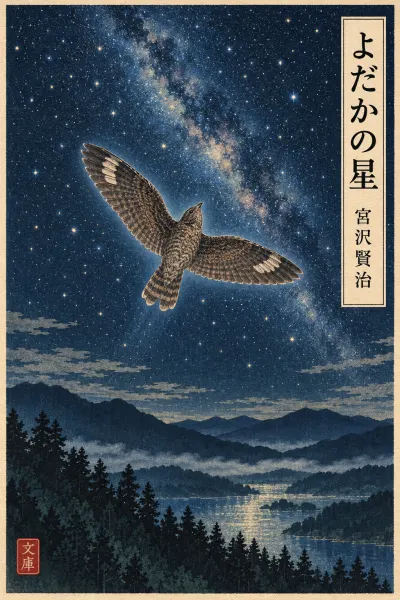
よだかの星 Yodaka no Hoshi, part 2: The Nighthawk Decides to Leave
In this part
The nighthawk begs the hawk to kill it rather than make it change its name, and the hawk flies off. Alone, the nighthawk recalls how everyone has scorned it, and while hunting at dusk it suddenly feels horror at the beetles it swallows, realising it kills just as the hawk will kill it. It decides to go far away and flies to say goodbye to its younger brother, the kingfisher, asking him not to catch fish needlessly.
AI translation · independently checked
「だってそれはあんまり無理じゃありませんか。そんなことをする位なら、私はもう死んだ方がましです。今すぐ殺して下さい。」"But surely that is far too much to ask. Rather than do a thing like that, I would sooner die. Kill me right now."
「まあ、よく、あとで考えてごらん。市蔵なんてそんなにわるい名じゃないよ。」鷹は大きなはねを一杯にひろげて、自分の巣の方へ飛んで帰って行きました。"Now, now, think it over properly later. Ichizō isn't such a bad name, you know." The hawk spread its great wings wide and flew back home toward its nest.
よだかは、じっと目をつぶって考えました。The nighthawk shut its eyes tight and thought.
(一たい僕は、なぜこうみんなにいやがられるのだろう。僕の顔は、味噌をつけたようで、口は裂けてるからなあ。(Why on earth does everyone dislike me so? It must be because my face looks as if it's been smeared with miso, and my mouth is split wide open.
それだって、僕は今まで、なんにも悪いことをしたことがない。赤ん坊のめじろが巣から落ちていたときは、助けて巣へ連れて行ってやった。Even so, I have never once done anything wrong. When a baby white-eye had fallen out of its nest, I helped it and carried it back home.
そしたらめじろは、赤ん坊をまるでぬす人からでもとりかえすように僕からひきはなしたんだなあ。And then the white-eye pulled its baby away from me as if it were snatching it back from a thief.
それからひどく僕を笑ったっけ。それにああ、今度は市蔵だなんて、首へふだをかけるなんて、つらいはなしだなあ。)And after that it laughed at me cruelly, didn't it. And on top of all that, now I'm to be called Ichizō and hang a tag around my neck. What a hard thing to bear.)
あたりは、もううすくらくなっていました。All around, it had already grown dim.
夜だかは巣から飛び出しました。The nighthawk flew out of its nest.
雲が意地悪く光って、低くたれています。The clouds were glinting spitefully and hanging low.
夜だかはまるで雲とすれすれになって、音なく空を飛びまわりました。The nighthawk flew about the sky without a sound, almost brushing against the clouds.
それからにわかによだかは口を大きくひらいて、はねをまっすぐに張って、まるで矢のようにそらをよこぎりました。Then suddenly the nighthawk opened its mouth wide, held its wings out straight, and shot across the sky like an arrow.
小さな羽虫が幾匹も幾匹もその咽喉にはいりました。Many, many tiny flying insects went into its throat.
からだがつちにつくかつかないうちに、よだかはひらりとまたそらへはねあがりました。Almost before its body touched the ground, the nighthawk flipped lightly back up into the sky.
もう雲は鼠色になり、向うの山には山焼けの火がまっ赤です。The clouds had already turned grey, and on the mountains beyond, the fires burning on the mountainside glowed bright red.
夜だかが思い切って飛ぶときは、そらがまるで二つに切れたように思われます。When the nighthawk flew with all its might, the sky seemed to be cut in two.
一疋の甲虫が、夜だかの咽喉にはいって、ひどくもがきました。A beetle went into the nighthawk's throat and struggled terribly.
よだかはすぐそれを呑みこみましたが、その時何だかせなかがぞっとしたように思いました。The nighthawk swallowed it at once, but at that moment it somehow felt a shiver run down its back.
雲はもうまっくろく、東の方だけ山やけの火が赤くうつって、恐ろしいようです。The clouds were now pitch black; only in the east did the mountain fires cast a red glow on them, and it looked frightening.
よだかはむねがつかえたように思いながら、又そらへのぼりました。Feeling as if something were stuck in its chest, the nighthawk rose into the sky again.
また一疋の甲虫が、夜だかののどに、はいりました。Another beetle went into the nighthawk's throat.
そしてまるでよだかの咽喉をひっかいてばたばたしました。And it thrashed about as if clawing at the nighthawk's throat.
よだかはそれを無理にのみこんでしまいましたが、その時、急に胸がどきっとして、夜だかは大声をあげて泣き出しました。The nighthawk forced it down, but at that moment its heart gave a sudden jolt, and the nighthawk burst into loud cries.
泣きながらぐるぐるぐるぐる空をめぐったのです。Crying, it circled round and round and round the sky.
(ああ、かぶとむしや、たくさんの羽虫が、毎晩僕に殺される。そしてそのただ一つの僕がこんどは鷹に殺される。それがこんなにつらいのだ。ああ、つらい、つらい。僕はもう虫をたべないで餓えて死のう。いやその前にもう鷹が僕を殺すだろう。いや、その前に、僕は遠くの遠くの空の向うに行ってしまおう。)(Oh, the beetles and all those flying insects are killed by me every night. And now I, the one and only me, am to be killed by the hawk in turn. That is what makes it so painful. Oh, it hurts, it hurts. I'll stop eating insects and starve to death. No, before that the hawk will surely kill me. No, before that, I'll go away, far, far off beyond the sky.)
山焼けの火は、だんだん水のように流れてひろがり、雲も赤く燃えているようです。The fire on the mountainside gradually flowed and spread like water, and the clouds too seemed to be burning red.
よだかはまっすぐに、弟の川せみの所へ飛んで行きました。The nighthawk flew straight to its younger brother, the kingfisher.
きれいな川せみも、丁度起きて遠くの山火事を見ていた所でした。The beautiful kingfisher happened to be awake as well, watching the distant mountain fire.
そしてよだかの降りて来たのを見て云いました。And when it saw the nighthawk come down, it said:
「兄さん。今晩は。何か急のご用ですか。」"Good evening, brother. Is there something urgent?"
「いいや、僕は今度遠い所へ行くからね、その前一寸お前に遭いに来たよ。」"No, it's just that I'm going somewhere far away now, so I came to see you for a moment before I go."
「兄さん。行っちゃいけませんよ。蜂雀もあんな遠くにいるんですし、僕ひとりぼっちになってしまうじゃありませんか。」"Brother, you mustn't go. The hummingbird lives so far away too. I'll be left all alone, won't I?"
「それはね。どうも仕方ないのだ。もう今日は何も云わないで呉れ。そしてお前もね、どうしてもとらなければならない時のほかはいたずらにお魚を取ったりしないようにして呉れ。ね、さよなら。」"Well, you see, it simply can't be helped. Please don't say anything more today. And you too, please don't catch fish needlessly, except when you really must. All right? Goodbye."
Vocabulary
| Word | Meaning | JLPT |
|---|---|---|
| よだかよだか | nighthawk (nightjar)dictionary form: 夜鷹A night bird that catches insects in its wide mouth. The name contains たか ('hawk'), which is why the hawk objects to it. The text writes it both as よだか and 夜だか. | — |
| 無理むり | unreasonable; impossible; forcedIn s.23 無理に means 'forcibly, against one's will'. | N4 |
| いやがられるいやがる | to dislike, to show dislike of (here passive: to be disliked)dictionary form: 嫌がるがる is added to feeling adjectives to describe someone else's feelings: いや → いやがる. | N2 |
| 裂けてるさける | to be split, torn opendictionary form: 裂ける裂けてる is a casual contraction of 裂けている. | N1 |
| ひきはなしたひきはなす | to pull apart, to pull away fromdictionary form: 引き離す | — |
| ふだふだ | tag, placard, labeldictionary form: 札 | N3 |
| 意地悪くいじわるい | spitefully, nastilydictionary form: 意地悪いThe noun/na-adjective 意地悪 (いじわる) is more common. | — |
| すれすれすれすれ | almost touching, just grazing | — |
| にわかににわかに | suddenlydictionary form: 俄にLiterary; everyday speech uses 急に or 突然. | — |
| 羽虫はむし | small flying insect, gnat | — |
| 山焼けやまやけ | burning of a mountainside (lit. the spring burning-off of dry grass on hills); here, the fire seen glowing red on the distant mountains, also called 山火事 later in the textA controlled burn done in the countryside to clear old growth. | — |
| もがきましたもがく | to struggle, to writhedictionary form: もがく | N1 |
| 餓えてうえる | to starvedictionary form: 餓えるAlso written 飢える. | N2 |
| いたずらにいたずらに | needlessly, in vaindictionary form: 徒にNot the same as いたずら 'mischief', although it is spelled the same in kana. | — |
Grammar
〜くらいなら〜ほうがましだ N2 rather than do X, Y would be better
くらいなら marks something the speaker finds unbearable, and ほうがまし says the alternative, even a bad one, is preferable. Here the nighthawk would rather die than take the new name.
そんなことをする位なら、私はもう死んだ方がましです。
Rather than do a thing like that, I would sooner die.
〜てごらん N4 try doing ~ (said to someone below you)
A softened command from ごらんなさい, used by a superior. It fits the hawk's condescending tone.
まあ、よく、あとで考えてごらん。
Now, now, think it over properly later.
〜っけ N3 recalling a past event ('didn't it', 'as I remember')
Added to a past verb, っけ shows the speaker is recalling something to themselves. The nighthawk is going over a bitter memory.
それからひどく僕を笑ったっけ。
And after that it laughed at me cruelly, didn't it.
〜か〜ないうちに N2 almost before ~, the moment ~
Repeating a verb in positive and negative (つくかつかない) with うちに means the next action happens at almost the same instant. The bird touches the ground and is up again at once.
からだがつちにつくかつかないうちに、よだかはひらりとまたそらへはねあがりました。
Almost before its body touched the ground, the nighthawk flipped lightly back up into the sky.
Volitional 〜よう / 〜てしまおう N4 I will ~, let me ~ (a decision)
The volitional form in inner speech expresses a resolve. With てしまう, 行ってしまおう adds the sense of going off completely, for good.
僕は遠くの遠くの空の向うに行ってしまおう。
I'll go away, far, far off beyond the sky.
〜ないようにして呉れ N3 please make sure not to ~
〜ないようにする means 'to take care not to do something', and 呉れ (くれ) makes it a plain request. The phrase ほかは adds 'except when'.
どうしてもとらなければならない時のほかはいたずらにお魚を取ったりしないようにして呉れ。
Please don't catch fish needlessly, except when you really must.