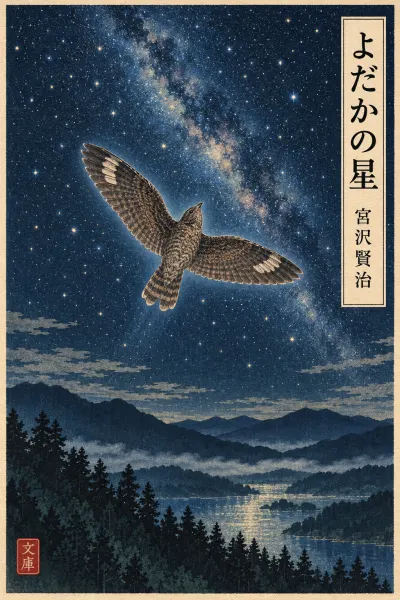
Part 3 of 4 · JLPT N2
よだかの星 Yodaka no Hoshi, part 3: Rejected by the Sun and Stars
In this part
The nighthawk says goodbye to its brother the kingfisher, tidies its nest, and flies toward the rising sun, begging to be taken up even if it burns. The sun tells it to ask the stars instead, since it is a bird of the night. That night it flies to Orion, Canis Major and the Great Bear in turn, but each one ignores, mocks or dismisses it.
AI translation · independently checked
「兄さん。どうしたんです。まあもう一寸お待ちなさい。」"Brother! What's the matter? Now, please wait a little longer."
「いや、いつまで居てもおんなじだ。はちすずめへ、あとでよろしく云ってやって呉れ。さよなら。もうあわないよ。さよなら。」"No. It'll be the same however long I stay. Give my regards to the hummingbird later, will you? Goodbye. We won't meet again. Goodbye."
よだかは泣きながら自分のお家へ帰って参りました。Weeping, the nighthawk went back to its own home.
みじかい夏の夜はもうあけかかっていました。The short summer night was already beginning to turn to dawn.
羊歯の葉は、よあけの霧を吸って、青くつめたくゆれました。The fern leaves drank in the mist of daybreak and swayed, green and cold.
よだかは高くきしきしきしと鳴きました。The nighthawk cried out high and shrill: kishi-kishi-kishi.
そして巣の中をきちんとかたづけ、きれいにからだ中のはねや毛をそろえて、また巣から飛び出しました。Then it tidied its nest neatly, carefully smoothed all the feathers and down on its body, and flew out of the nest again.
霧がはれて、お日さまが丁度東からのぼりました。The mist lifted, and the sun was just rising in the east.
夜だかはぐらぐらするほどまぶしいのをこらえて、矢のように、そっちへ飛んで行きました。Bearing a glare so bright that its head reeled, the nighthawk flew toward it like an arrow.
「お日さん、お日さん。どうぞ私をあなたの所へ連れてって下さい。灼けて死んでもかまいません。私のようなみにくいからだでも灼けるときには小さなひかりを出すでしょう。どうか私を連れてって下さい。」"Sun, oh Sun! Please take me with you to where you are. I don't mind if I burn to death. Even an ugly body like mine will surely give off a little light when it burns. Please, take me with you."
行っても行っても、お日さまは近くなりませんでした。It flew and flew, but the sun came no closer.
かえってだんだん小さく遠くなりながらお日さまが云いました。Instead, growing smaller and farther away, the sun spoke.
「お前はよだかだな。なるほど、ずいぶんつらかろう。今夜そらを飛んで、星にそうたのんでごらん。お前はひるの鳥ではないのだからな。」"You're the nighthawk, aren't you? Yes, it must be very hard for you. Tonight, fly through the sky and ask the stars the same thing. After all, you are not a bird of the daytime."
夜だかはおじぎを一つしたと思いましたが、急にぐらぐらしてとうとう野原の草の上に落ちてしまいました。The nighthawk thought it had made a bow, but suddenly everything reeled, and at last it fell onto the grass of a field.
そしてまるで夢を見ているようでした。And it was just as if it were dreaming.
からだがずうっと赤や黄の星のあいだをのぼって行ったり、どこまでも風に飛ばされたり、又鷹が来てからだをつかんだりしたようでした。It seemed that its body climbed on and on among red and yellow stars, was blown endlessly along by the wind, and then the hawk came and seized it.
つめたいものがにわかに顔に落ちました。Something cold suddenly fell onto its face.
よだかは眼をひらきました。The nighthawk opened its eyes.
一本の若いすすきの葉から露がしたたったのでした。Dew had dripped from a blade of young pampas grass.
もうすっかり夜になって、空は青ぐろく、一面の星がまたたいていました。It was now fully night; the sky was a deep blue-black, and stars twinkled all across it.
よだかはそらへ飛びあがりました。The nighthawk flew up into the sky.
今夜も山やけの火はまっかです。Tonight, too, the fires burning on the hills were bright red.
よだかはその火のかすかな照りと、つめたいほしあかりの中をとびめぐりました。The nighthawk flew round and round through the faint glow of those fires and the cold starlight.
それからもう一ぺん飛びめぐりました。Then it flew round once more.
そして思い切って西のそらのあの美しいオリオンの星の方に、まっすぐに飛びながら叫びました。Then, making up its mind, it flew straight toward those beautiful stars of Orion in the western sky, crying out:
「お星さん。西の青じろいお星さん。どうか私をあなたのところへ連れてって下さい。灼けて死んでもかまいません。」"Star! Pale blue-white star of the west! Please take me with you to where you are. I don't mind if I burn to death."
オリオンは勇ましい歌をつづけながらよだかなどはてんで相手にしませんでした。Orion kept on singing its brave song and paid no attention at all to anything like a nighthawk.
よだかは泣きそうになって、よろよろと落ちて、それからやっとふみとまって、もう一ぺんとびめぐりました。Close to tears, the nighthawk tumbled unsteadily downward, then at last caught itself and flew round once more.
それから、南の大犬座の方へまっすぐに飛びながら叫びました。Then it flew straight toward Canis Major in the south, crying out:
「お星さん。南の青いお星さん。どうか私をあなたの所へつれてって下さい。やけて死んでもかまいません。」"Star! Blue star of the south! Please take me with you to where you are. I don't mind if I burn to death."
大犬は青や紫や黄やうつくしくせわしくまたたきながら云いました。The Great Dog, twinkling busily and beautifully in blue and purple and yellow, said:
「馬鹿を云うな。おまえなんか一体どんなものだい。たかが鳥じゃないか。おまえのはねでここまで来るには、億年兆年億兆年だ。」そしてまた別の方を向きました。"Don't talk nonsense. Just what do you think you are? You're only a bird, aren't you? To come all the way here on your wings would take a hundred million years, a trillion years, a hundred million trillion years." And it turned away again in another direction.
よだかはがっかりして、よろよろ落ちて、それから又二へん飛びめぐりました。Disheartened, the nighthawk tumbled unsteadily downward, then flew round twice more.
それから又思い切って北の大熊星の方へまっすぐに飛びながら叫びました。Then, making up its mind once again, it flew straight toward the Great Bear in the north, crying out:
「北の青いお星さま、あなたの所へどうか私を連れてって下さい。」"Blue star of the north, please take me with you to where you are."
大熊星はしずかに云いました。The Great Bear spoke quietly.
「余計なことを考えるものではない。少し頭をひやして来なさい。そう云うときは、氷山の浮いている海の中へ飛び込むか、近くに海がなかったら、氷をうかべたコップの水の中へ飛び込むのが一等だ。」"You shouldn't think such needless thoughts. Go and cool your head a little. At times like this, the best thing is to dive into a sea where icebergs float, or, if there is no sea nearby, to dive into a glass of water with ice floating in it."
Vocabulary
| Word | Meaning | JLPT |
|---|---|---|
| よだかよだか | nighthawk (a nightjar)dictionary form: 夜鷹The name contains たか 'hawk', which is why the hawk resents it. The text sometimes writes it 夜だか, still read よだか. | — |
| 呉れくれる | to do (something) for me; here, as 〜てくれ, 'please do'dictionary form: 呉れるOlder kanji spelling; today usually written in kana. 〜てくれ is a plain, masculine request. | N4 |
| 羊歯しだ | fernA special reading: the kanji mean 'sheep' and 'tooth'. | — |
| こらえてこらえる | to bear, endure, hold backdictionary form: こらえるAlso written 堪える. Often used for pain, tears or laughter. | N2 |
| 灼けてやける | to burn, be scorcheddictionary form: 灼けるLiterary kanji for 焼ける, suggesting intense, scorching heat. | N4 |
| みにくいみにくい | uglydictionary form: 醜いDo not confuse with 見にくい 'hard to see'. | N2 |
| かえってかえって | on the contrary, insteaddictionary form: 却ってMarks a result opposite to what was expected. | N2 |
| にわかににわかに | suddenlydictionary form: 俄かにA literary word; compare にわか雨 'sudden shower'. | — |
| 露つゆ | dew | N1 |
| またたいてまたたく | to twinkledictionary form: 瞬くAlso 'to blink'; 瞬く間に means 'in the blink of an eye'. | — |
| 思い切っておもいきる | to make up one's mind, take the plungedictionary form: 思い切る思い切って + verb: 'boldly, resolutely do'. | — |
| てんでてんで | (not) at allColloquial; used with a negative, like 全然. | N1 |
| 相手にしませんでしたあいてにする | to pay attention to, deal withdictionary form: 相手にするIn the negative: 'ignore, take no notice of'. | — |
| たかがたかが | merely, nothing more thanBelittles what follows: たかが鳥 'just a bird'. | — |
| 余計なよけい | unnecessary, uncalled-fordictionary form: 余計余計なこと 'needless things; things that are none of your business'. | N2 |
Grammar
〜かかる N2 to be about to; to begin to
Attached to a verb stem, かかる shows an action that has just started or is on the point of happening. あけかかる means the night was beginning to give way to dawn.
みじかい夏の夜はもうあけかかっていました。
The short summer night was already beginning to turn to dawn.
〜ても〜ても N3 no matter how much one does ~
Repeating the same verb in the て-form plus も stresses repeated effort that brings no result. Here, however far the nighthawk flies, the sun gets no closer.
行っても行っても、お日さまは近くなりませんでした。
It flew and flew, but the sun came no closer.
〜てもかまいません N4 it doesn't matter if ~; I don't mind if ~
The て-form + も + かまわない gives permission or shows acceptance. The nighthawk says it is willing even to burn to death.
灼けて死んでもかまいません。
I don't mind if I burn to death.
〜かろう N1 it must be ~; probably ~ (i-adjectives)
An old conjecture form of i-adjectives: drop い and add かろう. つらかろう is a literary equivalent of つらいだろう, 'it must be hard'.
なるほど、ずいぶんつらかろう。
Yes, it must be very hard for you.
〜そうになる N3 to be on the verge of ~
A verb stem + そう + になる means something almost happens. 泣きそうになって means the nighthawk was close to tears.
よだかは泣きそうになって、よろよろと落ちて
Close to tears, the nighthawk tumbled unsteadily downward
〜ものではない N2 one should not ~
The dictionary form + ものではない gives advice or a mild rebuke about what is proper. The Great Bear uses it to tell the nighthawk to stop thinking such thoughts.
余計なことを考えるものではない。
You shouldn't think such needless thoughts.