Advanced · JLPT N1
雪渡りYukiwatari — Over the Frozen Snow
- JLPT N1
- 6,395 characters
- 5 parts
- about 53 minutes
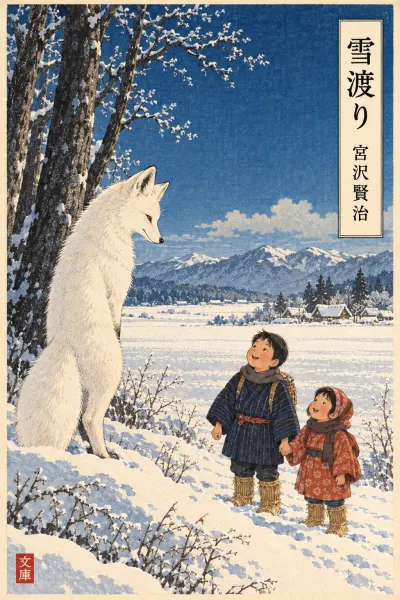
"Over the Frozen Snow" (雪渡り) is a gentle winter fairy tale by Miyazawa Kenji. On a morning when the snow has frozen hard enough to walk on, two village children, Shirō and his little sister Kanko, cross fields they normally cannot reach. At the edge of the woods they meet Konzaburō, a young white fox with very formal manners. He insists that foxes have been unfairly blamed for tricking people, and he invites the children to a magic-lantern show at the fox school on the next moonlit night. The story then turns on one question: will humans and foxes trust each other? The narrator speaks in warm desu/masu storytelling Japanese. Much of the text's charm comes from sound: chants, songs, stamping rhythms and plenty of onomatopoeia. This makes it fun to read aloud, but it is harder than its length suggests. You will meet several very different voices: the children's plain speech with northern dialect touches, the fox's stiff and slightly pompous keigo, and a ticket written in archaic letter style. With five short parts, it works well as a first step into literary Japanese with a lot of help.
Contents
Before you read
- Learn the snow and fox vocabulary before you start: 堅雪 (かたゆき, hard-frozen snow), 狐 (きつね), 幻燈会 (げんとうかい, magic-lantern show) and 黍団子 (きびだんご, millet dumplings). These words carry the plot and come back again and again.
- The children's lines use spoken contractions and dialect. ほしけりゃ means ほしければ, and 〜なきゃ means 〜なければ. Forms like 子ぁ and 嫁ぃ are dialect pronunciations of 子は and 嫁は or 嫁を. Say them aloud and they become much easier to recognise.
- Konzaburō's speech is deliberately over-polite. Watch for emphatic forms like 〜ですとも ('of course!') and rhetorical 〜もんですか (= 〜ものですか, 'as if…!'). Much of the humour is in the gap between his grand language and the fact that he is a small fox.
- The slide captions and the ticket use old written forms. 〜べからず means 'must not' (as in a prohibition on a notice), 〜せよ is a written command, and 申し候 is old letter style. You only need to recognise these here, not produce them.
- Don't try to translate every chant or sound word. The songs and onomatopoeia are there mainly for rhythm. Read them aloud for their sound, and save your effort for the sentences that move the story forward.
Words to know
The most useful words from the notes across the story.
| Word | Meaning | JLPT |
|---|---|---|
| こしらえたこしらえる | to make, to put togetherdictionary form: 拵えるInformal, slightly old-fashioned synonym of 作る. | N2 |
| 軽べつけいべつ | contempt; making light ofdictionary form: 軽蔑Normally written 軽蔑 and means 'to look down on'. Here it means not taking fire seriously. | N1 |
| 雪沓ゆきぐつ | snow boots (traditionally woven from straw)沓 is an old kanji for footwear; modern Japanese writes 靴. | — |
| 入場券にゅうじょうけん | admission ticket入場 (entering a venue) + 券 (ticket). | — |
| 尤もらしくもっともらしい | with a serious, knowing air; plausible-lookingdictionary form: 尤もらしいOften slightly ironic: someone looks wise or proper. | — |
| わなわな | trap, snaredictionary form: 罠 | — |
| 幻燈げんとう | magic lantern (an early slide projector)Now usually written 幻灯. Literally 'illusion lamp'. | — |
| 召しあがるめしあがる | to eat (honorific)dictionary form: 召し上がるThe fox uses respectful keigo for the children's actions, which sounds comically grand. | N4 |
| 悦んでよろこぶ | to be delighted, to rejoicedictionary form: 悦ぶOlder kanji spelling of 喜ぶ. | N4 |
| 凍ってこおる | to freezedictionary form: 凍るIn this story 凍み雪 uses the related verb 凍みる (しみる), a regional word for freezing hard. | N3 |
| 霜しも | frost | N3 |
| 嫁よめ | bride; wifeThe children say よめぃ, a northern dialect sound in which the particle is dropped (嫁ぃほしい = 嫁がほしい). | N3 |
| お断わりことわる | to refuse, turn down (お断わり = 'refused; no admittance')dictionary form: 断る〜はお断わりです is a polite way to say something is not allowed. | N3 |
| 断わりことわる | to refuse, to declinedictionary form: 断わるお断わり(いたします) is the set phrase on notices for 'not permitted'. Now usually written 断る. | N3 |
| しきりにしきりに | repeatedly, over and overDescribes an action done again and again, often a little restlessly. | N3 |
Plot summary
Show the full summary (contains spoilers)
On a day of hard-frozen snow, Shirō and Kanko chant a teasing rhyme near the woods. A young white fox, Konzaburō, answers them. He says foxes are falsely accused of trickery, offers them millet dumplings, and invites them to the fox school's magic-lantern show on the next moonlit night. Their older brothers are too old to be admitted. On the full-moon night the children bring rice cakes and are welcomed. The slides show drunk villagers, Taemon and Seisaku, eating strange 'food' in the fields, and they warn against sake, traps and fire. The foxes offer dumplings and wait anxiously. Trusting Konzaburō, the children eat them. The overjoyed foxes dance, and Konzaburō tells his pupils to remember that humans ate their food. They fill the children's pockets with gifts, and the brothers come across the snow to take them home.
About the author
Miyazawa Kenji was a poet and writer of children's stories from Hanamaki in Iwate Prefecture. He studied agricultural science in Morioka and later taught at an agricultural school. He devoted much of his life to helping local farmers improve their methods and their cultural lives. He was a devout Buddhist, and his faith, love of nature and interest in science run through his writing. His fame came after his death, with works such as 銀河鉄道の夜, 風の又三郎 and the poem 雨ニモマケズ.