Part 5 of 5 · JLPT N1
雪渡り Yukiwatari, part 5: Fox Songs and a Grateful Farewell
In this part
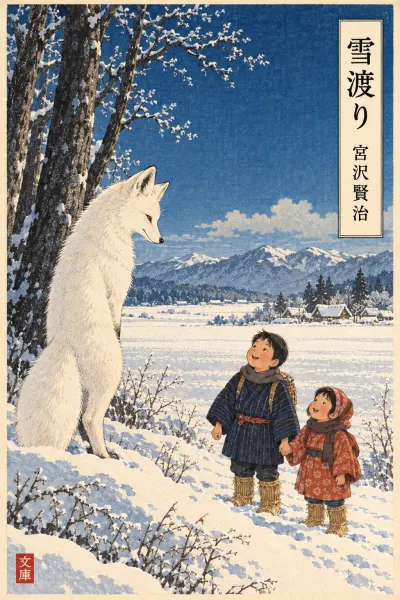
Shirō and Kanko trust Konzaburō and eat the foxes' millet dumplings, and the overjoyed fox pupils dance and sing about never lying, stealing or envying. The magic-lantern show ends with lessons about traps and fire. Konzaburō solemnly tells the pupils to remember that human children ate what the foxes made, and hopes they will grow up to clear away the foxes' bad name. The fox pupils fill the children's pockets with gifts, and on the pale snowfield Shirō and Kanko meet their older brothers, who have come to fetch them.
AI translation · independently checked
「ね、喰べよう。お喰べよ。僕は紺三郎さんが僕らを欺すなんて思わないよ。」そして二人は黍団子をみんな喰べました。"Come on, let's eat. Eat up. I don't believe Konzaburō would ever trick us." And the two of them ate up every one of the millet dumplings.
そのおいしいことは頬っぺたも落ちそうです。They were so delicious it felt as if their cheeks might fall off.
狐の学校生徒はもうあんまり悦んでみんな踊りあがってしまいました。The pupils of the fox school were so overjoyed that they all leapt up and danced.
キックキックトントン、キックキックトントン。Kick-kick, tap-tap, kick-kick, tap-tap.
「ひるはカンカン日のひかり"By day the sun shines hot and bright,
よるはツンツン月あかり、by night the moon shines cold and white,
たとえからだを、さかれてもand even if we're torn in two,
狐の生徒はうそ云うな。」fox pupils never tell a lie!"
キック、キックトントン、キックキックトントン。Kick, kick-tap-tap, kick-kick, tap-tap.
「ひるはカンカン日のひかり"By day the sun shines hot and bright,
よるはツンツン月あかりby night the moon shines cold and white,
たとえこごえて倒れてもand even if we freeze and fall,
狐の生徒はぬすまない。」fox pupils never steal at all!"
キックキックトントン、キックキックトントン。Kick-kick, tap-tap, kick-kick, tap-tap.
「ひるはカンカン日のひかり"By day the sun shines hot and bright,
よるはツンツン月あかりby night the moon shines cold and white,
たとえからだがちぎれてもand even if we're torn to bits,
狐の生徒はそねまない。」fox pupils never envy anyone!"
キックキックトントン、キックキックトントン。Kick-kick, tap-tap, kick-kick, tap-tap.
四郎もかん子もあんまり嬉しくて涙がこぼれました。Shirō and Kanko were so happy that tears spilled from their eyes.
笛がピーとなりました。The whistle went "Peep!"
『わなを軽べつすべからず』と大きな字がうつりそれが消えて絵がうつりました。The words SCORN NOT THE TRAP appeared in big letters; then they vanished and a picture appeared.
狐のこん兵衛がわなに左足をとられた景色です。It was a scene of Konbē the fox with his left foot caught in a trap.
「狐こんこん狐の子、去年狐のこん兵衛が"Fox, fox, little fox, last year Konbē the fox
左の足をわなに入れ、こんこんばたばたput his left foot in a trap, yelp-yelp, flap-flap,
こんこんこん。」yelp, yelp, yelp!"
とみんなが歌いました。sang everyone.
四郎がそっとかん子に云いました。Shirō whispered to Kanko.
「僕の作った歌だねい。」"That's the song I made up, isn't it?"
絵が消えて『火を軽べつすべからず』という字があらわれました。The picture vanished and the words SCORN NOT FIRE appeared.
それも消えて絵がうつりました。Those vanished too, and a picture appeared.
狐のこん助が焼いたお魚を取ろうとしてしっぽに火がついた所です。It showed Konsuke the fox, whose tail caught fire when he tried to snatch a grilled fish.
狐の生徒がみな叫びました。All the fox pupils shouted:
「狐こんこん狐の子。去年狐のこん助が"Fox, fox, little fox. Last year Konsuke the fox
焼いた魚を取ろとしておしりに火がつきtried to snatch a grilled fish, and his bottom caught fire,
きゃんきゃんきゃん。」yip, yip, yip!"
笛がピーと鳴り幕は明るくなって紺三郎が又出て来て云いました。The whistle went "Peep!", the screen grew bright, and Konzaburō came out again and said:
「みなさん。今晩の幻燈はこれでおしまいです。今夜みなさんは深く心に留めなければならないことがあります。"Ladies and gentlemen. This concludes this evening's magic-lantern show. Tonight there is something you must engrave deeply upon your hearts.
それは狐のこしらえたものを賢いすこしも酔わない人間のお子さんが喰べて下すったという事です。It is this: that the children of humankind, who are wise and not in the least bit drunk, have graciously eaten something made by us foxes.
そこでみなさんはこれからも、大人になってもうそをつかず人をそねまず私共狐の今迄の悪い評判をすっかり無くしてしまうだろうと思います。閉会の辞です。」Therefore I trust that from this day forth, even when you are grown, you will tell no lies, envy no one, and wipe away completely the bad name that we foxes have borne until now. Thus I close the proceedings."
狐の生徒はみんな感動して両手をあげたりワーッと立ちあがりました。The fox pupils were all deeply moved; some raised both hands high, and they sprang to their feet with a great cheer.
そしてキラキラ涙をこぼしたのです。And they shed sparkling tears.
紺三郎が二人の前に来て、丁寧におじぎをして云いました。Konzaburō came up to the two children, bowed politely, and said:
「それでは。さようなら。今夜のご恩は決して忘れません。」"Well then. Farewell. We shall never forget the kindness you have done us this night."
二人もおじぎをしてうちの方へ帰りました。The two of them bowed too and set off toward home.
狐の生徒たちが追いかけて来て二人のふところやかくしにどんぐりだの栗だの青びかりの石だのを入れて、The fox pupils came running after them and stuffed acorns, chestnuts, glittering blue stones and such into the fronts of their kimonos and into their pockets,
「そら、あげますよ。」「そら、取って下さい。」なんて云って風の様に逃げ帰って行きます。saying things like "Here, these are for you!" and "Here, please take them!", and then they dashed back home like the wind.
紺三郎は笑って見ていました。Konzaburō watched them, smiling.
二人は森を出て野原を行きました。The two left the woods and went on across the field.
その青白い雪の野原のまん中で三人の黒い影が向うから来るのを見ました。In the middle of the pale, bluish-white snowfield, they saw three dark figures coming toward them.
それは迎いに来た兄さん達でした。It was their older brothers, who had come to meet them.
Vocabulary
| Word | Meaning | JLPT |
|---|---|---|
| 欺すだます | to trick, to deceiveNow usually written 騙す; foxes in Japanese folklore are famous for tricking people. | N2 |
| 頬っぺたほっぺた | cheek頬っぺたが落ちる ("one's cheeks fall off") is a set phrase meaning food is extremely delicious. | N1 |
| 悦んでよろこぶ | to be delighted, to rejoicedictionary form: 悦ぶOlder kanji spelling of 喜ぶ. | N4 |
| そねまないそねむ | to envy, to be jealous ofdictionary form: 嫉むLiterary word; everyday Japanese uses ねたむ or うらやむ. | — |
| わなわな | trap, snaredictionary form: 罠 | — |
| 軽べつけいべつ | scorn, disdain; making light ofdictionary form: 軽蔑Written here half in kana because 蔑 is a difficult kanji. | N1 |
| 幻燈げんとう | magic-lantern show (early slide projection)dictionary form: 幻灯燈 is the old form of 灯. | — |
| こしらえたこしらえる | to make, to preparedictionary form: 拵えるColloquial and slightly old-fashioned alternative to 作る. | N2 |
| 評判ひょうばん | reputation | N3 |
| 閉会の辞へいかいのじ | closing address, closing remarksFormal ceremony language, part of the fox's comic pomposity. | — |
| ご恩おん | kindness, favour received; debt of gratitudedictionary form: 恩 | N3 |
| ふところふところ | the front fold of a kimono, used like a pocketdictionary form: 懐 | — |
| かくしかくし | pocketdictionary form: 隠しOld-fashioned word for a pocket sewn into clothing; today ポケット. | — |
| 迎いむかえ | meeting, fetching someonedictionary form: 迎え迎いに来る is an older/dialect form of 迎えに来る, "to come to pick someone up". | N3 |
Grammar
〜なんて思わない N3 I don't think (something as unlikely as) ...
なんて marks the idea before it as surprising or unthinkable. Here Shirō dismisses the very idea that Konzaburō would trick them.
僕は紺三郎さんが僕らを欺すなんて思わないよ。
I don't believe Konzaburō would ever trick us.
Verb stem + そうだ N4 looks / feels as if it is about to ...
Attached to the stem of 落ちる, そう expresses that something seems about to happen. Combined with the idiom 頬っぺたが落ちる, it means the food is extraordinarily tasty.
そのおいしいことは頬っぺたも落ちそうです。
They were so delicious it felt as if their cheeks might fall off.
たとえ〜ても N3 even if ...
たとえ at the start signals a strong concession that is completed by the て-form + も. The foxes vow to keep their rules no matter how bad things get.
たとえからだを、さかれても
and even if we're torn in two
〜べからず N1 must not ...; do not ...
A classical prohibition used on signs and notices, attached to the dictionary form (する → すべからず). It gives the slides a solemn, old-fashioned tone.
わなを軽べつすべからず
Scorn not the trap
〜なければならない N4 must ..., have to ...
The negative conditional of a verb followed by ならない expresses obligation. Konzaburō uses it to stress the importance of tonight's lesson.
今夜みなさんは深く心に留めなければならないことがあります。
Tonight there is something you must engrave deeply upon your hearts.
〜だの〜だの N2 things like ... and ... and ...
だの lists several examples casually, suggesting there were other things too. It conveys the jumble of little gifts the foxes stuffed into the children's clothes.
どんぐりだの栗だの青びかりの石だのを入れて
stuffed acorns, chestnuts, glittering blue stones and such into them