Part 1 of 5 · JLPT N1
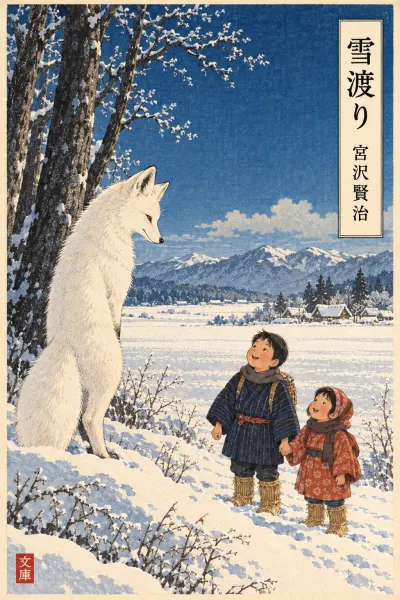
雪渡り Yukiwatari, part 1: The Children Meet a Little White Fox
In this part
On a bright winter day the snow has frozen hard, so Shirō and Kanko can walk across fields where they usually cannot go. Near the woods they chant a teasing rhyme about foxes, and a young white fox named Konzaburō comes out and answers them in rhyme. He politely insists that foxes have been wrongly accused of tricking people, and he offers the children millet dumplings he made himself.
AI translation · independently checked
雪渡り その一(小狐の紺三郎)Over the Frozen Snow, Part One (Konzaburō the Little Fox)
雪がすっかり凍って大理石よりも堅くなり、空も冷たい滑らかな青い石の板で出来ているらしいのです。The snow had frozen through and grown harder than marble, and even the sky seemed to be made of a cold, smooth slab of blue stone.
「堅雪かんこ、しみ雪しんこ。」"Crusty snow, kanko! Frozen snow, shinko!"
お日様がまっ白に燃えて百合の匂を撒きちらし又雪をぎらぎら照らしました。The sun blazed pure white, scattered the scent of lilies, and made the snow glare and glitter.
木なんかみんなザラメを掛けたように霜でぴかぴかしています。The trees and everything sparkled with frost, as if they had been sprinkled with coarse sugar.
「堅雪かんこ、凍み雪しんこ。」"Crusty snow, kanko! Frozen snow, shinko!"
四郎とかん子とは小さな雪沓をはいてキックキックキック、野原に出ました。Shirō and Kanko put on their little snow boots and went out into the field, kick, kick, kick.
こんな面白い日が、またとあるでしょうか。Could there ever be another day as much fun as this?
いつもは歩けない黍の畑の中でも、すすきで一杯だった野原の上でも、すきな方へどこ迄でも行けるのです。In the millet field, where you usually cannot walk, and across the meadow that had been full of pampas grass, you could go anywhere you liked, as far as you wanted.
平らなことはまるで一枚の板です。It was as flat as a single board.
そしてそれが沢山の小さな小さな鏡のようにキラキラキラキラ光るのです。And it shone and twinkled, twinkled and shone, like lots and lots of tiny little mirrors.
「堅雪かんこ、凍み雪しんこ。」"Crusty snow, kanko! Frozen snow, shinko!"
二人は森の近くまで来ました。The two of them came up close to the woods.
大きな柏の木は枝も埋まるくらい立派な透きとおった氷柱を下げて重そうに身体を曲げて居りました。A big oak tree hung with splendid, clear icicles, so many that its branches were almost buried, was bending its body as if it were heavy.
「堅雪かんこ、凍み雪しんこ。狐の子ぁ、嫁ほしい、ほしい。」と二人は森へ向いて高く叫びました。"Crusty snow, kanko! Frozen snow, shinko! Little fox wants a bride, wants a bride!" the two of them shouted loudly towards the woods.
しばらくしいんとしましたので二人はも一度叫ぼうとして息をのみこんだとき森の中からFor a while everything was very still, so the two of them took a breath to shout once more, and just then, from inside the woods,
「凍み雪しんしん、堅雪かんかん。」と云いながら、キシリキシリ雪をふんで白い狐の子が出て来ました。"Frozen snow, shin-shin! Crusty snow, kan-kan!" came a voice, and a little white fox stepped out, crunch, crunch, over the snow.
四郎は少しぎょっとしてかん子をうしろにかばって、しっかり足をふんばって叫びました。Shirō was a little startled; he shielded Kanko behind him, planted his feet firmly and shouted:
「狐こんこん白狐、お嫁ほしけりゃ、とってやろよ。」"Fox, fox, white fox! If you want a bride, we'll catch you one!"
すると狐がまだまるで小さいくせに銀の針のようなおひげをピンと一つひねって云いました。Then the fox, though he was still very small, gave one smart twist to his whiskers, which were like silver needles, and said:
「四郎はしんこ、かん子はかんこ、おらはお嫁はいらないよ。」"Shirō is shinko, Kanko is kanko, I don't want a bride, no!"
四郎が笑って云いました。Shirō laughed and said:
「狐こんこん、狐の子、お嫁がいらなきゃ餅やろか。」"Fox, fox, little fox! If you don't want a bride, shall I give you a rice cake?"
すると狐の子も頭を二つ三つ振って面白そうに云いました。Then the little fox shook his head two or three times too and said, sounding amused:
「四郎はしんこ、かん子はかんこ、黍の団子をおれやろか。」"Shirō is shinko, Kanko is kanko, shall I give you millet dumplings?"
かん子もあんまり面白いので四郎のうしろにかくれたままそっと歌いました。Kanko was having so much fun that she sang softly too, still hiding behind Shirō:
「狐こんこん狐の子、狐の団子は兎のくそ。」"Fox, fox, little fox! Fox's dumplings are rabbit poo!"
すると小狐紺三郎が笑って云いました。Then Konzaburō the little fox laughed and said:
「いいえ、決してそんなことはありません。あなた方のような立派なお方が兎の茶色の団子なんか召しあがるもんですか。私らは全体いままで人をだますなんてあんまりむじつの罪をきせられていたのです。」"No, no, that is by no means the case. Would such distinguished persons as yourselves ever partake of brown rabbit dumplings? Indeed, until now we foxes have been most unjustly charged with the crime of deceiving people."
四郎がおどろいて尋ねました。Shirō was surprised and asked:
「そいじゃきつねが人をだますなんて偽かしら。」"Then I wonder, is it a lie that foxes trick people?"
紺三郎が熱心に云いました。Konzaburō said earnestly:
「偽ですとも。けだし最もひどい偽です。だまされたという人は大抵お酒に酔ったり、臆病でくるくるしたりした人です。面白いですよ。甚兵衛さんがこの前、月夜の晩私たちのお家の前に坐って一晩じょうるりをやりましたよ。私らはみんな出て見たのです。」"A falsehood, most assuredly. Indeed, the very worst of falsehoods. Those who claim to have been tricked are, for the most part, people who were drunk on sake, or cowards who got themselves all in a spin. It is quite amusing. The other day, on a moonlit night, Mr Jinbē sat in front of our home and performed jōruri all night long. We all came out to watch."
四郎が叫びました。Shirō cried out:
「甚兵衛さんならじょうるりじゃないや。きっと浪花ぶしだぜ。」"If it was Mr Jinbē, it wasn't jōruri. I bet it was naniwa-bushi!"
子狐紺三郎はなるほどという顔をして、Konzaburō the little fox looked as if to say, "I see,"
「ええ、そうかもしれません。とにかくお団子をおあがりなさい。私のさしあげるのは、ちゃんと私が畑を作って播いて草をとって刈って叩いて粉にして練ってむしてお砂糖をかけたのです。いかがですか。一皿さしあげましょう。」"Yes, that may well be so. At any rate, please have some dumplings. The ones I am offering you I made properly myself: I prepared the field, sowed the seed, pulled the weeds, cut the stalks, threshed the grain, ground it into flour, kneaded it, steamed it and sprinkled it with sugar. What do you say? Allow me to offer you a plate."
と云いました。he said.
と四郎が笑って、At that, Shirō laughed,
「紺三郎さん、僕らは丁度いまね、お餅をたべて来たんだからおなかが減らないんだよ。この次におよばれしようか。」"Konzaburō, you see, we've only just eaten rice cakes, so we're not hungry. Shall we come and be your guests next time?"
Vocabulary
| Word | Meaning | JLPT |
|---|---|---|
| 凍ってこおる | to freezedictionary form: 凍るIn this story 凍み雪 uses the related verb 凍みる (しみる), a regional word for freezing hard. | N3 |
| 大理石だいりせき | marble | — |
| 霜しも | frost | N3 |
| ザラメざらめ | coarse granulated sugarUsually written in katakana; ざらめ雪 is also a word for granular, sugary snow. | — |
| 雪沓ゆきぐつ | snow boots (traditionally woven from straw)沓 is an old kanji for footwear; modern Japanese writes 靴. | — |
| 黍きび | milletMillet dumplings (黍団子) are famous from the Momotarō story. | — |
| 氷柱つらら | icicleA special reading: the kanji mean 'ice pillar'. | — |
| 嫁よめ | bride; wifeThe children say よめぃ, a northern dialect sound in which the particle is dropped (嫁ぃほしい = 嫁がほしい). | N3 |
| ぎょっとしてぎょっとする | to be startled, to get a frightdictionary form: ぎょっとする | — |
| かばってかばう | to shield, to protectdictionary form: 庇う | — |
| 召しあがるめしあがる | to eat (honorific)dictionary form: 召し上がるThe fox uses respectful keigo for the children's actions, which sounds comically grand. | N4 |
| むじつの罪むじつのつみ | a false charge; being blamed for something one did not dodictionary form: 無実の罪 | — |
| じょうるりじょうるり | jōruri, a traditional style of chanted storytelling to shamisen musicdictionary form: 浄瑠璃Often performed with puppet theatre (bunraku). | — |
| 浪花ぶしなにわぶし | naniwa-bushi, a popular style of sung storytellingdictionary form: 浪花節A more common, 'folksy' art than jōruri, so Shirō is poking fun at Jinbē. | — |
Grammar
〜らしい N4 seems to be; apparently
Attached to a plain form, らしい presents something as an impression or inference. Here the narrator suggests the sky looks as if it were made of stone.
空も冷たい滑らかな青い石の板で出来ているらしいのです。
even the sky seemed to be made of a cold, smooth slab of blue stone.
〜たように N4 as if; like
Past form + ように compares a situation to something that has happened. The frosty trees look as though sugar had been sprinkled on them.
木なんかみんなザラメを掛けたように霜でぴかぴかしています。
The trees and everything sparkled with frost, as if they had been sprinkled with coarse sugar.
〜けりゃ / 〜なきゃ (= 〜ければ / 〜なければ) N3 if ~ / if not ~ (casual contraction)
In casual speech ければ shrinks to けりゃ and なければ to なきゃ. The children's chants use these short forms, which gives them a playful, spoken rhythm.
お嫁ほしけりゃ、とってやろよ。
If you want a bride, we'll catch you one!
〜くせに N3 even though; despite (often with a nuance of surprise or criticism)
Xくせに contrasts X with a behaviour that does not seem to fit it. The fox is still tiny, yet he twirls his whiskers like a proud grown-up.
狐がまだまるで小さいくせに銀の針のようなおひげをピンと一つひねって云いました。
the fox, though he was still very small, gave one smart twist to his whiskers, which were like silver needles, and said
〜もんですか (= 〜ものですか) N2 as if ~ would; surely not
A rhetorical question that strongly denies something. The fox means that fine people like the children would never eat such a thing.
あなた方のような立派なお方が兎の茶色の団子なんか召しあがるもんですか。
Would such distinguished persons as yourselves ever partake of brown rabbit dumplings?
〜ですとも N2 of course; certainly
とも added after a sentence-final form gives an emphatic, confident agreement. It fits the fox's stiff, formal manner of speaking.
偽ですとも。
A falsehood, most assuredly.