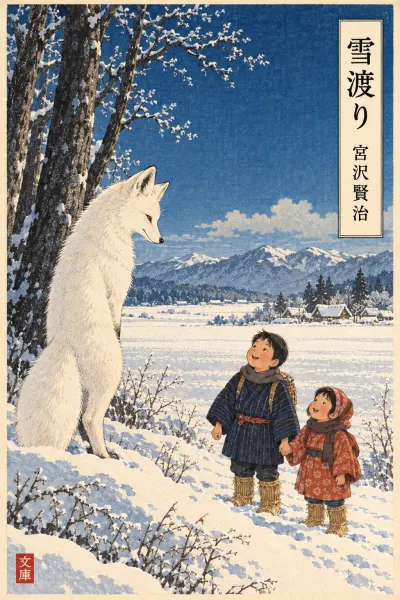
Part 2 of 5 · JLPT N1
雪渡り Yukiwatari, part 2: Tickets to the Fox's Lantern Show
In this part
Konzaburō the fox cub invites Shirō and Kanko to a magic-lantern show on the next moonlit night of frozen snow. Their older brothers cannot come because they are over eleven. The fox describes the pictures he will show and sings a teasing song, and the children join in with songs of their own. Dancing, the three go into the sparkling woods and call for a fawn, and a thin voice answers them with a song.
AI translation · independently checked
子狐の紺三郎が嬉しがってみじかい腕をばたばたして云いました。Konzaburō the fox cub was delighted, and he flapped his short arms and said:
「そうですか。そんなら今度幻燈会のときさしあげましょう。幻燈会にはきっといらっしゃい。この次の雪の凍った月夜の晩です。八時からはじめますから、入場券をあげて置きましょう。何枚あげましょうか。」"Is that so? In that case, I shall present you with some at our next magic-lantern show. Please be certain to attend the magic-lantern show. It will be on the next moonlit night when the snow is frozen. We shall begin at eight o'clock, so allow me to give you your admission tickets now. How many tickets shall I give you?"
「そんなら五枚お呉れ。」と四郎が云いました。"Then give us five," said Shirō.
「五枚ですか。あなた方が二枚にあとの三枚はどなたですか。」と紺三郎が云いました。"Five, you say? Two for yourselves, and who, may I ask, are the other three for?" said Konzaburō.
「兄さんたちだ。」と四郎が答えますと、"Our big brothers," answered Shirō, and
「兄さんたちは十一歳以下ですか。」と紺三郎が又尋ねました。"Are your big brothers eleven years of age or younger?" Konzaburō asked again.
「いや小兄さんは四年生だからね、八つの四つで十二歳。」と四郎が云いました。"No, our littlest big brother is in fourth grade, so eight and four makes twelve," said Shirō.
すると紺三郎は尤もらしく又おひげを一つひねって云いました。Then Konzaburō gave his whiskers another very serious twist and said:
「それでは残念ですが兄さんたちはお断わりです。あなた方だけいらっしゃい。特別席をとって置きますから、面白いんですよ。"In that case, I regret to say that your big brothers cannot be admitted. You two alone must come. I shall reserve special seats for you. It will be most entertaining, I assure you.
幻燈は第一が『お酒をのむべからず。』これはあなたの村の太右衛門さんと、清作さんがお酒をのんでとうとう目がくらんで野原にあるへんてこなおまんじゅうや、おそばを喰べようとした所です。The first picture in the lantern show is 'Thou Shalt Not Drink Sake.' It shows Taemon and Seisaku from your village, who drank sake until their heads were spinning, trying to eat some peculiar buns and noodles out in the field.
私も写真の中にうつっています。第二が『わなに注意せよ。』これは私共のこん兵衛が野原でわなにかかったのを画いたのです。I appear in the photograph myself. The second is 'Beware of Traps.' It is a picture of our Konbē, caught in a trap out in the field.
絵です。写真ではありません。第三が『火を軽べつすべからず。』これは私共のこん助があなたのお家へ行って尻尾を焼いた景色です。ぜひおいで下さい。」It is a drawing. It is not a photograph. The third is 'Thou Shalt Not Make Light of Fire.' It shows our Konsuke going to your house and burning his tail. Please do come."
二人は悦んでうなずきました。The two of them nodded happily.
狐は可笑しそうに口を曲げて、キックキックトントンキックキックトントンと足ぶみをはじめてしっぽと頭を振ってしばらく考えていましたがやっと思いついたらしく、両手を振って調子をとりながら歌いはじめました。The fox twisted his mouth as if he found it funny, began stamping his feet, kick-kick-tap-tap, kick-kick-tap-tap, and shook his tail and his head, thinking for a while. At last he seemed to have an idea, and swinging both arms to keep time, he began to sing:
「凍み雪しんこ、堅雪かんこ、"Frozen snow, crickle-crack, hard snow, crunch-crunch,
野原のまんじゅうはポッポッポ。The buns out in the field go puff, puff, puff.
酔ってひょろひょろ太右衛門が、Tipsy, wobbly Taemon
去年、三十八、たべた。Ate thirty-eight of them last year.
凍み雪しんこ、堅雪かんこ、Frozen snow, crickle-crack, hard snow, crunch-crunch,
野原のおそばはホッホッホ。The noodles in the field go whoo, whoo, whoo.
酔ってひょろひょろ清作が、Tipsy, wobbly, Seisaku
去年十三ばいたべた。」Ate thirteen bowls of them last year."
四郎もかん子もすっかり釣り込まれてもう狐と一緒に踊っています。Shirō and Kanko were completely carried away, and now they were dancing along with the fox.
キック、キック、トントン。Kick, kick, tap-tap.
キック、キック、トントン。Kick, kick, tap-tap.
キック、キック、キック、キック、トントントン。Kick, kick, kick, kick, tap-tap-tap.
四郎が歌いました。Shirō sang:
「狐こんこん狐の子、去年狐のこん兵衛が、ひだりの足をわなに入れ、こんこんばたばたこんこんこん。」"Fox, fox, kon-kon, little fox cub, last year Konbē the fox put his left foot in a trap, kon-kon, flap-flap, kon-kon-kon."
かん子が歌いました。Kanko sang:
「狐こんこん狐の子、去年狐のこん助が、焼いた魚を取ろとしておしりに火がつききゃんきゃんきゃん。」"Fox, fox, kon-kon, little fox cub, last year Konsuke the fox tried to grab a grilled fish, and his bottom caught fire, yelp, yelp, yelp!"
キック、キック、トントン。Kick, kick, tap-tap.
キック、キック、トントン。Kick, kick, tap-tap.
キック、キック、キック、キックトントントン。Kick, kick, kick, kick, tap-tap-tap.
そして三人は踊りながらだんだん林の中にはいって行きました。And, dancing all the while, the three of them went little by little into the woods.
赤い封蝋細工のほおの木の芽が、風に吹かれてピッカリピッカリと光り、林の中の雪には藍色の木の影がいちめん網になって落ちて日光のあたる所には銀の百合が咲いたように見えました。The buds of the magnolia trees, like little red works of sealing wax, glittered and glittered as the wind blew them. On the snow in the woods, the indigo shadows of the trees lay all around like a net, and where the sunlight fell, it looked as if silver lilies had bloomed.
すると子狐紺三郎が云いました。Then Konzaburō the fox cub said:
「鹿の子もよびましょうか。鹿の子はそりゃ笛がうまいんですよ。」"Shall we call the fawn as well? The fawn plays the flute ever so well, you know."
四郎とかん子とは手を叩いてよろこびました。Shirō and Kanko clapped their hands with joy.
そこで三人は一緒に叫びました。So the three of them shouted together:
「堅雪かんこ、凍み雪しんこ、鹿の子ぁ嫁ぃほしいほしい。」"Hard snow, crunch-crunch, frozen snow, crickle-crack, the little fawn wants a bride, wants a bride!"
すると向うで、Then, from over the way,
「北風ぴいぴい風三郎、西風どうどう又三郎」と細いいい声がしました。a thin, lovely voice sang, "North wind, whistle-whistle, Kazesaburō; west wind, whoosh-whoosh, Matasaburō."
Vocabulary
| Word | Meaning | JLPT |
|---|---|---|
| 幻燈会げんとうかい | magic-lantern show幻燈 is an old projector that throws painted or photographic slides onto a screen. Today it is usually written 幻灯. | — |
| 入場券にゅうじょうけん | admission ticket入場 (entering a venue) + 券 (ticket). | — |
| 尤もらしくもっともらしい | with a serious, knowing air; plausible-lookingdictionary form: 尤もらしいOften slightly ironic: someone looks wise or proper. | — |
| お断わりことわる | to refuse, turn down (お断わり = 'refused; no admittance')dictionary form: 断る〜はお断わりです is a polite way to say something is not allowed. | N3 |
| 目がくらんでめがくらむ | to be dazzled or dizzy; to lose one's judgementdictionary form: 目がくらむHere the men are so drunk they cannot see straight. | — |
| へんてこなへんてこ | weird, odd, funny-lookingdictionary form: へんてこCasual word, stronger and more playful than 変な. | — |
| わなわな | trap, snaredictionary form: 罠 | — |
| 軽べつけいべつ | contempt; making light ofdictionary form: 軽蔑Normally written 軽蔑 and means 'to look down on'. Here it means not taking fire seriously. | N1 |
| 凍み雪しみゆき | frozen snow凍みる (しみる) is a regional or old word for 'to freeze hard'. しんこ and かんこ are rhythmic sound words in the chant. | — |
| 堅雪かたゆき | hard-packed snow that you can walk onThe key image of the title: the crust is firm enough to walk across the fields. | — |
| 釣り込まれてつりこまれる | to be drawn in, carried awaydictionary form: 釣り込まれるLiterally 'to be reeled in', like a fish on a line. | — |
| 封蝋ふうろう | sealing wax封蝋細工 means 'a work made of sealing wax'. It describes the shiny red buds. | — |
| 藍色あいいろ | indigo (deep blue) | — |
| いちめんいちめん | all over, covering the whole surfacedictionary form: 一面 | N1 |
Grammar
〜べからず N1 must not; shall not
This is a classical prohibition, used on signs and in rules. It attaches to the dictionary form, and する becomes すべからず. The fox uses it for his lantern-slide titles to sound grand and official.
『お酒をのむべからず。』
'Thou Shalt Not Drink Sake.'
〜せよ N2 do ~ (written command)
せよ is the literary imperative of する, found in notices and instructions. 注意せよ means 'beware', said stiffly and officially.
『わなに注意せよ。』
'Beware of Traps.'
〜ようとする N3 to try to ~; to be about to ~
The volitional form + とする shows an attempt. Here the drunk men try to eat the strange food.
野原にあるへんてこなおまんじゅうや、おそばを喰べようとした所です。
It shows them trying to eat some peculiar buns and noodles out in the field.
〜て置く N4 to do ~ in advance
〜ておく (here written 置く) shows an action done ahead of time as preparation. The fox hands over the tickets now so that everything is ready for the show.
入場券をあげて置きましょう。
Allow me to give you your admission tickets now.
〜らしく N3 seemingly; it appears that
らしい expresses a guess based on what the narrator can see. The adverbial form らしく links it to the next clause: he seemed to have thought of something, and then he began to sing.
やっと思いついたらしく、両手を振って調子をとりながら歌いはじめました。
At last he seemed to have an idea, and swinging both arms to keep time, he began to sing.
〜ように見える N3 to look as if ~
This pattern is used for a visual comparison. The patches of sunlight on the snow look as though silver lilies had bloomed.
日光のあたる所には銀の百合が咲いたように見えました。
Where the sunlight fell, it looked as if silver lilies had bloomed.