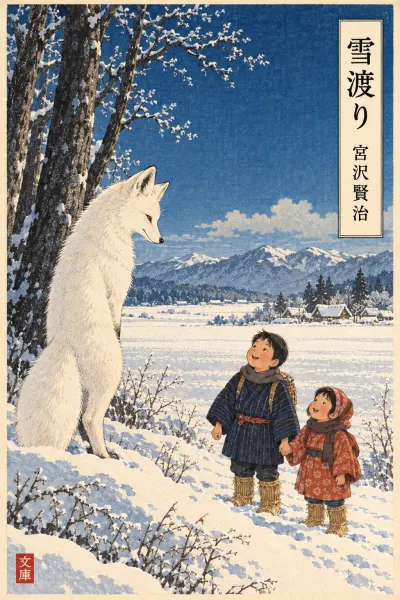
Part 3 of 5 · JLPT N1
雪渡り Yukiwatari, part 3: Off to the Foxes' Lantern Show
In this part
A fawn answers the children's chant with a distant song, and Konzaburō sends Shirō and Kanko home, inviting them to a magic-lantern show on the next moonlit night. On the full-moon night the children set off with a rice cake from their brother Jirō, who is too old to be admitted. In the woods a little fox checks their tickets, they find a clearing full of playing fox schoolchildren, and Konzaburō greets them.
AI translation · independently checked
狐の子の紺三郎がいかにもばかにしたように、口を尖らして云いました。Konzaburō the fox cub pursed his lips and spoke with a very scornful air.
「あれは鹿の子です。あいつは臆病ですからとてもこっちへ来そうにありません。けれどもう一遍叫んでみましょうか。」"That is a fawn. That fellow is a coward, so he is most unlikely to come over here. But shall we try calling once more?"
そこで三人は又叫びました。So the three of them called out again.
「堅雪かんこ、凍み雪しんこ、しかの子ぁ嫁ほしい、ほしい。」"Hard snow, kanko! Frozen snow, shinko! The little fawn wants a bride, a bride!"
すると今度はずうっと遠くで風の音か笛の声か、又は鹿の子の歌かこんなように聞えました。Then this time, from far, far away, came a sound like this. It might have been the wind, or a flute, or perhaps the fawn's song.
「北風ぴいぴい、かんこかんこ"North wind, peep-peep, kanko, kanko,
西風どうどう、どっこどっこ。」West wind, whoosh-whoosh, dokko, dokko!"
狐が又ひげをひねって云いました。The fox twirled his whiskers again and said:
「雪が柔らかになるといけませんからもうお帰りなさい。今度月夜に雪が凍ったらきっとおいで下さい。さっきの幻燈をやりますから。」"It would not do for the snow to go soft, so you had better go home now. Next time the snow freezes on a moonlit night, please be sure to come. We shall hold the magic-lantern show I mentioned."
そこで四郎とかん子とはSo Shirō and Kanko
「堅雪かんこ、凍み雪しんこ。」と歌いながら銀の雪を渡っておうちへ帰りました。went home across the silver snow, singing, "Hard snow, kanko! Frozen snow, shinko!"
「堅雪かんこ、凍み雪しんこ。」"Hard snow, kanko! Frozen snow, shinko!"
雪渡り その二(狐小学校の幻燈会)Over the Frozen Snow, Part Two (The Fox School's Magic-Lantern Show)
青白い大きな十五夜のお月様がしずかに氷の上山から登りました。The big, pale full moon of the fifteenth night rose quietly over Mount Hinokami.
雪はチカチカ青く光り、そして今日も寒水石のように堅く凍りました。The snow glittered blue, and today, too, it had frozen as hard as white marble.
四郎は狐の紺三郎との約束を思い出して妹のかん子にそっと云いました。Shirō remembered his promise to Konzaburō the fox and whispered to his little sister Kanko:
「今夜狐の幻燈会なんだね。行こうか。」"Tonight's the foxes' lantern show, isn't it? Shall we go?"
するとかん子は、At that, Kanko
「行きましょう。行きましょう。狐こんこん狐の子、こんこん狐の紺三郎。」とはねあがって高く叫んでしまいました。jumped up and shouted out loud, "Let's go! Let's go! Fox, fox, little fox cub, fox, fox, Konzaburō!"
すると二番目の兄さんの二郎がThen their second-oldest brother, Jirō,
「お前たちは狐のとこへ遊びに行くのかい。僕も行きたいな。」と云いました。said, "Are you two going to play at the foxes' place? I want to go too."
四郎は困ってしまって肩をすくめて云いました。Shirō didn't know what to do. He shrugged and said:
「大兄さん。だって、狐の幻燈会は十一歳までですよ、入場券に書いてあるんだもの。」"Big brother, the foxes' lantern show is only for kids up to eleven. It says so on the ticket."
二郎が云いました。Jirō said:
「どれ、ちょっとお見せ、ははあ、学校生徒の父兄にあらずして十二歳以上の来賓は入場をお断わり申し候、狐なんて仲々うまくやってるね。僕はいけないんだね。仕方ないや。お前たち行くんならお餅を持って行っておやりよ。そら、この鏡餅がいいだろう。」"Well, let me have a look. Aha: 'Guests aged twelve or above who be not parents or elder brothers of pupils of the school are hereby most humbly refused entry.' Those foxes are pretty clever, aren't they? So I can't go. Oh well. If you're going, take them some rice cake. Here, this round New Year rice cake should do."
四郎とかん子はそこで小さな雪沓をはいてお餅をかついで外に出ました。So Shirō and Kanko put on their little snow boots, hoisted the rice cake onto their shoulders, and went outside.
兄弟の一郎二郎三郎は戸口に並んで立って、Their brothers Ichirō, Jirō and Saburō stood in a row in the doorway
「行っておいで。大人の狐にあったら急いで目をつぶるんだよ。そら僕ら囃してやろうか。堅雪かんこ、凍み雪しんこ、狐の子ぁ嫁ぃほしいほしい。」と叫びました。and shouted, "Off you go! If you meet a grown-up fox, shut your eyes quick! Here, shall we sing you on your way? Hard snow, kanko! Frozen snow, shinko! The little fox wants a bride, a bride!"
お月様は空に高く登り森は青白いけむりに包まれています。The moon had climbed high into the sky, and the woods were wrapped in a pale blue haze.
二人はもうその森の入口に来ました。The two of them had already reached the entrance to the woods.
すると胸にどんぐりのきしょうをつけた白い小さな狐の子が立って居て云いました。There stood a small white fox cub with an acorn badge on his chest, and he said:
「今晩は。お早うございます。入場券はお持ちですか。」"Good evening. Good morning. Do you have your tickets?"
「持っています。」二人はそれを出しました。"We have them." The two of them held them out.
「さあ、どうぞあちらへ。」狐の子が尤もらしくからだを曲げて眼をパチパチしながら林の奥を手で教えました。"Now then, this way, please." The fox cub bowed very solemnly, blinking his eyes, and pointed with his paw into the depths of the wood.
林の中には月の光が青い棒を何本も斜めに投げ込んだように射して居りました。Moonlight slanted into the wood as if someone had tossed in lots of blue poles at an angle.
その中のあき地に二人は来ました。The two of them came to a clearing in the middle of it.
見るともう狐の学校生徒が沢山集って栗の皮をぶっつけ合ったりすもうをとったり殊におかしいのは小さな小さな鼠位の狐の子が大きな子供の狐の肩車に乗ってお星様を取ろうとしているのです。There they saw that lots of fox schoolchildren had already gathered, throwing chestnut husks at each other and wrestling; funniest of all, a tiny, tiny fox cub no bigger than a mouse was riding on the shoulders of a big fox child, trying to catch a star.
みんなの前の木の枝に白い一枚の敷布がさがっていました。A white sheet hung from a tree branch in front of everyone.
不意にうしろでSuddenly, from behind them,
「今晩は、よくおいででした。先日は失礼いたしました。」という声がしますので四郎とかん子とはびっくりして振り向いて見ると紺三郎です。came a voice: "Good evening, how good of you to come. Please forgive my rudeness the other day." Shirō and Kanko turned round in surprise, and there was Konzaburō.
Vocabulary
| Word | Meaning | JLPT |
|---|---|---|
| 尖らしてとがらす | to purse (one's lips), to make pointeddictionary form: 尖らす口を尖らす shows sulking or scorn. 尖 = small (小) on top of big (大), so it is pointed. | — |
| 臆病おくびょう | cowardly, timidA na-adjective: 臆病な人, 臆病だ. | N1 |
| 一遍いっぺん | once, one timeColloquial equivalent of 一度 or 一回. | — |
| 幻燈げんとう | magic lantern (an early slide projector)Now usually written 幻灯. Literally 'illusion lamp'. | — |
| 入場券にゅうじょうけん | admission ticket入場 (entry) + 券 (ticket), as in 乗車券 and 食券. | — |
| 断わりことわる | to refuse, to declinedictionary form: 断わるお断わり(いたします) is the set phrase on notices for 'not permitted'. Now usually written 断る. | N3 |
| 鏡餅かがみもち | round, stacked New Year rice cakeNamed after old round bronze mirrors. It is offered at New Year. | — |
| 雪沓ゆきぐつ | snow boots (traditional straw boots)沓 is an old kanji for 'shoe'. Note the rendaku: くつ → ぐつ. | — |
| 囃してはやす | to sing or chant along to cheer someone ondictionary form: 囃すRelated to お囃子, festival music. | — |
| きしょうきしょう | badge, insigniadictionary form: 記章Here the badge is an acorn, like a school badge. | — |
| 尤もらしくもっともらしい | solemn, with an air of great seriousnessdictionary form: 尤もらしいIt can also mean 'plausible-sounding'. Here it pokes gentle fun at the fox's formality. | — |
| 肩車かたぐるま | a piggyback ride on someone's shoulders肩車に乗る = to ride on someone's shoulders. | — |
| 敷布しきふ | bedsheetHere it serves as the projection screen. Modern Japanese often uses シーツ. | — |
| 不意にふい | unexpected, sudden, abrupt (不意に = unexpectedly, all of a sudden)dictionary form: 不意Literary. It is close in meaning to 突然. | N1 |
Grammar
〜そうにありません N3 is unlikely to ~
The verb stem + そうにない (polite: そうにありません) says that something looks unlikely to happen. With とても it becomes 'there's no way he'll ~'.
とてもこっちへ来そうにありません
he is most unlikely to come over here
〜んだもの N3 because ~ (childish justification)
A sentence-final もの or もん after a plain form gives a reason in a pleading, childlike way. Shirō uses it to excuse leaving his brother behind.
入場券に書いてあるんだもの
It says so on the ticket.
〜にあらずして N1 not being ~
This is the classical negative of ある (あらず) plus して, meaning 'who are not ~'. Together with 申し候 it makes the fox's ticket sound like a stiff, old-fashioned notice.
学校生徒の父兄にあらずして十二歳以上の来賓は入場をお断わり申し候
Guests aged twelve or above who be not parents or elder brothers of pupils are hereby most humbly refused entry.
〜ておやり N3 do ~ for someone (instruction to a junior)
おやり is a soft command form of やる in its 'give' sense. After a て-form it tells a younger person to do something kindly for someone else.
お餅を持って行っておやりよ
take them some rice cake
〜ように N4 as if ~, like ~
After a plain verb, ように makes a comparison or image. Here the slanting moonbeams are pictured as blue poles thrown into the wood.
月の光が青い棒を何本も斜めに投げ込んだように射して居りました
the moonlight slanted in as if lots of blue poles had been tossed in at an angle
〜たり〜たり N4 doing things like ~ and ~
This lists some typical actions out of many. The fox children are throwing chestnut husks, wrestling, and so on.
栗の皮をぶっつけ合ったりすもうをとったり
throwing chestnut husks at each other, wrestling