Part 1 of 1 · JLPT N3
I can speak Aikyansupīku, part 1: A Drunken Brother Speaks English
In this part
Struggling with a long novel, the narrator leaves the freezing Misaka Pass for a lodging house in Kōfu, beside a silk mill. He is cheered every day by the fine voice of a girl who leads the singing there, and longs to thank her but fears startling her into silence. One February night he overhears a drunk young man in the lane boasting to his sister, who leans from a mill window, that he is studying English and can speak it. The words strike the narrator hard, and he feels he has remembered a forgotten song, though he never learns whether the girl at the window was the singer.
AI translation · independently checked
くるしさは、忍従の夜。Suffering: a night of patient endurance.
あきらめの朝。A morning of resignation.
この世とは、あきらめの努めか。Is this world, then, but the labour of resignation?
わびしさの堪えか。The bearing of desolation?
わかさ、かくて、日に虫食われゆき、仕合せも、陋巷の内に、見つけし、となむ。And thus was youth eaten away, day upon day, as if by worms, and happiness too, so it is told, was found within a mean back alley.
わが歌、声を失い、しばらく東京で無為徒食して、そのうちに、何か、歌でなく、謂わば「生活のつぶやき」とでもいったようなものを、ぼそぼそ書きはじめて、自分の文学のすすむべき路すこしずつ、そのおのれの作品に依って知らされ、ま、こんなところかな?My song lost its voice, and for a while I lived idly in Tokyo, doing nothing; in the meantime I began mumbling something onto paper, not song, but what might be called "the murmurings of daily life," and little by little, through those works of my own, I was shown the road my writing ought to take. Well, that's about how it went, I suppose?
と多少、自信に似たものを得て、まえから腹案していた長い小説に取りかかった。With that I gained something that resembled confidence, and I set to work on a long novel I had been planning for some time.
昨年、九月、甲州の御坂峠頂上の天下茶屋という茶店の二階を借りて、そこで少しずつ、その仕事をすすめて、どうやら百枚ちかくなって、読みかえしてみても、そんなに悪い出来ではない。Last September I rented the upstairs of a teahouse called the Tenka Chaya, at the top of Misaka Pass in Kōshū, and there I pushed the work forward little by little until somehow it came to nearly a hundred pages; reading it back, I found it was not such bad work.
あたらしく力を得て、とにかくこれを完成させぬうちは、東京へ帰るまい、と御坂の木枯つよい日に、勝手にひとりで約束した。With fresh strength, on a day when the winter wind blew hard over Misaka, I made a promise, all alone and on my own authority: until I had finished this, whatever happened, I would not go back to Tokyo.
ばかな約束をしたものである。It was a foolish promise to have made.
九月、十月、十一月、御坂の寒気堪えがたくなった。September, October, November: the cold at Misaka grew hard to bear.
あのころは、心細い夜がつづいた。In those days, one forlorn night followed another.
どうしようかと、さんざ迷った。I agonised over what to do.
自分で勝手に、自分に約束して、いまさら、それを破れず、東京へ飛んで帰りたくても、何かそれは破戒のような気がして、峠のうえで、途方に暮れた。I had made the promise to myself, of my own accord, and now I could not break it; even though I longed to rush back to Tokyo, it somehow felt like breaking a sacred vow, and up on the pass I was at my wits' end.
甲府へ降りようと思った。I thought I would go down to Kōfu.
甲府なら、東京よりも温いほどで、この冬も大丈夫すごせると思った。Kōfu, I thought, was if anything warmer than Tokyo, and I could get through this winter there safely enough.
甲府へ降りた。I went down to Kōfu.
たすかった。It saved me.
変なせきが出なくなった。The strange cough stopped.
甲府のまちはずれの下宿屋、日当りのいい一部屋かりて、机にむかって坐ってみて、よかったと思った。I rented a single sunny room in a lodging house on the edge of Kōfu, and when I sat down at the desk I felt glad I had come.
また、少しずつ仕事をすすめた。Once more, I pushed my work forward little by little.
おひるごろから、ひとりでぼそぼそ仕事をしていると、わかい女の合唱が聞えて来る。From around midday, as I work away quietly on my own, I hear a chorus of young women's voices.
私はペンを休めて、耳傾ける。I rest my pen and listen.
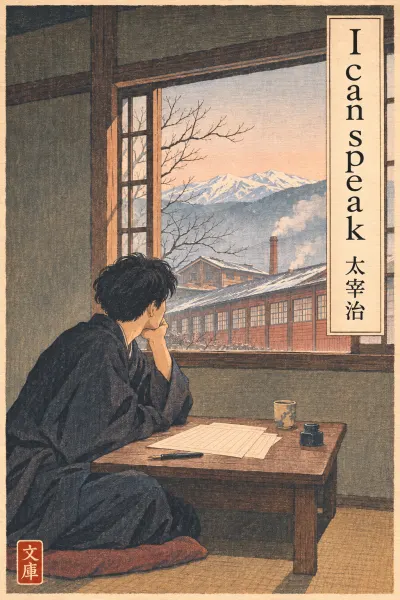
下宿と小路ひとつ距て製糸工場が在るのだ。Across a single narrow lane from my lodgings there stands a silk mill.
そこの女工さんたちが、作業しながら、唄うのだ。The women who work there sing as they go about their tasks.
なかにひとつ、際立っていい声が在って、そいつがリイドして唄うのだ。Among them is one remarkably fine voice, and it leads the others in the singing.
鶏群の一鶴、そんな感じだ。A crane among chickens, that is how it feels.
いい声だな、と思う。What a lovely voice, I think.
お礼を言いたいとさえ思った。I even felt I wanted to thank her.
工場の塀をよじのぼって、その声の主を、ひとめ見たいとさえ思った。I even wanted to climb the factory wall and catch a single glimpse of the owner of that voice.
ここにひとり、わびしい男がいて、毎日毎日あなたの唄で、どんなに救われているかわからない、あなたは、それをご存じない、あなたは私を、私の仕事を、どんなに、けなげに、はげまして呉れたか、私は、しんからお礼を言いたい。Here is a lonely man, and there is no telling how much he is saved, day after day, by your singing; you do not know it. How gallantly you have encouraged me, and my work! From the bottom of my heart, I want to thank you.
そんなことを書き散らして、工場の窓から、投文しようかとも思った。I even thought of scribbling something like that and tossing it as a note through the factory window.
けれども、そんなことして、あの女工さん、おどろき、おそれてふっと声を失ったら、これは困る。But if I did such a thing and that girl, startled and frightened, suddenly lost her voice, that would never do.
無心の唄を、私のお礼が、かえって濁らせるようなことがあっては、罪悪である。If my thanks should, on the contrary, cloud that artless song, it would be a sin.
私は、ひとりでやきもきしていた。I fretted over it all by myself.
恋、かも知れなかった。It may have been love.
二月、寒いしずかな夜である。It is February, a cold, quiet night.
工場の小路で、酔漢の荒い言葉が、突然起った。Suddenly, in the lane by the factory, a drunk man's rough voice rose up.
私は、耳をすました。I strained my ears.
――ば、ばかにするなよ。"D-don't you make fun o' me."
何がおかしいんだ。"What's so funny?"
たまに酒を呑んだからって、おらあ笑われるような覚えは無え。"So I had a drink for once. That ain't no reason for me to get laughed at."
I can speak English. おれは、夜学へ行ってんだよ。"I can speak English. I go to night school, see."
姉さん知ってるかい?"Didja know that, Sis?"
知らねえだろう。"Bet ya didn't."
おふくろにも内緒で、こっそり夜学へかよっているんだ。"I'm goin' to night school on the sly, without tellin' even Ma."
偉くならなければ、いけないからな。"'Cause I gotta make somethin' of myself."
姉さん、何がおかしいんだ。"Sis, what's so funny?"
何を、そんなに笑うんだ。"What're ya laughin' at so much?"
こう、姉さん。"Hey, Sis."
おらあな、いまに出征するんだ。"Listen, I'm gonna get shipped off to the war any day now."
そのときは、おどろくなよ。"Don't you go gettin' a shock when it happens."
のんだくれの弟だって、人なみの働きはできるさ。"Even a drunk of a kid brother can pull his weight like anybody else."
嘘だよ、まだ出征とは、きまってねえのだ。"I'm lyin'. It ain't settled yet that I'm goin'."
だけども、さ、I can speak English. Can you speak English?"But, see, I can speak English. Can you speak English?"
Yes, I can. いいなあ、英語って奴は。"Yes, I can. Ain't it grand, this English stuff."
姉さん、はっきり言って呉れ、おらあ、いい子だな、な、いい子だろう?"Sis, tell me straight. I'm a good boy, right? Right? I'm a good boy, ain't I?"
おふくろなんて、なんにも判りゃしないのだ。"Ma, she don't understand nothin'."
…………
私は、障子を少しあけて、小路を見おろす。I slide the paper screen open a little and look down into the lane.
はじめ、白梅かと思った。At first I thought it was white plum blossom.
ちがった。It was not.
その弟の白いレンコオトだった。It was the brother's white raincoat.
季節はずれのそのレンコオトを着て、弟は寒そうに、工場の塀にひたと脊中をくっつけて立っていて、その塀の上の、工場の窓から、ひとりの女工さんが、上半身乗り出し、酔った弟を、見つめている。Wearing that out-of-season raincoat, the brother stood looking cold, his back pressed flat against the factory wall, and from a factory window above the wall a woman worker was leaning out from the waist, gazing down at her drunken brother.
月が出ていたけれど、その弟の顔も、女工さんの顔も、はっきりとは見えなかった。The moon was out, but I could not clearly see the brother's face, nor the woman's.
姉の顔は、まるく、ほの白く、笑っているようである。The sister's face was round and faintly pale, and she seemed to be smiling.
弟の顔は、黒く、まだ幼い感じであった。The brother's face was dark, and he seemed still very young.
I can speak というその酔漢の英語が、くるしいくらい私を撃った。That drunk man's English, "I can speak," struck me so hard it hurt.
はじめに言葉ありき。In the beginning was the Word.
よろずのもの、これに拠りて成る。All things were made by it.
ふっと私は、忘れた歌を思い出したような気がした。Suddenly I felt as though I had remembered a song I had forgotten.
たあいない風景ではあったが、けれども、私には忘れがたい。It was a trifling scene, and yet for me it is unforgettable.
あの夜の女工さんは、あのいい声のひとであるか、どうかは、それは、知らない。Whether the factory girl of that night was the one with that lovely voice, I do not know.
ちがうだろうね。Probably not, I suppose.
(「若草」昭和十四年二月号)(Wakakusa, February 1939 issue)
Vocabulary
| Word | Meaning | JLPT |
|---|---|---|
| 忍従にんじゅう | patient submission, enduring in silenceLiterary; 忍 'endure' + 従 'obey'. | — |
| 無為徒食むいとしょく | living idly, eating without doing any workFour-character idiom (yojijukugo). | — |
| 腹案ふくあん | a plan one has in mind腹 'belly' is where plans are kept in Japanese; here used as a する verb. | — |
| 途方に暮れたとほうにくれる | to be at a loss, at one's wits' enddictionary form: 途方に暮れるSet phrase. | — |
| 下宿屋げしゅくや | lodging house, boarding house下宿 alone means 'lodgings, room rented in a house'. | — |
| 製糸工場せいしこうじょう | silk-reeling millSilk mills were a major industry in Yamanashi and employed many young women. | — |
| 女工じょこう | female factory worker, mill girlHistorical term; the narrator adds the polite さん. | — |
| 際立ってきわだつ | to stand out, be conspicuousdictionary form: 際立つ | — |
| 投文なげぶみ | a note thrown into someone's house or windowdictionary form: 投げ文Old-fashioned; usually written 投げ文. | — |
| やきもきやきもき | fretting, being anxious and impatientUsually used as やきもきする. | — |
| 酔漢すいかん | drunken manLiterary; everyday word is 酔っ払い. | — |
| 夜学やがく | night school | — |
| 内緒ないしょ | secret, keeping something from someone〜に内緒で = without telling someone. | — |
| 出征しゅっせい | going off to war, being sent to the frontVery topical in 1939, during the war with China. | — |
Grammar
〜まい N2 will not (negative intention)
〜まい expresses a firm negative intention or resolve ('will not'). It attaches to the dictionary form of godan verbs (with ichidan verbs, to the stem or dictionary form; する→すまい/しまい). 帰るまい means 'I will not go back,' said here as a vow.
とにかくこれを完成させぬうちは、東京へ帰るまい
until I had finished this, whatever happened, I would not go back to Tokyo
〜たものだ/ものである N2 expressing strong feeling about a past act
Past tense + ものである adds an emotional, reflective comment on what was done, here rueful self-criticism. It is not the 'used to' meaning of 〜たものだ.
ばかな約束をしたものである。
It was a foolish promise to have made.
〜がたい N2 hard to do, almost impossible to do
Added to the verb stem, がたい means something is emotionally or practically hard to do. 堪えがたい means 'unbearable' and 忘れがたい means 'unforgettable.'
御坂の寒気堪えがたくなった。
the cold at Misaka grew hard to bear.
〜とさえ思う N3 even think that…
さえ marks something as an extreme case: the narrator's feelings went so far that he even wanted to thank her. Repeating it in the next sentence builds up his growing yearning.
お礼を言いたいとさえ思った。
I even felt I wanted to thank her.
〜からって N3 just because…
A colloquial form of からといって. It introduces a reason and denies that the reason justifies the conclusion: having a drink once is no cause for being laughed at.
たまに酒を呑んだからって、おらあ笑われるような覚えは無え。
"So I had a drink for once. That ain't no reason for me to get laughed at."
〜ありき N1 there was (classical past of ある)
ありき is the classical past form of あり 'to exist.' It gives a solemn, scriptural tone, here quoting the Japanese Bible's 'In the beginning was the Word.' In modern use, 〜ありき also means 'X comes first, X is a given.'
はじめに言葉ありき。
In the beginning was the Word.