Intermediate · JLPT N3
I can speakAikyansupīku — A Voice Across the Lane
- JLPT N3
- 1,921 characters
- 1 part
- about 16 minutes
- 2 easier versions
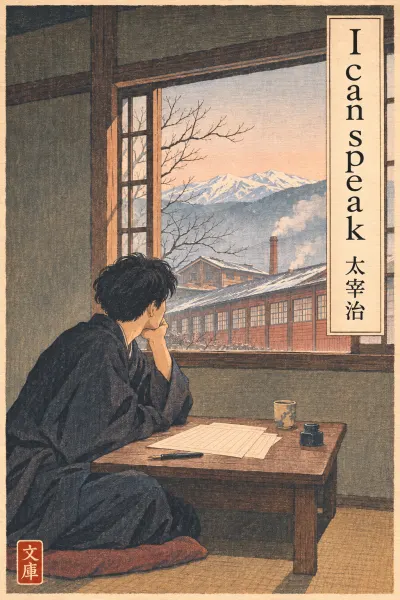
"I can speak" is a very short first-person sketch by Dazai Osamu, published in the February 1939 issue of the magazine Wakakusa. A writer, stuck on a long novel, leaves a freezing mountain pass for a lodging house on the edge of Kōfu, next to a silk mill. There he listens each day to a girl's voice leading the workers' singing, and one moonlit February night he overhears a brief exchange in the lane outside his window. Almost nothing happens, and that is the point. The piece is about loneliness, the stubbornness of writing, and the way a few clumsy words can reach someone unexpectedly. The tone is quiet and self-deprecating, with the narrator's gloom gently lifted by small sounds from the world outside. For learners, the length and the plain da/de aru narration make it a manageable first literary text.
Contents
Easier versions
This story is also retold in simpler Japanese. Reading an easier version first makes the original much more approachable.
Before you read
- Learn the brother's rough speech before you reach his lines. おらあ means おれは, 無え means ない, and 判りゃしない means わかりはしない ('nobody can tell'). 〜からって means 〜からといって ('just because'). His English phrases appear as English in the text, so read them as he would say them.
- Watch for the narrator's reflective grammar: 〜まい for negative intention or conjecture ('surely won't', 'I won't'), 〜たものだ/ものである for habitual past or strong feeling, 〜がたい for 'hard to (bring oneself to)', and 〜とさえ思う for 'I even think that'. These carry much of his self-mocking tone.
- Learn the place names first: 甲州 (Kōshū), 御坂峠 (Misaka Pass), 天下茶屋 (Tenka Chaya) and 甲府 (Kōfu). Also learn words for the silk mill and singing, such as 製糸 and 歌/唄, and for voice, 声. The setting moves from the pass to the Kōfu lodging house within the first few paragraphs.
- Much of the story is sound rather than sight: singing heard through walls and voices in the dark lane. Track who is speaking and who is only listening. The narrator never addresses anyone directly, and that distance is central to the ending.
Words to know
The most useful words from the notes across the story.
| Word | Meaning | JLPT |
|---|---|---|
| 忍従にんじゅう | patient submission, enduring in silenceLiterary; 忍 'endure' + 従 'obey'. | — |
| 無為徒食むいとしょく | living idly, eating without doing any workFour-character idiom (yojijukugo). | — |
| 腹案ふくあん | a plan one has in mind腹 'belly' is where plans are kept in Japanese; here used as a する verb. | — |
| 途方に暮れたとほうにくれる | to be at a loss, at one's wits' enddictionary form: 途方に暮れるSet phrase. | — |
| 下宿屋げしゅくや | lodging house, boarding house下宿 alone means 'lodgings, room rented in a house'. | — |
| 製糸工場せいしこうじょう | silk-reeling millSilk mills were a major industry in Yamanashi and employed many young women. | — |
| 女工じょこう | female factory worker, mill girlHistorical term; the narrator adds the polite さん. | — |
| 際立ってきわだつ | to stand out, be conspicuousdictionary form: 際立つ | — |
| 投文なげぶみ | a note thrown into someone's house or windowdictionary form: 投げ文Old-fashioned; usually written 投げ文. | — |
| やきもきやきもき | fretting, being anxious and impatientUsually used as やきもきする. | — |
| 酔漢すいかん | drunken manLiterary; everyday word is 酔っ払い. | — |
| 夜学やがく | night school | — |
| 内緒ないしょ | secret, keeping something from someone〜に内緒で = without telling someone. | — |
| 出征しゅっせい | going off to war, being sent to the frontVery topical in 1939, during the war with China. | — |
Plot summary
Show the full summary (contains spoilers)
The narrator is struggling with a long novel. He has been writing in a rented room above the Tenka Chaya teahouse on Misaka Pass. When it grows too cold there, he moves down to a lodging house on the outskirts of Kōfu, beside a silk mill. Every day the voice of a girl leading the mill workers' songs cheers him. He wants to thank her, but he fears that if she knew someone was listening, she might stop singing. One February night under the moon, he hears a drunk young man in the lane boasting to his sister, who leans out of a mill window. The plain words strike the narrator deeply. He feels as if he has remembered a song he had forgotten. He never learns whether the girl at the window was the singer.
About the author
Dazai Osamu (太宰治) was the pen name of Tsushima Shūji, born into a wealthy landowning family in Aomori Prefecture in northern Japan. He studied French literature at Tokyo Imperial University but did not graduate, devoting himself instead to writing. He is best known for the novels The Setting Sun (斜陽) and No Longer Human (人間失格), which draw heavily on his own troubled life. Much of his work is dark and confessional. Keep Running, Melos shows a brighter, more straightforwardly heroic side of his writing. He died by suicide in 1948.