Upper intermediate · JLPT N2
畜犬談Chikukendan — My Case Against Dogs
- JLPT N2
- 12,151 characters
- 8 parts
- about 101 minutes
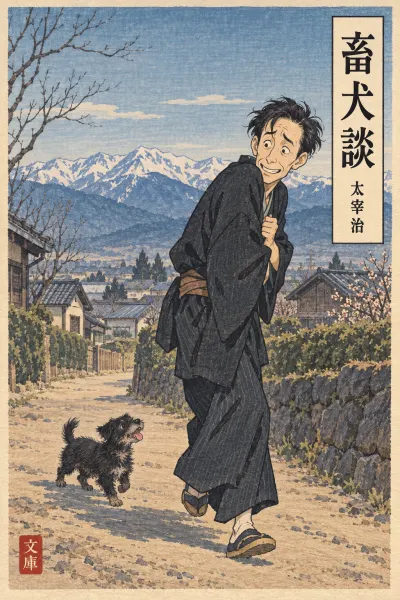
畜犬談 is a comic first-person story told as a mock essay. A self-declared dog-hater explains, at great length and with pretend-scholarly gravity, why dogs are dangerous and contemptible. He lives with his wife in a rented cottage on the edge of Kōfu while they wait to move to Mitaka near Tokyo. To survive the town's many stray dogs, he devises a cowardly strategy, and he ends up adopted by a scruffy black puppy he is too frightened to turn away. The puppy, Pochi, grows up, picks fights and falls ill, and he becomes a bigger problem as moving day approaches. The humour comes from the gap between the narrator's grand oratory, addressed to 'gentlemen' (諸君), and the pettiness and timidity he keeps admitting. For learners, part of the pleasure is watching that pose crack. The challenge is the register. Long sentences, four-character compounds and classical-flavoured forms such as ぬ, べし, ごとく and ざるを得ない sit alongside casual dialogue between husband and wife. At about 12,000 characters in eight parts, the story is a manageable length for an N2-level reader willing to work through some dense passages.
Contents
Before you read
- Learn the classical-flavoured forms before you start, because they carry the mock-heroic tone. ぬ is a negative equal to ない (知らぬ = 知らない). 〜のごとく means 'like / as if'. 〜べきである means 'ought to'. 〜ざるを得ない means 'cannot help but'. When you see them, read them as the narrator puffing himself up, not as real archaism.
- The narrator's tirades often run to long sentences with the main verb at the very end. Find the final verb first, then work back through the clauses separated by commas. Look out for 〜ば〜ほど ('the more…, the more…') and 〜にちがいない ('must surely be'), which structure many of his arguments.
- Watch for 〜(よ)うものなら ('if one were ever to…, then [something terrible]'). It sets up his exaggerated fears about what dogs might do, and 〜んばかり ('as if about to…') often comes with it in his descriptions of dogs.
- Words for dogs and fear recur constantly, so they are worth learning early: 犬, 畜犬, 野良犬 (stray dog), かむ (to bite), 狂犬病 (rabies), 吠える (to bark) and 練兵場 (parade ground, where key scenes take place). Pochi's skin disease (皮膚病) dominates the later parts.
- Switch gears for the dialogue, which is short and casual. The narrator uses plain male speech, and his wife uses soft plain or semi-polite speech. Her few lines carry a lot of weight, especially in Parts 6 and 8, so pay attention to her tone.
Words to know
The most useful words from the notes across the story.
| Word | Meaning | JLPT |
|---|---|---|
| 家主やぬし | landlord, owner of a rented house | N2 |
| 速達そくたつ | express mail, special delivery | N2 |
| 猛獣もうじゅう | ferocious beast, beast of preyThe narrator's key word for dogs. 猛 'fierce' + 獣 'beast'. | — |
| 油断ゆだん | carelessness, letting one's guard downCommon in the saying 油断大敵 'carelessness is the great enemy'. | N2 |
| 駄犬だけん | mongrel; worthless dogThe prefix 駄 means 'inferior, worthless', as in 駄目 and 駄作. | — |
| 卑屈ひくつ | servility; spinelessnessA な-adjective used here as a noun. | — |
| 顔色を伺いかおいろをうかがう | to watch someone's face for their mooddictionary form: 顔色を伺うDescribes anxiously trying to please someone. | — |
| 皮膚病ひふびょう | skin disease (here, mange)皮膚 = skin + 病 = illness. | — |
| 縁の下えんのした | the space under the veranda or floor of a houseTraditional houses are raised, so animals can shelter underneath. | — |
| 誤解ごかい | misunderstanding誤解する: to misunderstand or mistake one thing for another. | N3 |
| 用心ようじん | caution, care用心する: to be careful or on guard. | N3 |
| 霧きり | fog, mist | N3 |
| ぼんやりぼんやり | dimly, faintly, vaguelyAlso used for a person who is absent-minded. | N3 |
| 味方みかた | ally, someone on one's sideThe opposite is 敵 (てき), 'enemy'. | N3 |
| 怠ろうおこたる | to neglect, to fail to dodictionary form: 怠る | N2 |
Plot summary
Show the full summary (contains spoilers)
The narrator is sure he will one day be bitten and hates dogs. Yet in Kōfu he behaves so meekly toward them that they grow fond of him. A small black stray follows him home, and he is too scared to chase it away, so he raises it as Pochi. Pochi picks fights until a German shepherd cows him, and then he turns fawning. The couple find a house in Mitaka, and the narrator plans to leave Pochi behind. Pochi then catches a foul skin disease, and the wife begs her husband to kill him. The move keeps being delayed, and fleas reach the narrator's bedding. Worn down, he buys beef and poison. At dawn on the parade ground, he drops the poisoned meat and Pochi eats it. The poison fails, and Pochi follows him home. Declaring that artists should befriend the weak, the narrator decides to take Pochi to Tokyo.
About the author
Dazai Osamu (太宰治) was the pen name of Tsushima Shūji, born into a wealthy landowning family in Aomori Prefecture in northern Japan. He studied French literature at Tokyo Imperial University but did not graduate, devoting himself instead to writing. He is best known for the novels The Setting Sun (斜陽) and No Longer Human (人間失格), which draw heavily on his own troubled life. Much of his work is dark and confessional. Keep Running, Melos shows a brighter, more straightforwardly heroic side of his writing. He died by suicide in 1948.