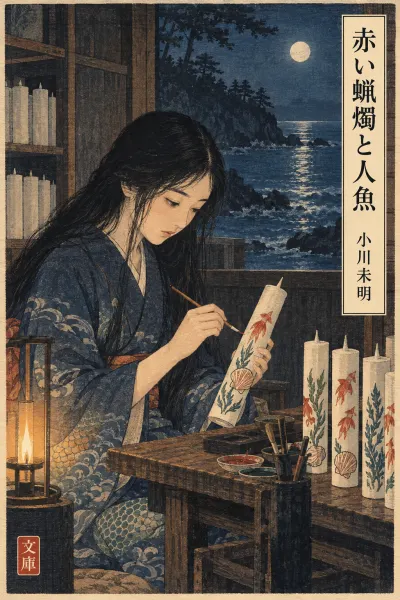
Part 3 of 5 · JLPT N3
赤い蝋燭と人魚(三) Akai Rōsoku to Ningyo, part 3: The Painted Candles and the Shrine
In this part
The mermaid girl grows up hidden away, and she begins painting red pictures on the old man's candles, which sell remarkably well. A rumour spreads that a painted candle stub offered at the hilltop shrine protects sailors from shipwreck, and the shrine becomes famous far and wide. The girl paints until her hands ache, grateful to the old couple, yet no one thinks of her, and on moonlit nights she weeps with longing for the northern sea.
AI translation · independently checked
娘は、大きくなりましたけれど、姿が変っているので恥かしがって顔を出しませんでした。The girl grew up, but because she looked different from other people, she was shy and would not show her face.
けれど一目その娘を見た人は、みんなびっくりするような美しい器量でありましたから、中にはどうかしてその娘を見ようと思って、蝋燭を買いに来た者もありました。Yet anyone who caught even a single glimpse of her was astonished at how beautiful she was, and some people even came to buy candles in the hope of somehow seeing her.
お爺さんや、お婆さんは、The old man and the old woman
「うちの娘は、内気で恥かしがりやだから、人様の前には出ないのです」と、言っていました。would say, "Our daughter is timid and bashful, so she does not come out in front of people."
奥の間でお爺さんは、せっせと蝋燭を造っていました。In the back room the old man worked busily away at making candles.
娘は、自分の思い付きで、きっと絵を描いたら、みんなが喜んで蝋燭を買うだろうと思いましたから、そのことをお爺さんに話ますと、そんならお前の好きな絵をためしに書いて見るがいいと答えました。The girl had an idea of her own: surely, if she painted pictures on the candles, everyone would be delighted to buy them. When she told the old man about it, he answered that in that case she should try painting whatever pictures she liked.
娘は、赤い絵具で、白い蝋燭に、魚や、貝や、また海草のようなものを産れつき誰にも習ったのでないが上手に描きました。With red paint, on the white candles, she painted fish and shells and things like seaweed. Although she had never learned from anyone, she painted them skilfully, as if by a gift she was born with.
お爺さんは、それを見るとびっくりいたしました。When the old man saw them, he was astonished.
誰でも、その絵を見ると、蝋燭がほしくなるように、その絵には、不思議な力と美しさとが籠っていたのであります。There was a mysterious power and beauty in those pictures, so that anyone who saw them found themselves wanting the candles.
「うまい筈だ、人間ではない人魚が描いたのだもの」と、お爺さんは感嘆して、お婆さんと話合いました。"No wonder they are so fine. They were painted by a mermaid, not a human being," said the old man in admiration, and he talked it over with the old woman.
「絵を描いた蝋燭をおくれ」と、言って、朝から、晩まで子供や、大人がこの店頭へ買いに来ました。"Give me a candle with a picture on it!" people would say, and from morning until night children and grown-ups came to the shop to buy them.
果して、絵を描いた蝋燭は、みんなに受けたのであります。Sure enough, the painted candles were a great hit with everyone.
するとここに不思議な話がありました。And then a strange story began to go around.
この絵を描いた蝋燭を山の上のお宮にあげてその燃えさしを身に付けて、海に出ると、どんな大暴風雨の日でも決して船が顛覆したり溺れて死ぬような災難がないということが、いつからともなくみんなの口々に噂となって上りました。It was said that if you offered one of these painted candles at the shrine on top of the hill and carried its burnt stub with you when you went to sea, then even on a day of the fiercest storm your boat would never capsize, and you would meet no misfortune such as drowning. No one knew when this rumour began, but it came to be on everyone's lips.
「海の神様を祭ったお宮様だもの、綺麗な蝋燭をあげれば、神様もお喜びなさるのにきまっている」と、その町の人々は言いました。"It is a shrine to the god of the sea, after all. If you offer him beautiful candles, of course the god will be pleased," said the people of the town.
蝋燭屋では、絵を描いた蝋燭が売れるのでお爺さんは、一生懸命に朝から晩まで蝋燭を造りますと、傍で娘は、手の痛くなるのも我慢して赤い絵具で絵を描いたのであります。Because the painted candles sold so well, the candle shop was busy. The old man made candles with all his might from morning till night, and beside him the girl painted pictures in red paint, bearing the ache in her hands.
「こんな人間並でない自分をも、よく育て可愛がって下すったご恩を忘れてはならない」と、娘はやさしい心に感じて、大きな黒い瞳をうるませたこともあります。"I must never forget the kindness of those who raised me and loved me so well, even though I am not like other people," the girl would think in her gentle heart, and at times her large black eyes grew moist with tears.
この話は遠くの村まで響きました。This story reached even distant villages.
遠方の船乗りやまた、漁師は、神様にあがった絵を描いた蝋燭の燃えさしを手に入れたいものだというので、わざわざ遠い処をやって来ました。Sailors and fishermen from far away wished to obtain the stub of a painted candle that had been offered to the god, and so they made the long journey on purpose.
そして、蝋燭を買って、山に登り、お宮に参詣して、蝋燭に火をつけて捧げ、その燃えて短くなるのを待って、またそれを戴いて帰りました。They would buy candles, climb the hill, and pay their respects at the shrine. There they lit the candles and offered them up, waited until they had burned down short, and then reverently took the stubs home.
だから、夜となく、昼となく、山の上のお宮には、蝋燭の火の絶えたことはありません。And so, by night and by day, the shrine on top of the hill was never without the light of candles.
殊に、夜は美しく燈火の光が海の上からも望まれたのであります。At night especially, the beautiful glow of the lights could be seen even from far out on the sea.
「ほんとうに有りがたい神様だ」と、いう評判は世間に立ちました。"He is truly a gracious god," people said, and the shrine's fame spread through the world.
それで、急にこの山が名高くなりました。And so this hill suddenly became famous.
神様の評判はこのように高くなりましたけれど、誰も、蝋燭に一心を籠めて絵を描いている娘のことを思う者はなかったのです。But though the god's fame grew so great, no one gave a thought to the girl who was painting the candles with her whole heart.
従ってその娘を可哀そうに思った人はなかったのであります。And so there was no one who felt sorry for her.
娘は、疲れて、折々は月のいい夜に、窓から頭を出して、遠い、北の青い青い海を恋しがって涙ぐんで眺めていることもありました。The girl grew weary, and sometimes on moonlit nights she would put her head out of the window and gaze, with tears in her eyes, longing for the far-off, blue, blue sea of the north.
Vocabulary
| Word | Meaning | JLPT |
|---|---|---|
| 器量きりょう | looks, beauty (especially of a woman)Older usage; 器量よし means 'a beauty'. It can also mean 'ability' or 'calibre'. | — |
| 内気うちき | timid, shy, reservedA na-adjective describing someone's temperament. | — |
| せっせとせっせと | busily, diligently, without a break | N2 |
| 思い付きおもいつき | an idea that comes to mind, a notionFrom 思い付く 'to think of, hit upon'. | N1 |
| 産れつきうまれつき | by nature, from birthdictionary form: 生まれつきWritten here with the older kanji 産; modern writing uses 生まれつき. | N1 |
| 燃えさしもえさし | the burnt stub of a candle or stickA key story word. 〜さし means 'partly done', as in 食べさし 'half-eaten food'. | — |
| 噂うわさ | rumour, talk | N3 |
| 災難さいなん | misfortune, disaster, mishap | N2 |
| 恩おん | a debt of gratitude, kindness receivedご恩を忘れない means 'never to forget the kindness one owes to someone'. | N3 |
| 参詣さんけい | visiting a shrine or temple to worshipA formal word; 参詣する means 'to go and pray at a shrine'. | — |
| 評判ひょうばん | reputation, fame, public talk評判が立つ means 'word gets around'. | N3 |
| 涙ぐんでなみだぐむ | to be moved to tears, to have tears welling updictionary form: 涙ぐむ | — |
Grammar
〜てみるがいい N2 you should try doing ~; go ahead and ~
The plain form followed by がいい gives advice or permission with a slightly old-fashioned, fatherly tone. Here it combines with 〜てみる 'try doing', so the old man is encouraging the girl to give it a try.
そんならお前の好きな絵をためしに書いて見るがいいと答えました
he answered that in that case she should try painting whatever pictures she liked
〜はずだ/〜だもの N3 no wonder ~ / because, after all ~
Here 筈だ expresses that a result makes sense once the reason is known ('no wonder'). The sentence-final もの gives that reason in a familiar, explanatory tone.
うまい筈だ、人間ではない人魚が描いたのだもの
No wonder they are so fine. They were painted by a mermaid, not a human being.
いつからともなく N1 from no one knows when; before anyone knew it
Question word + ともなく means that the when, where or who is unclear. The rumour started at some unknown moment and simply spread.
いつからともなくみんなの口々に噂となって上りました
No one knew when this rumour began, but it came to be on everyone's lips.
〜てはならない N3 must not ~
A strong, formal prohibition, used here as the girl's own resolve. It is stronger and more solemn than 〜てはいけない.
ご恩を忘れてはならない
I must never forget the kindness.
〜たいものだ N3 would really like to ~; how one longs to ~
Adding ものだ to 〜たい makes the wish sound deeper and more heartfelt. Here it is followed by というので ('saying that, and so') to give the sailors' reason for travelling.
燃えさしを手に入れたいものだというので、わざわざ遠い処をやって来ました
They wished to obtain the stub, and so they made the long journey on purpose.
〜となく〜となく N1 whether ~ or ~; regardless of ~
Two paired nouns with となく mean 'without distinction between A and B', that is, all the time. The expression is literary.
夜となく、昼となく、山の上のお宮には、蝋燭の火の絶えたことはありません
By night and by day, the shrine on top of the hill was never without the light of candles.