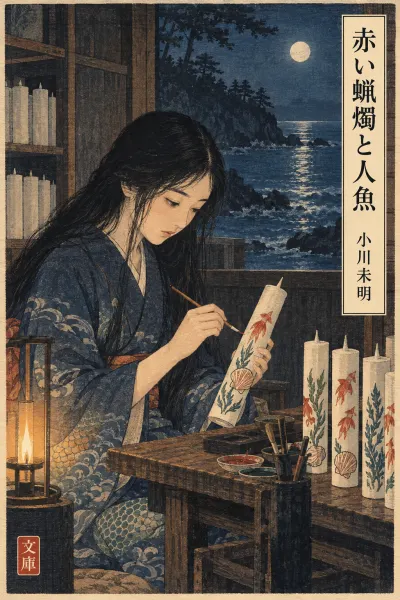
Part 5 of 5 · JLPT N3
赤い蝋燭と人魚(五) Akai Rōsoku to Ningyo, part 5: Shell Money and the Cursed Shrine
In this part
On a calm night a pale woman with dripping wet hair buys a red candle from the old woman and pays with seashells. That same night a terrible storm wrecks countless ships, including the one carrying the girl south. From then on, red candles appear at the shrine every night and bring storms and drowning, people come to hate the shrine, and within a few years the town falls into ruin.
AI translation · independently checked
ほんとうに穏かな晩でありました。It was a truly calm evening.
お爺さんとお婆さんは、戸を閉めて寝てしまいました。The old man and the old woman shut the door and went to bed.
真夜中頃であります。It was around midnight.
とん、とん、と誰か戸を叩く者がありました。Tap, tap: someone was knocking at the door.
年よりのものですから耳敏く、その音を聞きつけて、誰だろうと思いました。Being old, they had sharp ears, and when they caught the sound they wondered who it could be.
「どなた?」と、お婆さんは言いました。"Who is it?" said the old woman.
けれどもそれには答えがなく、つづけて、とん、とん、と戸を叩きました。But there was no answer, and the knocking went on, tap, tap.
お婆さんは起きて来て、戸を細目にあけて外を覗きました。The old woman got up, came to the door, opened it a crack and peeped outside.
すると、一人の色の白い女が戸口に立っていました。There in the doorway stood a fair-skinned woman.
女は蝋燭を買いに来たのです。The woman had come to buy candles.
お婆さんは、少しでもお金が儲かるなら、決していやな顔付をしませんでした。Whenever there was even a little money to be made, the old woman never put on a sour face.
お婆さんは、蝋燭の箱を出して女に見せました。The old woman brought out the box of candles and showed it to the woman.
その時、お婆さんはびっくりしました。At that moment the old woman was startled.
女の長い黒い頭髪がびっしょりと水に濡れて月の光に輝いていたからであります。For the woman's long black hair was soaking wet and glistening in the moonlight.
女は箱の中から、真赤な蝋燭を取り上げました。From the box the woman took up a deep red candle.
そして、じっとそれに見入っていましたが、やがて銭を払ってその赤い蝋燭を持って帰って行きました。She gazed at it intently for some time. Then at last she paid her coins and went away carrying the red candle.
お婆さんは、燈火のところで、よくその銭をしらべて見ますと、それはお金ではなくて、貝殻でありました。When the old woman looked carefully at the coins by the lamplight, she found they were not money at all but seashells.
お婆さんは、騙されたと思うと怒って、家から飛び出して見ましたが、もはや、その女の影は、どちらにも見えなかったのであります。Thinking she had been cheated, the old woman grew angry and rushed out of the house, but by then there was no trace of the woman in any direction.
その夜のことであります。It happened that very night.
急に空の模様が変って、近頃にない大暴風雨となりました。Suddenly the sky changed, and a great storm of wind and rain arose, such as had not been seen for a long time.
ちょうど香具師が、娘を檻の中に入れて、船に乗せて南の方の国へ行く途中で沖合にあった頃であります。It was just when the showman, having shut the girl in a cage and put her aboard a ship, was out at sea on his way to a country in the south.
「この大暴風雨では、とてもあの船は助かるまい」と、お爺さんと、お婆さんは、ふるふると震えながら話をしていました。"In a storm like this, that ship will never come through," the old man and the old woman said to each other, trembling all over.
夜が明けると沖は真暗で物凄い景色でありました。When day broke, the open sea was pitch-dark, a dreadful sight to see.
その夜、難船をした船は、数えきれない程でありました。The ships that were wrecked that night were beyond counting.
不思議なことに、赤い蝋燭が、山のお宮に点った晩は、どんなに天気がよくても忽ち大あらしになりました。Strange to say, on any night when a red candle burned at the shrine on the hill, however fine the weather, a great storm would blow up at once.
それから、赤い蝋燭は、不吉ということになりました。From that time on, red candles came to be thought of as ill-omened.
蝋燭屋の年より夫婦は、神様の罰が当ったのだといって、それぎり蝋燭屋をやめてしまいました。The old couple at the candle shop said the god's punishment had fallen upon them, and from then on they gave up their candle shop for good.
しかし、何処からともなく、誰が、お宮に上げるものか、毎晩、赤い蝋燭が点りました。And yet every night a red candle was lit at the shrine, though no one knew who offered it or where it came from.
昔は、このお宮にあがった絵の描いた蝋燭の燃えさしを持ってさえいれば、決して海の上では災難に罹らなかったものが、今度は、赤い蝋燭を見ただけでも、その者はきっと災難に罹って、海に溺れて死んだのであります。In the old days, anyone who simply carried a burnt stub of a painted candle offered at this shrine would never meet with disaster at sea; but now, anyone who so much as saw a red candle was sure to meet with disaster and drown in the sea.
忽ち、この噂が世間に伝わると、もはや誰も、山の上のお宮に参詣する者がなくなりました。As soon as this rumour spread abroad, no one came any more to worship at the shrine on the hill.
こうして、昔、あらたかであった神様は、今は、町の鬼門となってしまいました。And so the god who had once answered prayers so wonderfully now became the town's source of ill fortune.
そして、こんなお宮が、この町になければいいのにと怨まぬものはなかったのであります。And there was no one who did not bitterly wish that there were no such shrine in the town.
船乗りは、沖から、お宮のある山を眺めて怖れました。Sailors out at sea gazed at the hill where the shrine stood and were afraid.
夜になると、北の海の上は永に物凄うございました。When night came, the northern sea was forever a fearful place.
はてしもなく、何方を見まわしても高い波がうねうねとうねっています。Endlessly, wherever one looked, high waves rolled and heaved.
そして、岩に砕けては、白い泡が立ち上っています。And each time they broke upon the rocks, white foam rose up.
月が雲間から洩れて波の面を照らした時は、まことに気味悪うございました。When the moon slipped out between the clouds and shone upon the face of the waves, it was eerie indeed.
真暗な、星も見えない、雨の降る晩に、波の上から、蝋燭の光りが、漂って、だんだん高く登って、山の上のお宮をさして、ちらちらと動いて行くのを見た者があります。There were people who saw it: on pitch-dark, starless, rainy nights, the light of a candle drifting up from the waves, climbing higher and higher, and flickering its way towards the shrine on top of the hill.
幾年も経たずして、その下の町は亡びて、失なってしまいました。Before many years had passed, the town below had fallen to ruin and vanished.
Vocabulary
| Word | Meaning | JLPT |
|---|---|---|
| 耳敏くみみざとい | quick of hearing, sharp-eareddictionary form: 耳敏いLiterary word; the 敏 (quick, sharp) is also used in 敏感 'sensitive'. | — |
| 覗きましたのぞく | to peep, to peekdictionary form: 覗くUsed for looking through a small gap or opening. | N2 |
| 儲かるもうかる | to be profitable, to make moneyIntransitive; the transitive form is 儲ける 'to earn a profit'. | N2 |
| 香具師やし | showman; travelling peddler or entertainerAn irregular reading. Such people sold goods and put on shows at fairs and festivals. | — |
| 檻おり | cageA cage for animals, which shows how the girl was treated. | N1 |
| 難船なんせん | shipwreckOld-fashioned; the modern word is 難破 (なんぱ). | — |
| 忽ちたちまち | at once, instantlyUsually written in hiragana today. | N2 |
| 不吉ふきつ | ill-omened, unluckyThe opposite of 吉 'good fortune', as in 大吉 on fortune slips. | N1 |
| 参詣さんけい | worship at a shrine or temple; pilgrimageFormal word; 参拝 (さんぱい) is similar. | — |
| あらたかあらたか | (of a god) powerful and quick to answer prayersOften used in the set phrase 霊験あらたか. | — |
| 鬼門きもん | source of bad luck, something to be avoidedOriginally the unlucky north-east direction, the 'demon's gate'. | — |
| 怨まぬうらむ | to resent, to curse bitterlydictionary form: 怨むUsually written 恨む; ぬ is a literary negative (= 怨まない). | N2 |
| 亡びてほろびる | to fall to ruin, to perishdictionary form: 亡びるAlso written 滅びる. | N1 |
Grammar
〜まい N2 probably not; surely will not
Attached to a verb, まい expresses a negative guess, much like 〜ないだろう. With とても it gives a strong sense of 'there's no way'.
この大暴風雨では、とてもあの船は助かるまい
In a storm like this, that ship will never come through.
〜さえ〜ば N3 as long as; if only
さえ plus a conditional marks the one thing that is enough to bring about the result. Here simply carrying a candle stub was enough to keep a sailor safe.
絵の描いた蝋燭の燃えさしを持ってさえいれば
as long as one carried a burnt stub of a painted candle
〜たものが、今度は〜 N2 whereas in the past...; now...
〜たものが: 'whereas (formerly) ...'. Here もの nominalizes the preceding past clause ('the situation in which one never met disaster at sea'). The following が marks a contrast with what comes next: 今度は ('now, this time') introduces the reversed present situation, 'now even just seeing a red candle...'. The sense of 'never, as a rule' comes from 決して〜なかった, not from a special past-habit use of もの.
決して海の上では災難に罹らなかったものが、今度は、赤い蝋燭を見ただけでも
whereas one used never to meet with disaster at sea, now even just seeing a red candle...
〜ぬものはなかった N2 there was no one who did not ~ (= everyone ~)
A double negative that means 'everyone'. ぬ is the literary negative. Inside the clause, 〜ばいいのに expresses a wish that things were different.
こんなお宮が、この町になければいいのにと怨まぬものはなかったのであります
There was no one who did not bitterly wish that there were no such shrine in the town.
〜ては N3 repeatedly ~ and then; every time ~
The te-form plus は describes an action that happens over and over. Here the waves keep breaking and throwing up foam.
岩に砕けては、白い泡が立ち上っています。
As they broke upon the rocks, white foam leapt up.
〜ずして N1 without ~ing
A literary form of 〜ずに / 〜ないで. 幾年も経たずして means 'without many years passing', that is, 'before many years had gone by'.
幾年も経たずして、その下の町は亡びて、失なってしまいました。
Before many years had passed, the town below had fallen to ruin and vanished.