Part 1 of 5 · JLPT N3
赤いろうそくと人魚(一) Akai Rōsoku to Ningyo, part 1: A Mother's Hope from the Northern Sea
In this part
A lonely mermaid lives in the cold, dark northern sea and longs for the bright world of human beings. She is expecting a child. She has heard that people are kind and never abandon the helpless, so she decides to give birth on land and let humans raise her baby, even if she never sees it again. One night she swims towards the shore, where the lights of a shrine on a hill flicker over the waves.
AI translation · independently checked
人魚は、南の方の海にばかり棲んでいるのではありません。Mermaids do not live only in the seas of the south.
北の海にも棲んでいたのであります。They lived in the northern seas as well.
北方の海の色は、青うございました。The colour of the northern sea was blue.
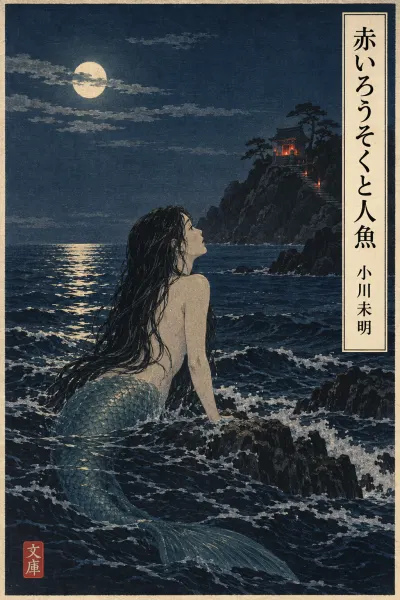
あるとき、岩の上に、女の人魚があがって、あたりの景色をながめながら休んでいました。Once, a mermaid had climbed up onto a rock and was resting there, gazing at the scene around her.
雲間からもれた月の光がさびしく、波の上を照らしていました。The moonlight slipped through a gap in the clouds and shone forlornly upon the waves.
どちらを見ても限りない、ものすごい波が、うねうねと動いているのであります。Whichever way she looked, endless, fearsome waves were heaving and rolling.
なんという、さびしい景色だろうと、人魚は思いました。"What a lonely sight this is," thought the mermaid.
自分たちは、人間とあまり姿は変わっていない。We are not so very different in form from human beings.
魚や、また底深い海の中に棲んでいる、気の荒い、いろいろな獣物などとくらべたら、どれほど人間のほうに、心も姿も似ているかしれない。Compared with the fish, and with all the fierce beasts that live down in the depths of the sea, how much closer we are to humans, in heart as well as in form!
それだのに、自分たちは、やはり魚や、獣物などといっしょに、冷たい、暗い、気の滅入りそうな海の中に暮らさなければならないというのは、どうしたことだろうと思いました。And yet we must still live among the fish and the beasts, in this cold, dark, dispiriting sea. Why should that be? she wondered.
長い年月の間、話をする相手もなく、いつも明るい海の面をあこがれて、暮らしてきたことを思いますと、人魚はたまらなかったのであります。When she thought of how she had lived through so many long years with no one to talk to, always yearning for the bright surface of the sea, the mermaid could hardly bear it.
そして、月の明るく照らす晩に、海の面に浮かんで、岩の上に休んで、いろいろな空想にふけるのが常でありました。And so, on nights when the moon shone brightly, she would rise to the surface, rest upon a rock, and lose herself in all kinds of daydreams.
「人間の住んでいる町は、美しいということだ。人間は、魚よりも、また獣物よりも、人情があってやさしいと聞いている。私たちは、魚や獣物の中に住んでいるが、もっと人間のほうに近いのだから、人間の中に入って暮らされないことはないだろう。」と、人魚は考えました。"They say the towns where humans live are beautiful. I have heard that humans are warmer-hearted and kinder than fish, and kinder than beasts too. We live among fish and beasts, but we are much closer to humans, so surely it would not be impossible for us to go and live among them," the mermaid thought.
その人魚は女でありました。This mermaid was a female.
そして妊娠でありました。And she was with child.
……私たちは、もう長い間、このさびしい、話をするものもない、北の青い海の中で暮らしてきたのだから、もはや、明るい、にぎやかな国は望まないけれど、これから産まれる子供に、せめても、こんな悲しい、頼りない思いをさせたくないものだ。…We have lived so long in this lonely blue northern sea, where there is no one even to talk to, that I no longer hope for a bright and lively land for myself. But I would not wish the child who is soon to be born to know such sad and helpless feelings, at least.
………
子供から別れて、独り、さびしく海の中に暮らすということは、このうえもない悲しいことだけれど、子供がどこにいても、しあわせに暮らしてくれたなら、私の喜びは、それにましたことはない。To be parted from my child and live alone and lonely in the sea would be the saddest thing of all. Yet if my child could live happily, wherever it may be, I could have no greater joy than that.
人間は、この世界の中で、いちばんやさしいものだと聞いている。I have heard that humans are the kindest creatures in all the world.
そして、かわいそうなものや、頼りないものは、けっしていじめたり、苦しめたりすることはないと聞いている。And I have heard that they would never bully or torment anything pitiful or helpless.
いったん手づけたなら、けっして、それを捨てないとも聞いている。I have heard, too, that once they have taken a creature into their care, they will never abandon it.
幸い、私たちは、みんなよく顔が人間に似ているばかりでなく、胴から上は人間そのままなのであるから――魚や獣物の世界でさえ、暮らされるところを思えば――人間の世界で暮らされないことはない。Fortunately, all of us not only have faces much like human faces, but from the waist up we are just like human beings. And when I think that we can live even in the world of fish and beasts, surely we could live in the human world.
一度、人間が手に取り上げて育ててくれたら、きっと無慈悲に捨てることもあるまいと思われる。If once a human takes my child up and raises it, I feel sure they will never cruelly cast it away.
………
人魚は、そう思ったのでありました。So the mermaid thought.
せめて、自分の子供だけは、にぎやかな、明るい、美しい町で育てて大きくしたいという情けから、女の人魚は、子供を陸の上に産み落とそうとしたのであります。Out of a mother's tender wish that at least her own child be raised and grow up in a lively, bright and beautiful town, the mermaid set out to give birth to her child on land.
そうすれば、自分は、ふたたび我が子の顔を見ることはできぬかもしれないが、子供は人間の仲間入りをして、幸福に生活をすることができるであろうと思ったのです。If she did so, she thought, she might never see her child's face again, but the child would become one of the humans and be able to live a happy life.
はるか、かなたには、海岸の小高い山にある、神社の燈火がちらちらと波間に見えていました。Far, far away, the lights of a shrine on a low hill by the shore could be seen flickering between the waves.
ある夜、女の人魚は、子供を産み落とすために、冷たい、暗い波の間を泳いで、陸の方に向かって近づいてきました。One night, in order to give birth to her child, the mermaid swam through the cold, dark waves and drew near to the land.
Vocabulary
| Word | Meaning | JLPT |
|---|---|---|
| 棲んですむ | to live, to dwell (of animals)dictionary form: 棲むSame reading as 住む. 棲む is used for creatures living in a habitat. | — |
| ながめながめる | to gaze at, to look out overdictionary form: 眺めるUsed for looking at a view or scenery for a while. | N3 |
| 雲間くもま | a gap in the clouds間 (ま) means a space or gap, as in 波間. | — |
| 獣物けもの | beast, wild animalUsually written 獣 today. | — |
| 気の荒いきがあらい | fierce, wild-tempereddictionary form: 気が荒い | — |
| 気の滅入りそうなきがめいる | to feel gloomy or depresseddictionary form: 気が滅入る〜そうな here means 'enough to make one gloomy'. | — |
| あこがれてあこがれる | to long for, to yearn fordictionary form: 憧れるTakes を here (海の面をあこがれて). In modern Japanese, 〜に憧れる is more common. | N2 |
| ふけるふける | to be absorbed in, to lose oneself indictionary form: 耽るOften used in the phrase 空想にふける, 'to be lost in daydreams'. | — |
| 人情にんじょう | human kindness, warm-heartedness | N1 |
| 妊娠みもち | pregnancy, being with childdictionary form: 身持ちThe author gives the old reading みもち to the kanji 妊娠 (normally にんしん). | — |
| 手づけたてづける | to take in hand, to take into one's caredictionary form: 手づけるUsually written 手なずける today. | — |
| 無慈悲むじひ | merciless, cruel無 (without) + 慈悲 (mercy). | — |
| 産み落とそううみおとす | to give birth to, to bring into the worlddictionary form: 産み落とす | — |
| 仲間入りなかまいり | joining a group, becoming one of them | — |
Grammar
〜うございます N2 very polite form of an い-adjective
The adjective's く form changes its sound (青く → 青う) and is followed by ございます. This makes a very formal, old-fashioned polite form, like 青いです.
北方の海の色は、青うございました。
The sea of the north was a deep blue.
どれほど〜かしれない N2 how very much…; beyond measure
This pattern means literally 'one cannot know how much'. It stresses a very high degree. Here the mermaid says how very much closer to humans her kind are.
どれほど人間のほうに、心も姿も似ているかしれない。
How much closer we are to humans, in heart as well as in form!
〜のが常だ N1 it was one's habit to…; would usually…
常 means 'the usual thing'. Adding it to a verb clause with の describes a regular habit. It is similar to よく〜していた but more literary.
いろいろな空想にふけるのが常でありました。
She would lose herself in all kinds of daydreams.
〜ないことはない N3 it is not impossible that…; one can…
This is a double negative that gives a careful positive. 暮らされる is an old potential form of 暮らす, so the phrase means 'it is not the case that we cannot live there'.
人間の世界で暮らされないことはない。
Surely we could live in the human world.
〜たくないものだ N3 I really would not want…
ものだ after a たい form expresses a deeply felt wish. Here it is used for something the mermaid hopes her child will never have to feel.
これから産まれる子供に、せめても、こんな悲しい、頼りない思いをさせたくないものだ。
I would not wish the child soon to be born to know such sad and helpless feelings, at least.
〜まい N2 probably will not…
まい is a literary negative guess, like 〜ないだろう. こともあるまい means 'there will surely be no case of…'.
きっと無慈悲に捨てることもあるまいと思われる。
I feel sure they will never cruelly cast it away.