Part 3 of 5 · JLPT N3
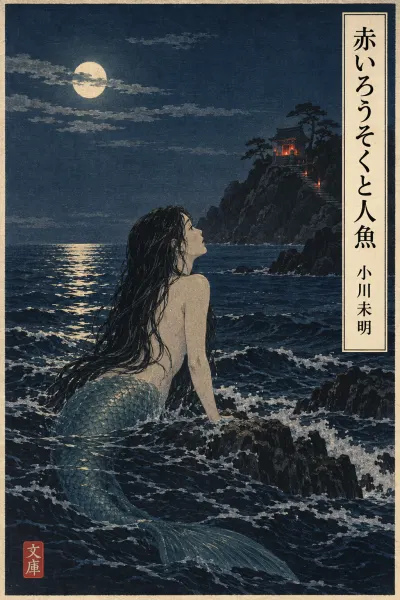
赤いろうそくと人魚(三) Akai Rōsoku to Ningyo, part 3: Painted Candles and a Hillside Shrine
In this part
The mermaid girl grows up hidden away because she is shy of her unusual form. She begins painting red pictures on the old man's candles, and they sell wonderfully. A rumour spreads that painted candle stubs offered at the hill shrine protect sailors from storms, and the shrine becomes famous. No one thinks of the tired girl, who secretly longs for the northern sea.
AI translation · independently checked
娘は、大きくなりましたけれど、姿が変わっているので、恥ずかしがって顔を外へ出しませんでした。The girl grew up, but because her form was different, she was shy and would not show her face outside.
けれど、一目その娘を見た人は、みんなびっくりするような美しい器量でありましたから、中にはどうかしてその娘を見たいと思って、ろうそくを買いにきたものもありました。Yet her looks were so beautiful that anyone who caught even a single glimpse of her was astonished, and so there were some who came to buy candles in the hope of somehow seeing her.
おじいさんや、おばあさんは、The old man and the old woman
「うちの娘は、内気で恥ずかしがりやだから、人さまの前には出ないのです。」といっていました。would say, "Our daughter is timid and bashful, so she does not come out before other people."
奥の間でおじいさんは、せっせとろうそくを造っていました。In the back room, the old man busily went on making candles.
娘は、自分の思いつきで、きれいな絵を描いたら、みんなが喜んで、ろうそくを買うだろうと思いましたから、そのことをおじいさんに話しますと、そんならおまえの好きな絵を、ためしにかいてみるがいいと答えました。The girl had an idea of her own: if she painted pretty pictures on the candles, everyone would be pleased and buy them. When she told the old man so, he answered, "Well then, you had best try painting whatever pictures you like."
娘は、赤い絵の具で、白いろうそくに、魚や、貝や、または海草のようなものを、産まれつきで、だれにも習ったのではないが上手に描きました。With red paint, on the white candles, the girl painted fish and shells and things like seaweed, and she painted them skilfully, by a gift she was born with, though no one had ever taught her.
おじいさんは、それを見るとびっくりいたしました。When the old man saw them, he was astonished.
だれでも、その絵を見ると、ろうそくがほしくなるように、その絵には、不思議な力と、美しさとがこもっていたのであります。For those pictures held a strange power and beauty, so that anyone who looked at them came to want the candles.
「うまいはずだ。人間ではない、人魚が描いたのだもの。」と、おじいさんは感嘆して、おばあさんと話し合いました。"No wonder they are so fine. She is no human being; it was a mermaid who painted them," said the old man in admiration, and he talked it over with the old woman.
「絵を描いたろうそくをおくれ。」といって、朝から晩まで、子供や、大人がこの店頭へ買いにきました。"Give me one of the painted candles," people would say, and from morning till night children and grown-ups came to the shop front to buy them.
はたして、絵を描いたろうそくは、みんなに受けたのであります。Just as they had expected, the painted candles were a great success with everyone.
すると、ここに不思議な話がありました。Then a strange story arose.
この絵を描いたろうそくを山の上のお宮にあげて、その燃えさしを身につけて、海に出ると、どんな大暴風雨の日でも、けっして、船が転覆したり、おぼれて死ぬような災難がないということが、いつからともなく、みんなの口々に、うわさとなって上りました。No one knew quite when it began, but a rumour came to be on everyone's lips: if you offered one of these painted candles at the shrine on top of the hill and carried its burnt-down stub with you when you went to sea, then however fierce the storm, your boat would never capsize and no misfortune such as drowning would ever befall you.
「海の神さまを祭ったお宮さまだもの、きれいなろうそくをあげれば、神さまもお喜びなさるのにきまっている。」と、その町の人々はいいました。"It is a shrine to the god of the sea, after all. If we offer beautiful candles, the god is sure to be pleased," said the people of the town.
ろうそく屋では、ろうそくが売れるので、おじいさんはいっしょうけんめいに朝から晩まで、ろうそくを造りますと、そばで娘は、手の痛くなるのも我慢して、赤い絵の具で絵を描いたのであります。Because the candles sold so well at the candle shop, the old man worked with all his might from morning till night making them, and beside him the girl painted the pictures in red, enduring it even when her hands grew sore.
「こんな、人間並でない自分をも、よく育てて、かわいがってくだすったご恩を忘れてはならない。」と、娘は、老夫婦のやさしい心に感じて、大きな黒い瞳をうるませたこともあります。"I must never forget the kindness they have shown in raising and loving someone like me, who is not even a proper human being," the girl thought, and at times, moved by the old couple's gentle hearts, her large black eyes filled with tears.
この話は遠くの村まで響きました。The story spread as far as distant villages.
遠方の船乗りや、また漁師は、神さまにあがった、絵を描いたろうそくの燃えさしを手に入れたいものだというので、わざわざ遠いところをやってきました。Sailors and fishermen from far-off places, wishing to obtain the stub of a painted candle that had been offered to the god, made the long journey on purpose to get one.
そして、ろうそくを買って山に登り、お宮に参詣して、ろうそくに火をつけてささげ、その燃えて短くなるのを待って、またそれをいただいて帰りました。They bought candles, climbed the hill and paid their respects at the shrine, lit the candles and offered them, waited until they had burned down short, and then reverently took them home.
だから、夜となく、昼となく、山の上のお宮には、ろうそくの火の絶えたことはありません。And so, by night and by day alike, the candle flames never once went out at the shrine on top of the hill.
殊に、夜は美しく、燈火の光が海の上からも望まれたのであります。At night especially it was beautiful, and the glow of the lights could be seen even from far out on the sea.
「ほんとうに、ありがたい神さまだ。」という評判は、世間にたちました。Word spread through the world that this was "truly a god who grants blessings."
それで、急にこの山が名高くなりました。And so the hill suddenly became famous.
神さまの評判は、このように高くなりましたけれど、だれも、ろうそくに一心をこめて絵を描いている娘のことを、思うものはなかったのです。Yet although the god's fame had grown so great, no one gave a thought to the girl who was pouring her whole heart into painting pictures on the candles.
したがって、その娘をかわいそうに思った人はなかったのであります。And so there was no one who felt any pity for her.
娘は、疲れて、おりおりは、月のいい夜に、窓から頭を出して、遠い、北の青い、青い、海を恋しがって、涙ぐんでながめていることもありました。The girl grew weary, and now and then, on nights when the moon was fine, she would put her head out of the window and gaze, her eyes wet with tears, longing for the far-off, blue, blue northern sea.
Vocabulary
| Word | Meaning | JLPT |
|---|---|---|
| 器量きりょう | looks, beauty (of a face)Old-fashioned word for someone's looks, especially a woman's. It can also mean ability or capacity. | — |
| 内気うちき | timid, shy, reservedLiterally 'inward spirit'. Used as a な-adjective. | — |
| 恥ずかしがりやはずかしがりや | a bashful persondictionary form: 恥ずかしがり屋〜屋 attached to a verb stem describes a type of person, as in 寂しがり屋 'someone who gets lonely easily'. | — |
| せっせとせっせと | busily, diligently, without a break | N2 |
| 思いつきおもいつき | an idea that comes to mind, a notion | N1 |
| 産まれつきうまれつき | by nature, from birthdictionary form: 生まれつきUsually written 生まれつき today. | N1 |
| こもっていたこもる | to be contained or filled with (feeling, power)dictionary form: こもるRelated to 心をこめる, 'to put one's heart into something'. | N1 |
| 燃えさしもえさし | a partly burnt stub (of a candle)〜さし attached to a verb stem means 'left partway done', as in 飲みさし. | — |
| 転覆てんぷく | capsizing, overturning | — |
| 災難さいなん | misfortune, disaster | N2 |
| 参詣さんけい | visiting a shrine or temple to worship | — |
| 評判ひょうばん | reputation, public talk評判がたつ means 'a reputation spreads'. | N3 |
| 一心いっしん | wholehearted devotion一心をこめて means 'with one's whole heart'. | N1 |
| 恋しがってこいしがる | to long for, to yearn fordictionary form: 恋しがるThe suffix 〜がる turns an adjective of feeling (恋しい) into a verb that describes someone else's feelings. | — |
Grammar
〜てみるがいい N2 you should try ~; go ahead and ~
〜がいい after a plain verb gives permission or advice from an older or higher-status speaker. Here the old man encourages the girl to try painting.
ためしにかいてみるがいい
you had best try painting
〜はずだ N4 no wonder; it stands to reason
Here はずだ does not predict anything. It shows that the speaker has found the reason for something that surprised him: of course she paints well, because she is a mermaid.
うまいはずだ。
No wonder they are so fine.
〜のだもの N3 because, after all (giving a reason)
〜もの at the end of a sentence gives a reason in a conversational, slightly emotional way. The same pattern appears in the townspeople's お宮さまだもの.
人魚が描いたのだもの。
it was a mermaid who painted them, after all.
〜にきまっている N3 is sure to ~; must certainly ~
This expresses strong certainty based on the speaker's own judgement. The townspeople are confident the god will be pleased.
神さまもお喜びなさるのにきまっている。
the god is sure to be pleased.
〜てはならない N3 must not ~
This is a formal prohibition, often used for moral duties. Here the girl uses it about herself: she must never forget the old couple's kindness.
ご恩を忘れてはならない。
I must never forget their kindness.
AとなくBとなく N1 whether A or B; regardless of A or B
This literary pattern pairs two opposite nouns to mean 'at all times, without distinction'. Here it stresses that the candles burned constantly, both day and night.
夜となく、昼となく、山の上のお宮には、ろうそくの火の絶えたことはありません。
By night and by day alike, the candle flames never once went out at the shrine on top of the hill.