Part 5 of 5 · JLPT N3
赤いろうそくと人魚(五) Akai Rōsoku to Ningyo, part 5: The Pale Woman and the Cursed Shrine
In this part
Late one night a pale woman with dripping wet hair buys a red candle from the old couple and pays with seashells. That night a terrible storm wrecks countless ships, and the old couple fear for the ship carrying the mermaid girl. From then on, red candles lit at the shrine bring storms and death, people stop visiting it, and within a few years the town at the foot of the hill falls to ruin.
AI translation · independently checked
ほんとうに穏やかな晩のことです。It happened on a truly calm night.
おじいさんとおばあさんは、戸を閉めて、寝てしまいました。The old man and the old woman had shut the door and gone to sleep.
真夜中ごろでありました。It was around midnight.
トン、トン、と、だれか戸をたたくものがありました。Tap, tap: someone was knocking at the door.
年寄りのものですから耳さとく、その音を聞きつけて、だれだろうと思いました。Being old, she was quick to hear things, so she caught the sound and wondered who it could be.
「どなた?」と、おばあさんはいいました。"Who is there?" said the old woman.
けれどもそれには答えがなく、つづけて、トン、トン、と戸をたたきました。But there was no answer, and the knocking went on: tap, tap.
おばあさんは起きてきて、戸を細めにあけて外をのぞきました。The old woman got up, opened the door a little way, and peeped outside.
すると、一人の色の白い女が戸口に立っていました。There in the doorway stood a woman with a pale white face.
女はろうそくを買いにきたのです。The woman had come to buy candles.
おばあさんは、すこしでもお金がもうかることなら、けっして、いやな顔つきをしませんでした。If there was even a little money to be made, the old woman never showed a sour face.
おばあさんは、ろうそくの箱を取り出して女に見せました。The old woman took out the box of candles and showed it to the woman.
そのとき、おばあさんはびっくりしました。Just then, the old woman was startled.
女の長い、黒い頭髪がびっしょりと水にぬれて、月の光に輝いていたからであります。For the woman's long black hair was soaking wet, and it glistened in the moonlight.
女は箱の中から、真っ赤なろうそくを取り上げました。The woman took a deep red candle out of the box.
そして、じっとそれに見入っていましたが、やがて金を払って、その赤いろうそくを持って帰ってゆきました。She gazed at it intently for a while, but at last she paid her money and went away, taking the red candle with her.
おばあさんは、燈火のところで、よくその金をしらべてみると、それはお金ではなくて、貝がらでありました。When the old woman looked closely at the money by the lamplight, she found that it was not money at all, but seashells.
おばあさんは、だまされたと思って、怒って、家から飛び出してみましたが、もはや、その女の影は、どちらにも見えなかったのであります。Thinking she had been cheated, the old woman flew out of the house in anger, but the woman was already nowhere to be seen, in any direction.
その夜のことであります。It was that very night.
急に空の模様が変わって、近ごろにない大暴風雨となりました。Suddenly the sky changed, and there came a great storm such as had not been seen in years.
ちょうど香具師が、娘をおりの中に入れて、船に乗せて、南の方の国へゆく途中で、沖にあったころであります。It was just at the time when the showman, having put the girl in a cage and taken her aboard ship, was out at sea on his way to a country in the south.
「この大暴風雨では、とても、あの船は助かるまい。」と、おじいさんと、おばあさんは、ぶるぶると震えながら、話をしていました。"In a storm like this, that ship can never be saved," the old man and the old woman said to each other, trembling all over.
夜が明けると、沖は真っ暗で、ものすごい景色でありました。When dawn came, the open sea was pitch dark, a fearful sight to behold.
その夜、難船をした船は、数えきれないほどであります。The ships wrecked that night were beyond counting.
不思議なことには、その後、赤いろうそくが、山のお宮に点った晩は、いままで、どんなに天気がよくても、たちまち大あらしとなりました。Strange to say, from then on, on any night when a red candle was lit at the shrine on the hill, however fine the weather had been until then, a great storm would rise at once.
それから、赤いろうそくは、不吉ということになりました。After that, red candles came to be thought of as ill-omened.
ろうそく屋の年より夫婦は、神さまの罰が当たったのだといって、それぎり、ろうそく屋をやめてしまいました。The old couple of the candle shop said it was the punishment of the gods that had fallen on them, and from then on they gave up the candle shop for good.
しかし、どこからともなく、だれが、お宮に上げるものか、たびたび、赤いろうそくがともりました。And yet, time and again, red candles were lit at the shrine, though no one knew from where they came or who offered them.
昔は、このお宮にあがった絵の描いたろうそくの燃えさしさえ持っていれば、けっして、海の上では災難にはかからなかったものが、今度は、赤いろうそくを見ただけでも、そのものはきっと災難にかかって、海におぼれて死んだのであります。In the old days, anyone who merely kept the burnt stub of a painted candle offered at this shrine would never meet with disaster at sea; but now, anyone who so much as saw a red candle would surely meet with disaster and drown in the sea.
たちまち、このうわさが世間に伝わると、もはや、だれも、この山の上のお宮に参詣するものがなくなりました。As soon as this rumour spread through the world, no one came to worship at the shrine on the hill any more.
こうして、昔、あらたかであった神さまは、いまは、町の鬼門となってしまいました。And so the god who had once worked such wonders now became the town's unlucky quarter, a place of ill fortune.
そして、こんなお宮が、この町になければいいものと、うらまぬものはなかったのであります。And there was no one who did not bear a grudge against it, wishing that the town had no such shrine.
船乗りは、沖から、お宮のある山をながめておそれました。Sailors gazed from the open sea at the hill where the shrine stood, and were afraid.
夜になると、この海の上は、なんとなくものすごうございました。When night came, the sea here was somehow dreadful.
はてしもなく、どちらを見まわしても、高い波がうねうねとうねっています。Endlessly, whichever way one looked, high waves rolled and heaved.
そして、岩に砕けては、白いあわが立ち上がっています。And breaking against the rocks, they threw up white foam.
月が、雲間からもれて波の面を照らしたときは、まことに気味悪うございました。When the moon slipped out between the clouds and lit the face of the waves, it was eerie indeed.
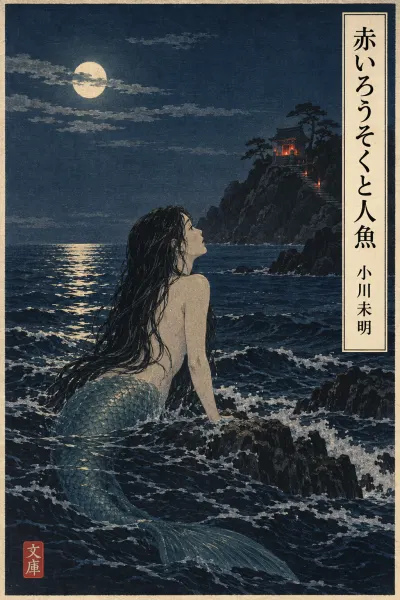
真っ暗な、星もみえない、雨の降る晩に、波の上から、赤いろうそくの灯が、漂って、だんだん高く登って、いつしか山の上のお宮をさして、ちらちらと動いてゆくのを見たものがあります。Some people saw, on pitch-dark, starless, rainy nights, the flame of a red candle drifting up from the waves, climbing higher and higher, and before they knew it, flickering its way toward the shrine on the hilltop.
幾年もたたずして、そのふもとの町はほろびて、滅くなってしまいました。Before many years had passed, the town at the foot of the hill fell into ruin and vanished.
Vocabulary
| Word | Meaning | JLPT |
|---|---|---|
| 耳さとくみみざとい | sharp-eared, quick to heardictionary form: 耳聡い聡い means 'quick, sharp'; here in the continuative く form linking to the next clause. | — |
| 細めほそめ | narrowly, just a little (of an opening)戸を細めにあける = to open the door a crack. | — |
| もうかるもうかる | to be profitable, to make moneydictionary form: 儲かるIntransitive; the transitive partner is 儲ける. | N2 |
| 見入ってみいる | to gaze intently at, to be absorbed in lookingdictionary form: 見入るTakes に: それに見入る. | — |
| 香具師やし | travelling showman, peddler at fairsAn irregular reading; the kanji do not suggest the sound. Such people ran stalls and sideshows at festivals. | — |
| 難船なんせん | shipwreck難船をする = to be shipwrecked. | — |
| 不吉ふきつ | unlucky, ill-omenedOpposite of 吉 (good fortune). | N1 |
| 罰ばち | divine punishment罰が当たる = to be punished by the gods. Read ばつ in the sense of an ordinary penalty. | N1 |
| 燃えさしもえさし | a half-burnt stub, embers〜さし marks something left partway done, as in 読みさし (a book left half-read). | — |
| 参詣さんけい | a visit to a shrine or temple to worshipFormal word; everyday Japanese often uses お参り. | — |
| あらたかあらたか | (of a god) miraculously powerful, efficaciousMostly heard in the set phrase 霊験あらたか. | — |
| 鬼門きもん | unlucky direction or place; something to be avoidedLiterally 'demon gate', the north-east direction traditionally feared as unlucky. | — |
| うらまぬうらむ | to resent, to bear a grudge againstdictionary form: 恨むぬ is the classical negative, equal to ない. | N2 |
| ほろびてほろびる | to fall into ruin, to perishdictionary form: 滅びるUsed for towns, nations or families that come to an end. | N1 |
Grammar
〜まい N2 probably not; surely not
Attached to a verb, まい expresses negative conjecture, like 〜ないだろう. With とても it gives a strong sense that there is no hope at all.
この大暴風雨では、とても、あの船は助かるまい。
In a storm like this, that ship can never be saved.
〜さえ〜ば N3 as long as; if only
さえ marks the one condition that is enough by itself; the ば clause states it. Merely keeping a candle stub was all it took to stay safe at sea.
このお宮にあがった絵の描いたろうそくの燃えさしさえ持っていれば
anyone who merely kept the burnt stub of a painted candle offered at this shrine
〜ぬものはなかった N2 there was no one who did not ~ (= everyone did)
A double negative using the classical negative ぬ. Saying 'no one did not resent it' strongly affirms that everyone did.
うらまぬものはなかったのであります
there was no one who did not bear a grudge against it
adjective + うございます N1 very polite, old-fashioned form of an い-adjective
The adjective's final い changes to う (sometimes with a vowel shift) before ございます: ものすごい → ものすごうございます, 気味悪い → 気味悪うございます. It gives the narration a courteous, old-fashioned tone.
夜になると、この海の上は、なんとなくものすごうございました。
When night came, the sea here was somehow dreadful.
〜ずして N1 without ~ing
A literary form of 〜ないで or 〜ずに. 幾年もたたずして means 'without many years passing', that is, within only a few years.
幾年もたたずして、そのふもとの町はほろびて、滅くなってしまいました。
Before many years had passed, the town at the foot of the hill fell into ruin and vanished.